
Focal points are the anchors of visual interest. They guide the eye, set the mood, and give purpose to a room’s layout. But there’s a fine line between drawing attention and overwhelming the space. When everything competes for focus, nothing wins.
Whether you’re furnishing a new home or refreshing a single room, knowing how to establish focal points can elevate your design without adding clutter or cost. Here’s how to do it effectively—one room at a time.
Living Room: Let the Layout Do the Talking
In most homes, the living room doubles as a central gathering space. It’s also where focal points can either shine or get lost in the noise.
Best strategy: Let one feature dominate. This could be:
- A fireplace (natural or electric)
- A statement sofa or sectional
- A large piece of art or gallery wall
- A bold coffee table in an unusual material
Once you’ve chosen your focal point, arrange the rest of the furniture to support it. The layout should feel like a conversation circling around that central idea.
Avoid adding multiple competing features. For example, if your TV wall has built-ins, don’t overload the opposite wall with large-scale art. Let the main feature breathe.
Bedroom: Focus on the Headboard
The bedroom is where serenity meets style, and it doesn’t need more than one visual centerpiece. In transitional and modern design alike, the headboard often plays this role.
How to amplify its impact:
- Choose textured materials (tufted fabric, rattan, wood slats)
- Frame it with simple nightstands and symmetrical lighting
- Add dimension with art above the bed or statement wallpaper behind it
If the bed is low-profile, the wall itself can become the feature—especially with bold paint, wainscoting, or a sculptural wall hanging.
Many shoppers discover during visits to a furniture store that bedroom impact doesn’t require ornate furniture—it’s about strategic focus and scale.
Dining Area: Make the Table the Star
Dining spaces offer limited surfaces, so there’s little room for visual noise. A well-selected dining table can carry the entire aesthetic.
Enhance it with:
- Coordinated or contrasting chairs
- A linear or oversized pendant light overhead
- A centerpiece that’s low, sculptural, or seasonal
Don’t feel the need to fill every wall. A blank wall can help the table stand out, especially when paired with subtle textures like linen curtains or natural fiber rugs.
Entryway: Create a Welcome Moment
The entry sets the tone for the entire home. Even in small spaces, a focal point adds polish.
Simple tricks:
- A narrow console with a tall mirror
- A bench with pillows and art above
- A wall-mounted shelf with seasonal decor
Focus on height, symmetry, and one or two decorative elements. Avoid overcrowding—entryways benefit from visual simplicity.
Kitchen: Highlight Function with Flair
Kitchens naturally draw the eye due to activity and utility. But a focal point can still be intentional.
Ideas to explore:
- A striking backsplash
- Statement pendant lights over an island
- A display shelf with curated dishware
If your kitchen is open-concept, use an adjoining wall (even the side of a pantry or hallway) as a visual pause—art, plants, or functional hooks help balance flow.
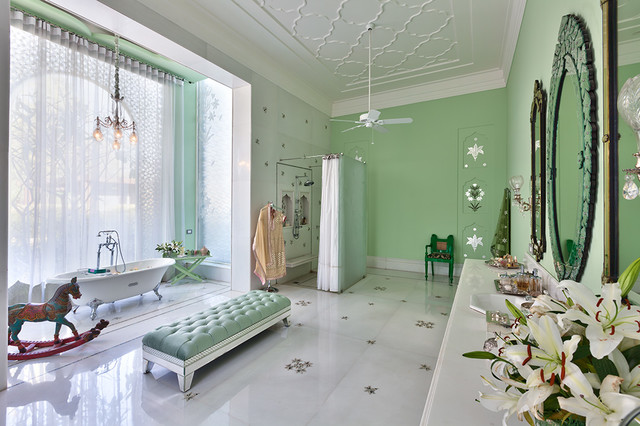
Bathroom: Go Bold on a Single Element
In small spaces, a little goes a long way. That’s especially true for bathrooms.
Effective focal points include:
- A framed mirror with dramatic lighting
- A colorful vanity
- Graphic floor tiles or wallpaper behind the toilet
Avoid cluttering counters or walls. One great design element per bathroom is enough to make a lasting impression.
Home Office: Let Your Desk Lead
The desk isn’t just a workspace—it’s your creative and professional anchor. Its placement and style set the tone for productivity.
Ways to spotlight it:
- Position it near natural light or framed by shelving
- Choose a desk with architectural features (e.g., waterfall edges, tapered legs)
- Add a striking chair or area rug beneath
Keep the backdrop simple if you’re in video calls often. A neutral wall with subtle texture or one strong art piece works best.
Bonus Tips for Any Room
No matter the space, these universal focal-point rules apply:
- Size matters: Larger features draw more attention. Use scale intentionally.
- Lighting enhances: Spotlighting a focal area with directional lighting or pendants adds dimension.
- Contrast counts: A high-contrast item (e.g., black cabinet in a white room) will naturally become the center of attention.
- Don’t over-layer: One bold piece plus two soft complements is usually enough.
- Leave space around it: Give your focal point “breathing room.” Crowding weakens its effect.
When all else fails, ask: “Where does my eye go first?” If the answer is unclear, your room may be lacking a strong anchor.
Final Thought: A Room Without a Focus Is Like a Story Without a Plot
Well-designed rooms, like good narratives, have structure. Focal points give us orientation. They create hierarchy, movement, and mood. And they help prevent the common design mistake of trying to do too much with too little space.
When exploring options—whether online or at a carefully arranged showroom like What’s New Furniture—it helps to imagine how one standout item might transform an entire room.
Because it’s not about having everything. It’s about giving attention to the right thing, in the right place, at the right scale.