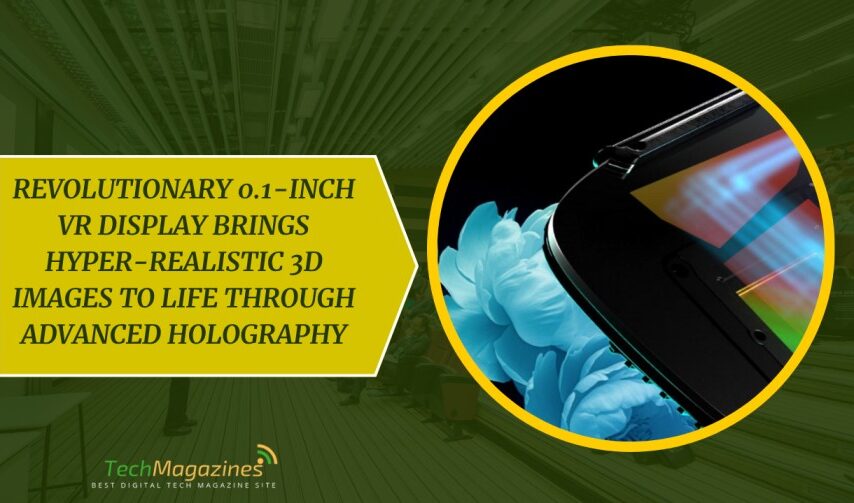

Virtual reality is passing through a phase of quiet but radical change, seeking to compress full-bodied experiences into slimmer, more practical forms. At Stanford University, working alongside Meta Reality Labs, a team has built a new kind of display using holographs, waveguides, and machine intelligence. This device, little more than a tenth of an inch thick (0.12 inches), manages to render convincing three-dimensional images with startling clarity. As the machinery grows more refined, this development marks a clear point along the road to bringing simulated worlds into ordinary life. Its uses could one day change the way we see and move through the digital world.
The Holographic Leap in VR Headsets
For years, progress in virtual reality has been slowed by the awkward bulk of headsets and the narrowness of their visual range. Most systems depend on stereoscopic tricks to imitate depth, often at the cost of convincing realism. The use of holography in VR offers a way out of this bind. Once seen as too unwieldy for common use, holography is now being shaped into a practical method for lifelike display. At Stanford, in partnership with Meta Reality Labs, researchers have assembled a prototype that brings holographic imagery into a form no thicker than a pair of spectacles. Measuring just 0.12 inches, the device marks a clear advance in both form and function.
Where older systems offer the illusion of depth, this new design recreates the full light field, drawing the viewer deeper into the scene. A specially designed waveguide and a spatial light modulator work together to cast high-resolution holograms straight into the eye. The result is an image that does not merely appear to float in space, but feels as though it belongs there. In this way, the experience grows more natural, and the gap between digital and real begins to narrow.
How AI is Enhancing Immersion
Among the most striking aspects of the new VR display is its use of artificial intelligence to deepen the sense of immersion. The system employs an AI-based method of calibration, which sharpens the image and gives a more convincing sense of depth. One of the chief problems in holographic optics, the difficulty of keeping a wide field of view along with a generous eyebox, has long limited the realism of such systems. With the help of machine learning, this device allows the eyes to move freely without the picture blurring or losing focus. It is a step forward in making the virtual world feel more continuous and whole.
The glasses themselves are built with an unusually slim optical stack, making them light on the face and easy to wear for long stretches of time. Eye strain and neck fatigue, once common complaints, are largely absent here. By overcoming these physical hurdles, the new system raises expectations for what wearable virtual reality can be. If comfort and clarity can be kept throughout the day, it may change the way people work, play, and live within digital space.
Can Reality Be Simulated? Pushing Toward the Visual Turing Test
The long-term aim of this work is to reach what is called “mixed reality,” a state in which digital images and the real world merge so completely that the boundary between them disappears. This idea is often described as passing the “Visual Turing Test.” As Suyeon Choi, a postdoctoral researcher and lead author of the study, puts it, the goal is to make it impossible for the viewer to tell whether what they see is genuine or generated. This marks the second phase in the team’s broader effort.
In its first stage, announced the previous year, the project concentrated on building the core waveguide technology needed for holography. The current model builds upon that base, bringing the system nearer to a working product and, in time, to use beyond the lab.
The Road to Mainstream VR
Despite the fact that the new VR display is a real step forward, there are still several barriers on the way to its implementation in daily life. The most notable of them is the high cost of production, which should be minimized in case the technology is to become more accessible to the general population. Work also remains to be done in making the device more robust and more efficient in the use of power.
Nevertheless, the variety of potential applications is extensive. It might alter how we play games, watch movies, acquire new skills, or telecommute. The digital and the real can start to blur as the tools become better. The path to a fully persuasive holographic world remains a long way off, but what the Stanford and Meta team has managed to accomplish demonstrates that the concept is not out of reach.
Their collaboration is the beginning of a new era in virtual reality- one that may change the way we perceive and create virtual reality. With the development of the field, it will be interesting to observe the way these tools are applied in work, learning, and everyday life. What will be the new shapes of things as machines and reality become closer and closer?
Final Words
And here we are, on the precipice of a world in which reality may require an asterisk. The ultra-thin holographic display developed by Stanford and Meta is not only another technological milestone, but also a peek at a future where the definition of what is real and what is rendered becomes the latest parlor game in society.
Yes, we still have to deal with the cost of production that would leave your wallet in tears and power efficiency problems that engineers are surely losing sleep over. But when you can stuff persuasive 3D holographs into something that is less than your morning pancake, then you know we have crossed a boundary.
The consequences go much further than marathon gaming and film evenings. All of these things, education, remote work, and socialization may receive spectacular makeovers. Whether this will bring about a golden age of digital enlightenment or just more creative means of avoiding human contact is charmingly ambiguous. Whichever way you look at it, reality has just received a run for its money.