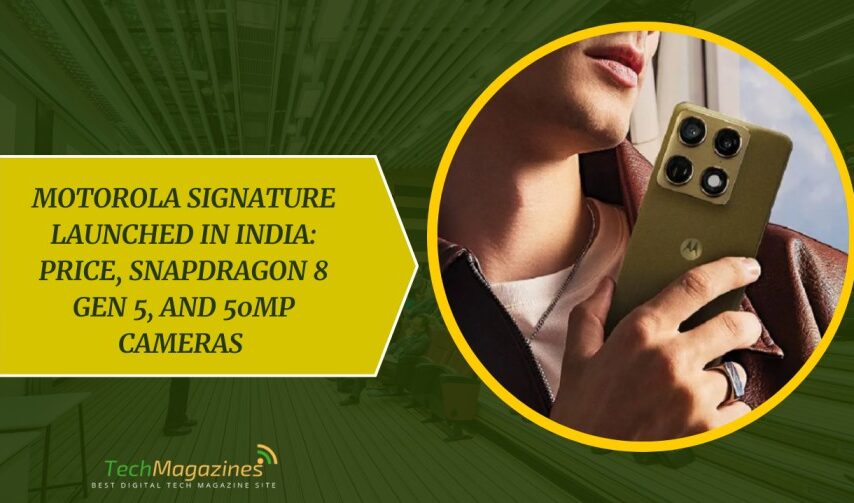

Motorola launched a new premium smartphone in India on January 23, 2026. The gadget is known as the Motorola Signature and is meant to herald a change. With this name, the brand owned by Lenovo implies that it is the beginning of a new line and, possibly, a more precise declaration of what Motorola is now supposed to be.
The phone is equipped with the Snapdragon 8 Gen 5 chip, and a 165Hz LTPO AMOLED display. Its camera has a 50-megapixel sensor, and the storage can go up to 1TB with UFS 4.1 technology. Motorola also pledged a seven-year software support, which is a promise that translates to the long life in a market where obsolescence is a common feature. Costing Rs 59,999, the Signature will be in direct competition with the OPPO Reno15 Pro Mini and Samsung Galaxy S25 FE.
The handset will come in Pantone Carbon and Pantone Martini Olive finishes. On Flipkart, the sales commence on January 30. HDFC and Axis Bank cardholders will be offered an immediate discount of Rs 5,000 as part of the launch offers, which will reduce the effective price to Rs 54,999.
A New Motorola Era Begins With a Premium Flagship Blueprint
The Motorola Signature, which is introduced in India, has the same technical composition as the global version that was introduced in January this year at CES 2026. Regional changes are not of significance. The device has a 6.8-inch FHD+ AMOLED LTPO display, which can support a refresh rate of 165Hz. The display has a purported peak of 6,200 nits and is compatible with Dolby Vision and HDR10+, at its brightest. It is encased with Gorilla Glass Victus 2.
The phone is based on the Qualcomm Snapdragon 8 Gen 5 processor. This puts it right behind the extremely high-end mobile chip category and implies that it does not outmatch all of its competition on paper. But practice indicates that these differences are of less importance in practice. The hardware is configured to provide fast application starts and consistent performance in daily tasks, multitasking, and games with LPDDR5X memory and UFS 4.1 storage.
Software-wise, the Motorola Signature comes with Android 16 and a suite of Moto AI features that is supposed to make daily use more productive. Motorola has also committed to seven years of Android version updates and security patches, which puts the device on par with the long-term support policies currently attached to Samsung and Google.
Camera Hardware That Prioritizes Balance Over Spec-Sheet Shock Value
The camera system on the Motorola Signature is arranged with an air of symmetry and intent. At the center is a 50-megapixel Sony Lytia 828 sensor with optical stabilization, supported by a 50-megapixel ultra-wide camera that covers a 112-degree field of view. Alongside these sits a 50-megapixel Sony Lytia 600 periscope lens, providing three-time optical zoom. Each lens is set within its own ring, grouped together in a square module on the rear, with an LED flash forming a neat border around the arrangement.
On the front, Motorola has fitted a 50-megapixel Sony Lytia 500 camera with autofocus, placed within a punch-hole cutout. The overall setup appears capable, though it falls short on paper when compared with the Reno 15 Pro Mini, which raises the bar in this class with a 200-megapixel main sensor.
Slim Build, Practical Battery, and Fast Charging to Keep Up With Daily Use
Power management tells a quieter story. Motorola states that its Moto Watch can last up to thirteen days on a charge, or around seven days with the always-on display enabled, supported by more than two dozen display styles. The phone itself draws energy from a 5,200mAh battery. In isolation this would seem adequate, but in a market where 7,000mAh cells are increasingly common due to silicon-carbon battery technology, the capacity feels restrained rather than ambitious.
Charging, at least, is an area where the device shows confidence. It supports 90W wired fast charging, along with 10W reverse wireless charging and 5W reverse charging through a cable. All of this hardware is contained within a frame that is only 7mm thick and weighs 186 grams. The result is a phone that feels notably slim for its class and, over extended use, less tiring to handle than many of its heavier rivals.
Durability, Audio, and Materials That Lean Into Substance
The handset carries IP68 and IP69 ratings for resistance to dust and water and complies with the U.S. military’s MIL-STD-810H durability standard. In practical terms, this suggests a phone designed to endure ordinary knocks and exposure without complaint. Motorola has also given the Signature a distinct physical character. The rear panel uses a fabric-like finish, set within an aluminum frame, to convey a sense of restraint rather than excess. Security is provided by an in-display fingerprint reader. Sound comes through stereo speakers positioned at both the top and bottom, tuned by Bose and supported by Dolby Atmos, offering a full and balanced audio presence.
Final Words
The Motorola Signature comes with all the trappings of a well-built flagship: the highest-quality silicon, a gorgeous display, and software guarantees that go far into the next decade. The price of Rs 54,999 with launch offers makes it a logical decision among the people who want performance but not theatrics. But rationality does not always prevail in the market that is getting more and more battery-behemoth and megapixel-arms-race obsessed.
The 5,200mAh battery is nearly retro when competitors are selling power banks in the form of phones, and that 50-megapixel camera, good as it is, is not as much of a spec-sheet show-off as buyers usually want. Nevertheless, it is pleasant to have a gadget that is not obsessed with spectacle but with substance. At least Motorola has gotten the right to make its case when sales commences on January 30.