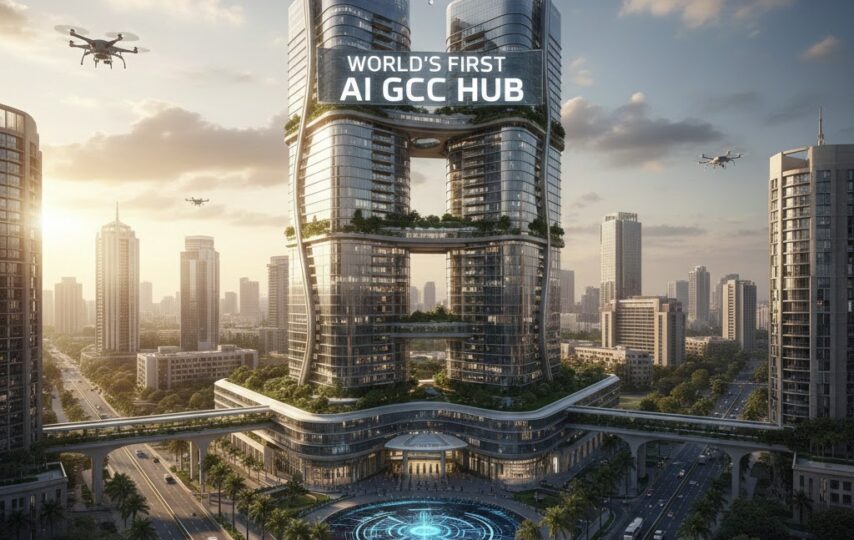

Bandra Kurla Complex (BKC) of Mumbai is not new to huge deals, larger structures and the type of corporate scramble that makes your Monday morning look like a holiday. However, the financial district of the city is currently preparing to launch what would be a futuristic boardroom pitch deck: the first AI Global Capability Center (GCC) hub in the world.
Yes, “world’s first.” Not one of the first, not the first in India, but the type of title that is accompanied by the dramatic background music. This article outlines what we already know about the new AI hub that will be located in BKC, and why it is important.
Maharashtra government signs MoU with Supervity AI
It is developed following the signing of a Memorandum of Understanding (MoU) with Supervity AI of the United States in the World Economic Forum (WEF) in Davos. The signing was not low profile either. Chief Minister Devendra Fadnavis was there to make the announcement, which provided the announcement with the sort of official weight that sends the message: this is not a fanciful press release.
The main idea is to make Mumbai the first AI GCC hub in the world, making it a key destination of applied AI research and enterprise-grade AI work.
Why BKC? Because business is already there
The hub will be established in Bandra Kurla Complex (BKC) and is described as an advanced agentic AI research and innovation hub. In less complex words: it will not be a place where people discuss AI. This is aimed at establishing a hub where AI is developed and experimented in real business applications, particularly when it comes to large business processes.
Since the BKC is already overrun with financial institutions and corporate headquarters, locating the hub there is virtually like dropping a rocket into an already overrun place full of engineers and investors.
A dedicated Agentic AI R&D Centre focused on “safe” deployment
Among the most important highlights, the intention to create a special Agentic AI Research and Development (R&D) Center can be noted. The purpose? Assisting businesses in the design, deployment, and scaling of AI-based operating models safely. That safely aspect is not merely window dressing, but an indicator of an interest in governance, systematic policy and responsible execution, not unregulated automation.
The hub will be trying to ensure that AI does not run wild within corporate systems, because how do you justify to the board that your AI assistant has “freelanced” the company budget.
The rise of “AI Employees”
The hub of Supervity AI is supposed to serve as a launchpad to experiment with what is referred to as AI Employees by multinational corporations (MNCs).
These are not chatbots that respond to the frequently asked questions in a polite manner. These are autonomous AI Employees that are meant to perform the fundamental business processes- the ones that are usually human-intensive as per what has been shared.
The idea is that businesses can safely test out the idea, and then expand these AI-powered systems to departments.
What will these AI Employees actually do?
The autonomous AI Employees would be able to control some of the most important business processes which include:
- Finance
- Procurement
- Compliance
- Supply chain
- Customer operations
- Other key business tasks
The implication of this promise is obvious: AI systems will perform the tasks traditionally done by large teams, which needed to be constantly coordinated.
It is said to replace human-intensive execution and implies that the hub is concerned with automation that transcends support functions and enters the realm of mission-critical business processes.
Productivity, resilience, and auditability built under human governance
The AI model is claimed to guarantee:
- Higher productivity
- Operational resilience
- Enterprise-grade auditability
Notably, these systems will be supposed to perform functions in accordance with human-stipulated policies and governance systems. Thus, the AI may do the work, but the game rules, policies, governance, etc., are still human-made. That is an important fact since automation without responsibility is what businesses do not desire.
The bigger ambition: Mumbai as a global AI-led enterprise center
Placing this hub in Mumbai, Maharashtra is strengthening its goal of becoming a worldwide hub in the operations of AI-driven digital enterprises. The announcement also makes this a move that would bring multinational investment, and creating an ecosystem that encompasses:
- AI talent
- Solution partners
- Enterprise adopters
The hub will also be set to accommodate AI-first frameworks in line with the international regulations, which will indicate that compliance and international alignment are not an afterthought to the larger scheme.
Final Words
The vision of Supervity AI seems to be in integrating policy, governance, and autonomous AI to provide quantifiable enterprise results. It is aimed at developing AI systems capable of running businesses in a responsible manner, in a secure and scalable manner.
Provided that the plan succeeds, BKC will not only be the place where deals are made and strategies are debated, but it may also be the place where AI Employees will report to work (metaphorically, of course) and begin to execute core business processes at speed with governance and audit trails built in.