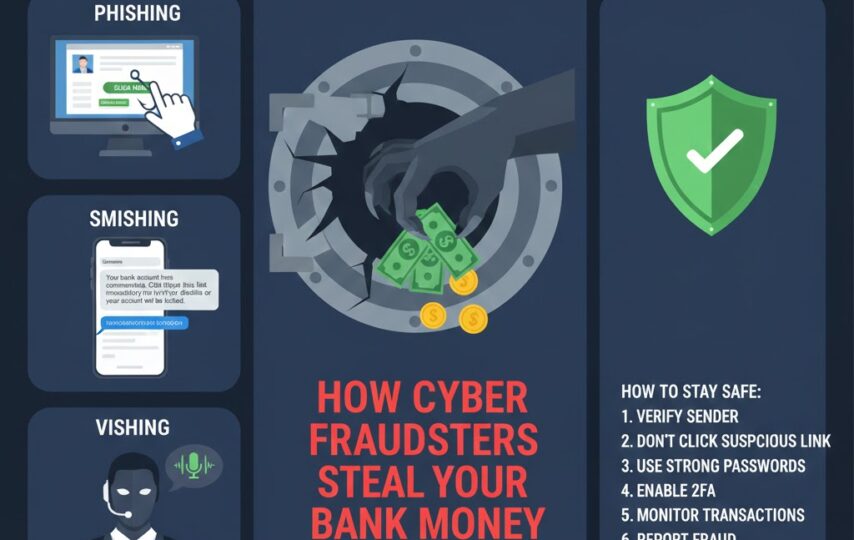

Online fraud is not a new thing, it is a common aspect of everyday life and it is developing rapidly. The ones who implement it hardly ever come up with something completely new. Rather, they modify common practices to the extent of leaving their victims in a state of uncertainty and off balance. Phishing, Smishing, and Vishing are among the most popular forms of this type that are currently being encountered.
Their names are a few letters different, yet their mission is not different in any way. They are all created to deceive you into giving out personal information and once that is done, the money is almost guaranteed to be lost. In order to protect oneself, one has to first comprehend the means through which these frauds are committed.
Phishing: Email-Based Identity Traps and Fake Banking Alerts
Phishing is an online deception. The offender sends emails or opens websites that are similar to the websites of reputable banks, firms or government agencies. The similarity is intentional and frequently persuasive, as it is aimed to disarm the suspicion instead of arousing it.
Tactics Used to Trick Victims
- You receive an email purportedly sent by your bank or some other reputable organization.
- The message talks of abnormal activity or demands that your account is to be verified immediately.
- It contains a link which seems valid but goes to a fake site.
- Once you enter your user-ID, password, OTP, or card details, they steal the information and empty your account.
Red Flags That Signal Fraud
- Messages which generate a sense of urgency, stating that something has to be done now.
- Sender addresses which mimic official addresses but are not exactly the same.
- Website links which appear to be right on the surface but have little, revealing errors.
These frauds are effective not because individuals are stupid, but because they are in a rush, anxious, and used to believing messages that put on the cloak of authority.
Smishing: SMS Fraud Messages, Prize Scams, and Malicious Links
Smishing, a combination of SMS and phishing, is a type of fraud that is performed via text messages. It does away with the formality of email and comes in a way that is immediate and personal. It is exactly because of this that it is successful so often.
Tactics Used to Trick Victims
- You are sent a message on your phone stating that your bank account is suspended.
- Or it tells you that you have won a prize or lottery.
- Or it asks you to take a link to get a refund.
- The message contains a link or a telephone number, both of which are used for deception.
- When you visit the link or make the call, you might be convinced to disclose your OTP, card information or install the software that will provide the fraudster with access to your device.
Why This Threat Is Serious
A text message is considered to be more credible to many people than an email. It comes to a personal device and is read immediately. That little bit of trust, which has been misplaced, is sufficient to bring the scheme to work.
Vishing: Phone Call Impersonation Scams and Fake Authority Threats
Vishing is a type of fraud that is carried out via phone. In this instance, the weapon is not a site or a message, but a human voice that is trained to sound calm, official and urgent all at the same time.
Tactics Used to Trick Victims
The caller identifies himself as an authority figure: a bank officer, a member of the police, an income tax official, or a KYC-verifying executive.
They talk of anomalies, fines, or direct dangers. With this anxiety in place, he requests information: your OTP, the CVV number on your card, your credit card or debit card information, or your online banking account password.
As soon as this information is provided, money transfer is rapid.
Step-by-Step Method Used to Drain Your Bank Balance
The description is different, but the approach remains similar. The fraudster follows a series of easy, practiced steps. To begin with, he generates a feeling of danger or urgency. Then, he establishes himself as an authority who should be obeyed. After the trust has been built, he requests information that is not supposed to be shared.
Having an OTP or card number, the transfer is done and the money is transferred very fast using accounts that are hard and sometimes impossible to trace. It is best to say it bluntly, no bank will ever request you to provide your OTP, PIN, CVV, or passwords on phone.
Essential Cyber Safety Habits Everyone Should Follow
The first rule is restraint. There are some facts that should never be disclosed: OTP, PIN, CVV, Net banking passwords and UPI PIN.
- Look at site addresses, and not appearances.
- Turn on SMS and email notifications to ensure that you are aware of all the transactions.
- Only download apps in the official app stores.
- Check customer care figures using the organization site.
- Use passwords which are hard to crack and use two-factor authentication where possible.
Immediate Actions to Take After Becoming a Fraud Victim
Speed is important in case you believe that fraud has taken place. Call your bank on the official helpline immediately. Block credit or debit card immediately. Report the case in the National Cyber Crime Portal of India and complain at the nearest cybercrime police station. Timely response is not a guarantee of recovery but it enhances the possibilities.
Conclusion
Phishing, Smishing, and Vishing are different in their mediums, which are email, text messages, or phone calls, but not in their purpose. They are all after the same thing: they want to get access to your personal data and, by extension, your funds. Be careful. Pause before responding.
They are counting on you being distracted, in a hurry or simply being a little too trusting on a Tuesday afternoon. And then before you click that urgent link or forward your OTP to somebody who says they are with the security department of the bank, breathe. Authentic banks do not creep into your DMs and require you to provide passwords. Be vigilant and keep your money where it belongs.
FAQs
Q1: What’s the difference between phishing, smishing, and vishing?
Phishing is the one that slides into your email inbox, smishing involves texting, and vishing entails calling. Various tactics of delivery, one scummy objective: theft of your information. That is like deciding between being robbed by letter, telegram or even a phone call, none of them is very attractive.
Q2: What I should never do online or on the phone?
Under no circumstances should you ever disclose your OTP, PIN, CVV and passwords to anyone. The information is already present in legitimate institutions that will never demand such information. Always remember this rule.
Q3: I clicked a suspicious link. What should I do now?
To start with, do not panic, because panic causes more mistakes. Change your passwords now, make sure two factor authentication is on, and monitor your bank accounts. Call the official helpline of your bank, file a case with the National Cyber Crime Portal.
Q4: Can scammers really empty my account with just an OTP?
Absolutely. OTP is a virtual key to your vault. When it gets in the hands of fraudsters, they are able to approve transactions quicker than you can utter the words “wait, what just happened?” This is why banks keep on telling you never to share OTPs, they are seeking to save you a very bad experience.
Q5: Can antivirus software protect me from phishing?
Antivirus software is akin to a good umbrella; it is useful, but not foolproof. It is capable of identifying a few phishing sites and malicious links, but it will do nothing to prevent you willingly giving your OTP to a smooth-talking scammer over the phone. Technology helps but skepticism wins.
Disclaimer:
The information given here is intended for general guidance only. Care has been taken to ensure that it is accurate, but no claim is made that it is complete or beyond error. The material should not be treated as authoritative in all cases. Readers are expected to check facts for themselves and to seek professional advice when the situation requires it. Any decision taken on the basis of this information is taken at the reader’s own responsibility.