
Are you getting thousands of visitors every month, but almost no leads or sales? Getting website traffic has never been easier. Companies spend huge sums of money on SEO, paid ads, and even social media marketing to get people to visit their websites. Traffic alone doesn’t pay the bills. Conversions do.
It’s not frustrating but costly. You spend resources trying to get more people on your website, yet you won’t benefit much unless they convert into customers. This problem is among the most widespread concerns faced by many business owners.
Understanding and fixing this gap is the key to true digital success.
Understanding the Traffic vs Conversion Gap
Website traffic can be defined as the number of users who access your site via different methods, which include organic search, paid advertisements, email campaigns, or social media. The conversions, on the other hand, are the desired actions taken by users. For instance, making contact via a form, signing up for an email newsletter, making a purchase, or registering for the services.
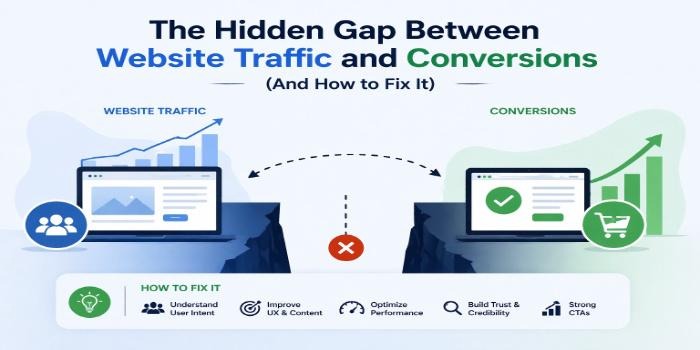
The gap occurs when there is a mismatch between user intent and website experience. For instance, a visitor may click on an advertisement expecting a solution, but end up on a site which doesn’t address their requirements. This can lead to high bounces and low levels of engagement.
Without a proper conversion strategy, even high traffic numbers become vanity metrics that don’t contribute to revenue.
The Real Reason Your Website Traffic Isn’t Converting (And How to Fix It)
A lot of companies think that just because they have traffic to their business, revenue will come too. Getting traffic without revenue is like pouring water into a leaky bucket (traffic) without having a strategy.
Before jumping to the solutions of the problem, you need to explore what causes the gap between traffic and conversions, and then select solutions that are appropriate for the problem.
There are various reasons why traffic may not be meeting conversion rates:
- Wrong Audience Targeting → Align Traffic with Intent
The primary reason for low conversions is having the wrong type of audience come to your site. For example, your SEO project may target irrelevant (broad) keywords or you could use improperly segmented paid ads. You can acquire traffic from your paid campaigns, but if the demographics of the people that see your ad do not match the demographics of the people you want to sell to, you will not see results.
How to fix it:
Create a marketing strategy focused on topic-driven marketing to reduce unintentional audience traffic and attract those that matter most to you. Your website features should reflect what the target market desires from it. Finding keywords that relate to the subject of the traffic keyword, along with identifying which segments of the audience will have the highest propensity (trend) to convert, means the traffic you bring in aligns with the intent of your customers, increasing conversions before they get to your site.
- Weak Landing Page Experience → Optimize for Performance & UX
Your landing page is where users decide whether to stay, engage, or leave. In case the page appears to be slow-moving, outdated in its appearance, and not easily understandable, you may lose a visitor in seconds. In today’s era, there is little patience when it comes to online performance and any delay of even a single second may cause a huge difference in conversions.
How to fix it:
Make sure to improve landing page speed and make pages user-friendly. Apply simple designs, attractive titles, and organized text that is readable at a glance. Make certain that the site is adaptable to mobile phones and works swiftly. The most important thing is to keep the major bits of information and the call to action above the fold so people can do something straight away without any hardships.
- Lack of Clear Value Proposition → Communicate Immediate Value
Users visiting your website should immediately understand what your message is and why they should care. If your message is unclear or too technical for visitors to understand quickly become disinterested and leave quickly.
How to fix it:
Build a compelling and unambiguous value proposition that basically addresses the one most important question of the user: What’s in it for me? Besides that, don’t forget to point out what sets you apart, which, among things, can be your digital marketing services; keep your message easy and understandable, and also make sure that it is prominent within the very first seconds of a visit.
- Poor Call-to-Action (CTA) → Make Actions Clear and Compelling
A CTA is what guides users toward conversion. Without a clear direction, even interested visitors may not take the step. Generic CTAs like “Submit” or “Click Here” often fail to create urgency or motivation.
How to fix it:
The use of compelling calls to action should make people understand what the benefits will be. Calls such as “Get Your Free Quote” or “Start Your Free Trial” should be used. Testing is required for various positions, colors, and wording to find out which works better.
- Trust Deficit → Build Credibility and Confidence
Trust plays a crucial role in conversion decisions. If your website lacks social proof, such as reviews, testimonials, or case studies, users may hesitate to engage, especially in competitive markets.
How to fix it:
Integrate trust-inducing features into your website. This will include displaying client reviews and testimonials. You could also enhance this by adding security seals and clear policies that prove the reliability of your website.
- No Data-Driven Optimization → Use Testing and CRO
Many companies take a leap in the dark by guessing when attempting to improve performance on their websites. If you don’t understand user behavior, it becomes highly challenging to recognize what is really stopping the conversion.
How to fix it:
Use A/B testing to gauge the differences in headlines, CTAs, images and layouts that could create significant improvements for visitors. Even subtle adjustments may bring significant shifts. Also, consider Conversion Rate Optimization (CRO) and employ tools such as heatmaps, recordings of your sessions, and analytics tools that help you learn how people use your site. This assists you in the identification of areas of friction and in enhancing the user experience constantly.
Key Metrics You Should Be Tracking
In order to successfully bridge the gap between traffic and conversions, you need to rely on data rather than assumptions. Measuring the right things will enable you to know at what point users are lost and what requires corrections.
- Conversion Rate: Without a doubt, the most important metric of all. The conversion rate displays the percentage of traffic that is performing your desired call to action. This will clearly show if you have problems within your funnel.
- Bounce Rate: A very high bounce rate indicates users probably didn’t get what they expected the minute they hit your page. This could be due to poor targeting, slow load times, or irrelevant content.
- Average Session Duration: This measures how long users stay on your site. Longer sessions usually indicate higher engagement and interest in your content.
- Click-Through Rate (CTR): This shows how effectively your CTAs, ads, or internal links are performing. A low CTR may point to weak messaging or poor placement.
Keeping a close eye on these and other similar figures allows a company to keep in touch with what the market is feeling and reacting to them in real-time.
Visitors + Matebiz + Digital Strategy = Business Success
Matebiz, being one of the best digital marketing agency, understands that sustainable business success is not driven by traffic alone, but by how effectively that traffic is converted. Operating from Delhi, India, with clients all around the world, one needs to find a balance with the digital strategy as well as connect the target audience with their user experience.
Each visitor receives direction through clear communication, optimizing the data to make decisions. You can take cost-effective packages that are based on the size of your business.
Turn every click into an opportunity and every visitor into a customer.