
Introduction
In the world of sourcing custom precision parts, manufacturing managers and procurement specialists frequently encounter a frustrating dilemma: for the same CNC turning drawing, quotes from different suppliers can vary wildly, sometimes by over 50%. This staggering price disparity not only makes budgeting a challenge but also conceals significant risks related to quality and process transparency, turning project cost management into a guessing game.
The root cause of this situation is information asymmetry. Traditional quotes often provide only a lump-sum price, obscuring the breakdown of material, machine time, programming, tooling, and overhead costs. Buyers lack the professional tools to decode this, making it difficult to assess the rationale behind the price. Choices are then made based on trust or the lowest bid, often leading to hidden charges or quality compromises later.
This article serves as your cost-decoding manual. It delves into the core components of a transparent CNC turning quote, systematically deconstructs the five key drivers of CNC turning pricing, and provides actionable design for manufacturing (DFM) optimization strategies along with a supplier evaluation checklist. The goal is to equip readers with the ability to scrutinize quotes, conduct effective CNC turning supplier evaluation, and ultimately build an accurate CNC turning budget.To solve the opacity of CNC turning cost, one must start by understanding its very composition.
Why Do CNC Turning Quotes Differ by Over 50%? A Complete Analysis of Key Cost Drivers
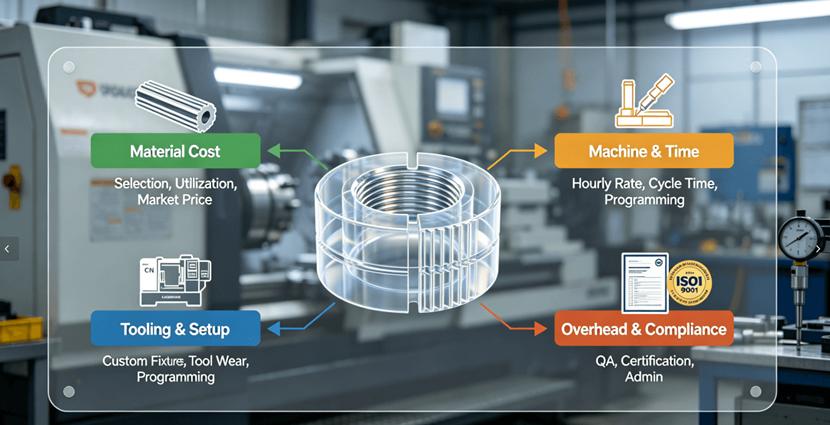
The vast differences in CNC turning pricing are not accidental. They stem from varying calculations and transparency regarding four fundamental cost pillars. Understanding these is the first step to demystifying quotes.
Material Cost: More Than Unit Price
Material cost extends beyond the raw stock purchase price. It includes material utilization (scrap rate), premiums for special alloys (e.g., aerospace-grade), and risk costs from market price fluctuations. A supplier’s choice of bar stock diameter—whether optimal for the part or a standard inventory size—significantly impacts utilization and final cost.
Machine Time, Labor, and Tooling: The Hub of Hidden Costs
This is the primary source of quote variance.
- Machine and Labor Rates:
The hourly rate (machine time cost) differs greatly between lathes of varying age, brand, and precision. The complexity of programming and the chosen machining strategy (conservative vs. aggressive) directly impact the total machining time. The product of these two factors forms the core of the quote. - Tooling and Setup:
Non-standard parts often require custom fixtures (e.g., lathe chucks) and special cutting tools. This cost may be charged as a one-time fee or amortized into the unit price. Opaque quotes frequently blur this line.
Overhead and Compliance: The Often-Overlooked Quality Tax
This encompasses process engineering, quality inspection (FAIR reports, in-process checks), documentation (material certifications, inspection reports), and the cost of maintaining industry certifications like ISO 9001. Rigorous suppliers have higher costs here, but this translates to lower quality risk.
| Cost Driver | Supplier A (Aggressive/Opaque Quote) | Supplier B (Robust/Transparent Quote) | Impact on Final CNC turning quote |
| Material Cost | Estimates based on standard bar, assumes 85% utilization. | Optimizes material selection, uses near-net-shape bar, achieves 92% utilization. | Less waste. Supplier B may save 5-8% here. |
| Machine & Labor | Underestimates programming/machining difficulty, quotes 2 hours. | Based on rich experience, quotes 2.8 hours, explains critical operations. | Supplier A’s quote appears lower but risks hidden costs from overruns; Supplier B’s is more reliable. |
| Tooling & Overhead | Bundled into total price, not itemized. | Clearly lists: Custom Fixture: XXX(one−time),Inspection:XX/part. | Supplier A’s quote may hide risk of later charges; Supplier B’s CNC machining pricing structure is clear. |
Industry data suggests that in non-transparent quotes, undisclosed tooling and compliance overhead can add an extra 15-20% to the total cost.
How to Directly Reduce CNC Turned Part Cost Through Design Optimization (DFM)?
In custom CNC turning, the principle that design determines 70% of cost is paramount. Proactively applying Design for Manufacturability (DFM) before sending a CNC turning RFQ is the most effective way to secure competitive pricing. Key strategies include simplifying part geometries to reduce machining complexity, relaxing non-critical tolerances to minimize costly precision machining, standardizing features like hole sizes to limit tool changes, and designing around standard raw material stock to improve yield. A DFM-optimized design is foundational for a fair CNC turning quote, facilitating efficient supplier communication and enabling significant collaborative cost-saving.
How Does CNC Turning Cost Change from Low- to High-Volume Production?
Creating an accurate CNC turning budget requires understanding the non-linear impact of order quantity on unit cost. Costs do not decrease in a simple, straight line with volume but exhibit significant economies of scale.
In CNC turning, costs are composed of fixed and variable elements. Fixed costs include programming, process engineering, first-article inspection, and fixture/tooling fabrication. These costs are incurred once, regardless of whether 1 or 1000 parts are made. Variable costs include material, actual machining time, and tool wear, which scale proportionally with quantity.
Economies of scale in CNC turning come from amortizing fixed costs (setup, programming). Prototype unit cost is high. Cost drops sharply at mid-volumes (50-500 pcs) as fixed costs dilute. In high-volume (500+ pcs), reductions slow, focusing on cycle-time optimization. Effective budget planning targets the economic order quantity where cost-curve flattens, maximizing value.
How to Decode a CNC Turning Quote and Identify Hidden Costs?
A detailed and transparent CNC turning quote is the cornerstone of a trusted partnership. Upon receiving responses to your CNC turning RFQ, use the following audit checklist to decode the true structure of the CNC machining pricing.
| Audit Dimension | Key Questions to Ask | Purpose & Risk Mitigation |
| 1. Cost Breakdown | Are material, machine time, programming/setup, tooling, surface finish, overhead/profit listed separately? | Transparent quotes reveal cost drivers. A lump-sum price hides these factors, hindering comparison and future optimization. |
| 2. Material Details | Is the material grade, specification, and supplier brand clear? Is the unit price comparable to current market rates? | Prevents substitution with inferior grades or price inflation. Specifying brands ensures material consistency. |
| 3. Time Estimate | What is the total machining time? Is the supplier willing to briefly outline estimated times for key operations (e.g., roughing, finishing, grooving)? | Machining time is the core variable. Suppliers providing details typically have more rigorous estimates and confident processes. |
| 4. Tooling Charges | Is custom tooling/fixturing required? Is the charge one-time/NRE or amortized per unit? How is it handled if the order is canceled? | Clarifies one-time costs to avoid being locked in. The amortization method affects unit price across different batches. |
| 5. Quality & Compliance | Does the quote include First Article Inspection Report (FAIR), Material Certificates (CoC), or key dimension inspection? How are additional inspections charged? | Quality cost is a major area for hidden costs. Clarifying standards and fees upfront prevents disputes upon delivery. |
| 6. Commercial Terms | Are the Minimum Order Quantity (MOQ), payment terms, lead time, packaging, and freight responsibilities clear? | These terms directly impact the total cost of ownership and project timeline and must be agreed upon before proceeding. |
A professional quote should clearly answer most of these questions. For a more in-depth framework on cost analysis, readers can refer to this detailed guide on CNC turning cost.
Beyond Price: What Core Competencies Should You Evaluate in a CNC Turning Supplier?
In the realm of custom CNC turning, the lowest quote often carries the highest risk. Wise sourcing decisions should be based on Total Cost of Ownership (TCO), evaluating a supplier’s core competencies, which are far more important than a simple price number.
Technical Engineering & Collaboration Capability
A superior supplier acts as a manufacturing consultant. Evaluate if they proactively provide DFM feedback to optimize design, reduce cost, and improve manufacturability. This demonstrates their process knowledge and customer-centric service, forming the foundation for applying Advanced Manufacturing Technologies.
Quality System and Sustainability
Quality is not inspected in but built in through systems.
- Certifications & Systems:
Verify if they hold certifications relevant to your industry, such as ISO 9001, IATF 16949 for automotive, or AS9100D for aerospace. This is the bedrock of quality consistency. - Process Control:
Understand how they control critical processes and conduct first-article and in-process inspections. Reliable processes mean fewer rejects and delivery delays.
Operational Transparency & Supply Chain Resilience
Assess if production progress is visible (e.g., regular photo/video updates) and if communication is smooth. Also, inquire how they manage raw material market volatility and delivery risks, which reflects supply chain maturity and stability.
Choosing a partner capable of delivering Smart Manufacturing Solutions means gaining not just parts, but also long-term value derived from process optimization, production stability, and risk management. Partnering with such a supplier for your custom CNC turning needs minimizes project risk and enables true cost control.
Conclusion
In summary, mastering CNC turning costs is not an insurmountable professional barrier. The key is to break information asymmetry. By systematically understanding cost drivers, incorporating manufacturability thinking into design, scientifically evaluating volume effects, rigorously auditing quote structures, and ultimately selecting partners with strong engineering capabilities and robust quality systems, buyers can transform cost from an uncontrollable variable into a predictable, optimizable project parameter. This process itself represents an upgrade from traditional procurement to value-chain management through Smart Manufacturing Solutions.
If you are seeking a transparent and competitive quote for a complex or high-value custom CNC turning project, along with data-driven cost analysis, the expert team at LS Manufacturing offers a free project evaluation and DFM analysis. Upload your part drawings today to receive a professional quote with detailed cost breakdown and optimization suggestions.
Author Bio
This article was written by Jane , a manufacturing contributor has over a decade of experience in advanced manufacturing and supply chain management, specializing in interpreting manufacturing technology trends and cost-optimization strategies for engineers and procurement professionals.
FAQs
Q: What are the most common hidden costs in CNC turning?
A: The most common hidden costs include undisclosed charges for custom fixtures/tooling, stringent First Article Inspection Report (FAIR) fees, additional charges for higher-than-expected material waste, and secondary operations or hand-finishing required to meet tight tolerances. Suppliers should be asked to clarify the inclusion of these items during quoting.
Q: How to create a reasonable preliminary budget for a brand-new CNC turned part?
A: One can start with analogous estimation based on historical projects of similar complexity, material, and size. A more scientific approach is to use an online instant quoting tool for a baseline price, then reserve an additional 15-25% of the budget for design iterations, potential process changes, and unforeseen engineering challenges. This creates a robust CNC turning budget.
Q: Can Design for Manufacturability (DFM) really significantly reduce costs? Any example?
A: Yes, the effect can be substantial. A classic example: relaxing a non-critical internal corner radius from R0.5mm to R1mm may allow the use of a standard tool instead of a custom one. This single change can save hundreds in tooling costs and shorten the cycle time. Accumulating multiple such DFM optimizations can achieve 10-30% overall cost savings.
Q: How to control CNC turning costs for small-batch prototyping?
A: The core for small batches is simplification and consolidation. Prioritize standard, in-stock material sizes to reduce scrap; design features that can be made with standard tools; consider consolidating multiple different small parts into a single request for quote (RFQ) to amortize the fixed programming and setup costs, achieving a better overall unit price.
Q: After receiving multiple quotes, how to choose the supplier with the best value, not just the lowest price?
A: Establish a scoring matrix. Price might weigh 40-50%. Distribute the remaining weight to: transparency of quote details, quality and speed of DFM feedback, proposed Advanced Manufacturing Technologies processes, level of quality certifications (e.g., ISO 9001), and references from past similar projects. The supplier with the highest composite score typically represents better long-term value and lower risk.