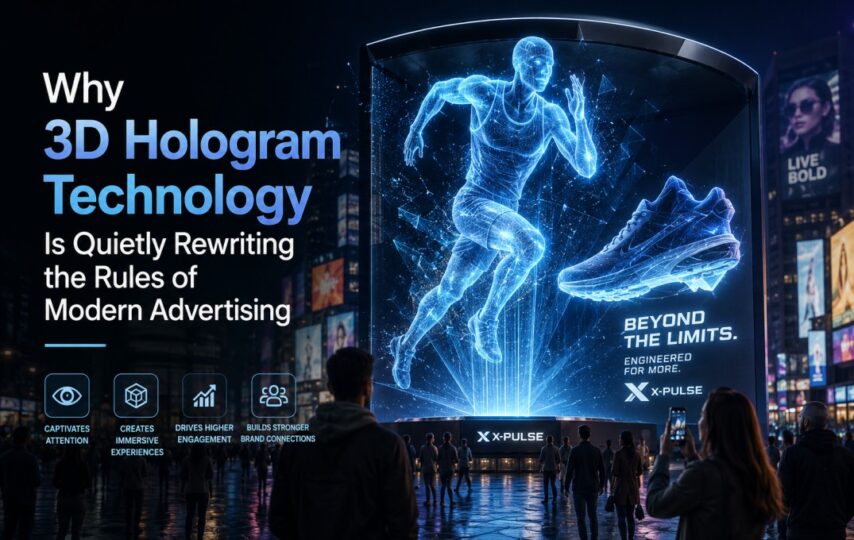

Walk into most retail stores today and you’ll find the same tired arsenal: fluorescent lighting, printed banners, maybe a flat-screen looping the same promotional video on repeat. Nobody stops. Nobody stares. The cashier at the register has probably memorized every frame. Advertising, for all its supposed creativity, started to feel like furniture — present, functional, and completely invisible.
That changed when holographic display technology moved from science fiction sets into real commercial spaces. And the shift has been faster, and more affordable, than most business owners expected.
The Problem With Traditional Visual Advertising
There’s a well-worn statistic in marketing: the average person is exposed to somewhere between 6,000 and 10,000 ads per day. Most of those ads are ignored before they’re even consciously registered. The human brain, brilliant at filtering noise, has learned to treat signage and screen-based promotions as background static.
Businesses have responded to this with louder colors, bigger fonts, more motion. But more of the same doesn’t solve the underlying problem — which is that the format itself has become invisible. A scrolling LED sign is still a sign. A digital banner is still a banner. Even the most polished video wall is, at its core, a flat rectangle on a flat wall.
The only meaningful solution is a format the brain hasn’t learned to dismiss yet. That’s precisely where holographic display technology earns its place.
What a 3D Hologram Fan Actually Does
A 3D hologram fan (also called a holographic fan, LED fan, or holographic display fan) works through a phenomenon called persistence of vision. High-density LED strips are mounted on spinning blades — rotating fast enough that the human eye blends the light into a single, floating three-dimensional image. When positioned correctly, objects appear to hang suspended in mid-air, with no screen, no frame, no enclosure around them.
The effect is genuinely arresting. People stop mid-stride. They lean in. They pull out their phones to record it. That instinctive response — the one no amount of banner advertising can reliably trigger — is exactly what makes holographic displays so commercially valuable.
Unlike complicated legacy holographic projection systems that required darkened rooms, precise calibration, and significant technical overhead, modern hologram fans are plug-and-play devices. You upload your content via a memory card or Wi-Fi app, mount the unit, and power it on. For business owners without dedicated A/V teams, that simplicity is not a minor convenience — it’s the whole ballgame.
The Range of Commercial Applications
One reason holographic fan technology has gained traction across such a diverse range of industries is that the use case is almost universally applicable. Anywhere a business wants to attract visual attention, a holographic display can perform.
In retail, the technology works as a product showcase — animating footwear, jewelry, cosmetics, or electronics in 3D above a countertop or display case, creating the illusion that the product is right there in front of the customer. Studies consistently show that 3D product visualization increases purchasing intent. A floating, rotating 3D render of a product does more to communicate its design and quality than any printed photograph.
In hospitality and events, full-size holographic fan installations create experiences guests genuinely remember. A hotel lobby featuring a slowly rotating holographic display of its property, or a product launch event where the new item materializes in 3D before an audience, generates social media content organically — attendees share it because it’s remarkable, not because they were prompted to.
In food service and entertainment, small-format desk hologram fans serve as compelling menu feature displays or ambient brand elements. The size of the unit matters less than the visual language: this business is doing something different.
Medical and pharmaceutical companies have adopted holographic displays for trade show presentations and clinical education, using animated 3D models of anatomy or molecular structures that communicate complexity clearly and engagingly.
The common thread across all these verticals is simple: attention is the resource, and holographic displays deliver it efficiently.
What to Look for When Buying Holographic Fans for Your Business
Not all holographic fan products are built to the same commercial standard. For businesses making a purchasing decision, a few factors separate reliable long-term investments from units that will underperform in real-world conditions.
Resolution and LED density determine image clarity. Lower-density fans look impressive in a dim room and blurry in a lit retail environment. Commercial-grade units designed for business use will specify LED count and refresh rate clearly — and the numbers will be meaningfully higher than consumer-grade alternatives.
Size range matters because deployment context varies dramatically. A 16-inch desk unit is ideal for countertop retail or reception desk applications. A 39-inch model commands attention across a full retail floor or trade show booth. Life-size installations require units in the 55-inch-and-above class. Businesses with multiple locations may want to operate units of different sizes in different contexts, so working with a brand that offers a full product range is advantageous.
Warranty and support are underappreciated at the purchase stage and deeply appreciated six months later. Commercial display technology operates for extended hours under consistent load — warranty coverage and accessible customer support make a material difference when something needs attention.
Content management is increasingly important as businesses want flexibility to update their displays without technical friction. The best units support Wi-Fi connectivity and companion apps that allow remote content updates across multiple devices simultaneously — a critical feature for chain retailers, franchise operations, or event companies managing multiple installations.
Businesses researching this category would do well to explore the full range of 3D hologram fans offered by INNAYA™, which has built a commercially focused product lineup covering everything from compact desk models to life-size advertising installations — all backed by free global shipping, a 12-month warranty, and a free 16GB memory card included with each unit.
The Competitive Advantage Window Is Still Open — But Not Indefinitely
Early adopters of any display technology enjoy a disproportionate attention advantage. When flat-screen digital signage first entered retail spaces in the early 2000s, the stores that installed it stood out immediately. Within a decade, screens were everywhere, and the novelty was gone. The format became furniture.
Holographic fan displays are at the inflection point right now — past the experimental phase where the technology was unreliable and expensive, but not yet at the saturation point where every window has one. The businesses moving on this now are not gamblers; they’re early-majority adopters catching a wave that’s clearly already moving.
The underlying question isn’t whether holographic advertising technology will become a standard part of the commercial display landscape — the trajectory on that is clear. The question is whether a given business wants to be the one in their market segment that introduced it, or the one that followed once everyone else already had.
Final Thought
Advertising has always been a competition for attention in a world that produces an ever-growing surplus of things to look at. The tools that win that competition reliably are the ones that do something the eye hasn’t learned to ignore. Right now, a well-executed holographic display does exactly that.
For businesses willing to invest in standing out rather than blending in, the technology exists, the price points are accessible, and the barrier to entry has never been lower. The question is simply what you want customers to remember when they walk away.