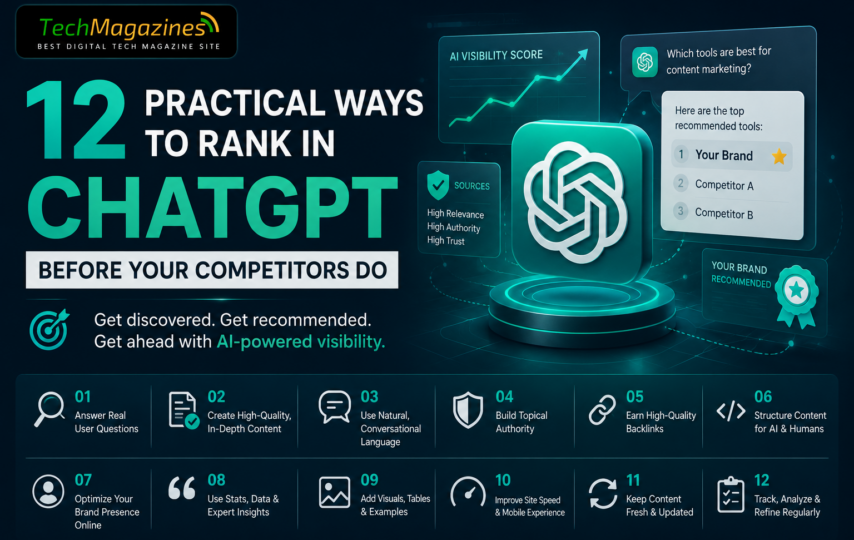

ChatGPT is already shaping how people research vendors, compare services, and discover brands. That matters because if a business is invisible in AI-generated answers, it can lose attention before a user ever reaches Google. The good news is that ranking in ChatGPT is not magic. It is mostly the result of clear content, strong authority signals, crawlable pages, and brand mentions that large language models can understand and trust.
As Emarketed founder Matt Ramage puts it, “We’re seeing more and more searches come from ChatGPT for companies we work with. If you’re not optimizing for AI you’re missing out.” That lines up with what many marketers are now seeing in referral data and assisted conversions.
1. Publish Pages That Answer Specific Questions Clearly
ChatGPT favors content that is easy to extract and restate. Pages built around one clear topic tend to perform better than vague pages trying to cover everything at once. Tight topical focus helps AI systems understand what a page should be cited for.
Use direct headings, short paragraphs, and plain language. If a page answers a question in the first few lines, it has a better chance of being useful in AI summaries.
2. Build Topical Authority, Not Just Isolated Articles
One article rarely earns consistent visibility on its own. ChatGPT is more likely to trust websites that show depth across a subject. That means publishing connected pages around a core theme, such as local SEO, rehab marketing, healthcare compliance, or B2B lead generation.
Topical clusters help AI systems see patterns. They also make it easier for journalists, bloggers, and analysts to cite the site elsewhere, which strengthens off-site authority.
3. Make Brand Mentions Easy To Find Across The Web
ChatGPT does not only rely on a company website. It also draws from third-party sources, directories, reviews, press mentions, and other public references. A business with consistent brand signals across the web is easier for AI to recognize and recommend.
That means keeping business information accurate, earning mentions from relevant publications, and making sure experts associated with the brand are visible online.
4. Use Original Data, Examples, And Opinions
Generic content is easy to ignore. Original insights are more likely to be cited. This can include internal benchmarks, short case examples, survey findings, or a clear point of view on what is changing in search behavior.
AI systems tend to favor content that adds something distinct to the conversation. If every page sounds like a rewrite of ten others, it becomes harder to stand out.
5. Strengthen E-E-A-T Signals
Experience, expertise, authoritativeness, and trust still matter. Even when AI systems do not use Google’s ranking systems directly, they still benefit from the same quality signals. Clear author bios, cited sources, updated company details, and transparent policies all help.
If a site operates in healthcare, legal, finance, or addiction treatment, trust signals matter even more because the factual bar is higher.
6. Format Content So AI Can Parse It Fast
Good formatting is not cosmetic. It helps machines interpret meaning. Use descriptive headings, bullet lists, tables when useful, and concise definitions near the top of a section. Avoid walls of text and vague subheads.
Structured content increases the odds that a model can lift a clean answer without guessing what the page means.
7. Improve Crawlability And Technical Clarity
If important pages are blocked, slow, thin, or buried in weak site architecture, they are less likely to be discovered and understood. Strong technical SEO still matters because AI systems often depend on the same web infrastructure that supports search discovery.
Focus on internal linking, indexable pages, clean HTML, schema where appropriate, and fast page performance. Technical friction makes AI visibility harder than it needs to be.
8. Write For Citations, Not Just Clicks
Traditional SEO often focuses on getting the click. AI search adds another layer: getting cited inside the answer. That changes how content should be written. Strong definition paragraphs, memorable statistics, and concise explanations improve citation potential.
Pages should still convert human readers, but they also need quotable passages that an AI system can confidently summarize.
9. Earn Links And Mentions From Trusted Sources
Authority still travels through the web graph. Links from respected industry sites, associations, local news outlets, and niche publications help validate a business. So do unlinked mentions on reputable websites.
This is especially important for local and regional companies that want to appear credible outside their own market.
10. Keep Important Pages Updated
Outdated service pages, stale bios, and old statistics weaken trust. Refreshing key pages helps maintain accuracy and relevance. This does not mean changing dates for no reason. It means improving substance when information changes.
Freshness matters most on topics where tools, policies, or search behavior are moving quickly.
11. Track AI Visibility Separately From SEO Rankings
Ranking reports alone do not show whether a brand is appearing in ChatGPT or other AI answer engines. Businesses need a separate way to monitor that visibility. One option is Emarketed’s free AI Search Visibility tool, which helps evaluate how friendly a website is for AI search and where gaps may exist.
That kind of measurement is useful because AI visibility often lags behind traditional SEO improvements, and the causes are not always obvious from standard analytics.
12. Give ChatGPT A Clear Reason To Trust The Brand
The final piece is simple: become the kind of source an AI system would want to repeat. That means publishing accurate information, showing real expertise, maintaining a consistent digital footprint, and offering content that is genuinely helpful instead of padded for keywords.
Businesses that treat ChatGPT visibility as a reputation problem, not just a ranking trick, usually make better decisions. The next step is to audit the pages that matter most, tighten their structure, strengthen off-site signals, and measure whether AI platforms are starting to mention the brand more often. That is where momentum begins.