
There’s a reason shoppers open certain apps daily and delete others after one visit. It’s rarely about the product selection. It’s almost always about how the app makes them feel. Does it understand them? Does it surface what they actually want, or does it make them dig through irrelevant noise?
AI-powered personalization answers that question at scale. It’s the difference between an eCommerce app that treats every user identically and one that adapts in real time, changing what it shows, when it shows it, and how it presents it based on individual behavior. That gap in experience translates directly into revenue.
UK eCommerce brands are sitting on one of the most competitive digital retail markets in Europe. Shoppers have high expectations and low patience for generic experiences. As a mobile app development company in UK, TekRevol has built eCommerce apps for brands navigating exactly this environment.
As an eCommerce app development company that has seen the before-and-after of personalization implementation, the revenue impact is consistent and measurable. Here’s how it actually works.
AI Personalization in eCommerce Apps Works by Turning Behavioral Data Into Revenue
Most eCommerce apps collect user data. Very few use it effectively. Browsing history, search queries, time spent on product pages, abandoned carts, and previous purchases all sit in a database while the app shows every user the same homepage banner.
AI personalization closes that gap. It processes behavioral signals in real time and uses them to make the app feel individually tailored to each user. Not approximately tailored. Actually tailored.
The revenue mechanisms are specific:
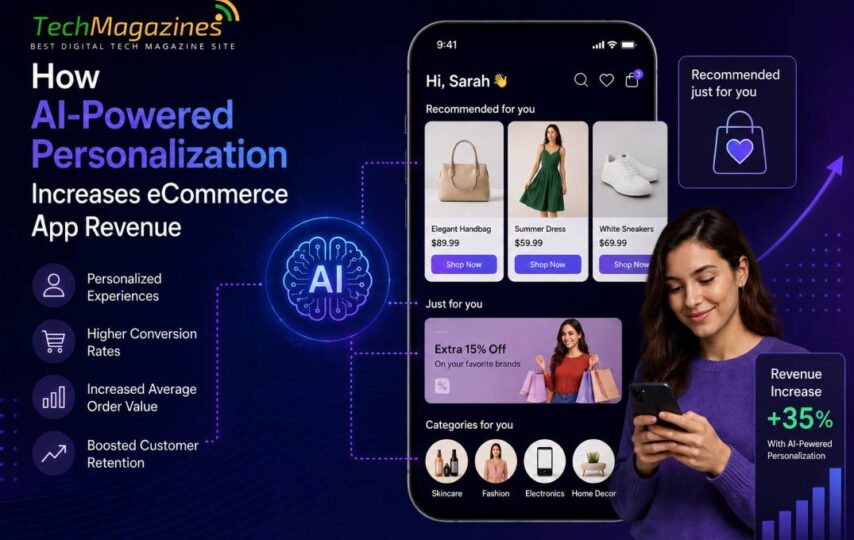
- Higher conversion rates — Users who see products relevant to them buy more. A shopper browsing running shoes who gets surfaced compression socks and hydration gear converts at a meaningfully higher rate than one who sees random homepage features.
- Larger basket sizes — AI-driven cross-sell and upsell recommendations shown at the right moment — during browsing, at cart review, at checkout — increase average order value without pressure selling.
- Lower abandonment — Personalized push notifications that reference the specific item left in cart, timed based on the user’s typical activity window, recover purchases that would otherwise be lost.
- Stronger retention — An app that feels like it knows a user is an app they come back to. Retention is cheaper than acquisition, and personalization is one of the most reliable drivers of it.
As a mobile app development company in UK, TekRevol builds these personalization layers into eCommerce apps from the first sprint, not as an afterthought once the core product is live.
Recommendation Engines Are the Highest-ROI Personalization Feature
Recommendation engines are where most eCommerce apps see the clearest revenue lift. When they work well, they feel effortless. The right product appears at the right moment, and the user buys without needing to be persuaded.
How Recommendation Engines Actually Work
The engine processes a user’s browsing history, purchase history, wishlist additions, and time-on-page signals. It compares this data against the behavior of similar users, a collaborative filtering approach, to predict what the current user is likely to want next.
For fashion brands, this means a user browsing a black midi dress gets shown matching ankle boots and a belt, not a random assortment from the same category. For electronics retailers, a user who just bought a laptop gets surfaced compatible accessories at the moment they’re most likely to need them.
Where They Fail
Recommendation engines fail when they’re trained on insufficient data. A new user with no purchase history gets generic recommendations, which undermines the experience before any personalization can kick in. The fix is cold-start handling, using initial onboarding signals (stated preferences, category interests, device type) to populate early recommendations until behavioral data accumulates.
They also fail when the model weights are wrong, surfacing items the user has already purchased, or recommending within too narrow a category. Good recommendation architecture requires ongoing tuning, not a one-time setup.
Dynamic Pricing and Personalized Promotions Drive Conversion at the Right Moment
Blanket discounts are expensive and train users to wait for sales. Personalized promotions are targeted, efficient, and convert at higher rates because they reach the right user at the right time with the right offer.
AI-powered dynamic promotion systems analyze a user’s purchase history and behavioral patterns to determine:
- Whether a user tends to buy full-price or needs an incentive
- What discount threshold triggers a purchase for this specific user
- Which product categories they haven’t explored yet
- How long they typically browse before buying
A user who consistently purchases within three minutes of browsing doesn’t need a discount. A user who has viewed the same jacket four times over two weeks does. Treating those users identically wastes margin on the first and loses the second.
UK eCommerce brands with loyalty programs can layer this further, AI-driven points promotions, birthday offers timed to the right week, and tier-based incentives that reward high-value users differently from casual browsers.
Personalized Search Is the Feature Most Brands Underinvest In
Users who search know what they want. They have the highest purchase intent of any behavior in your app. And yet most eCommerce apps serve the same search results to every user regardless of their history, preferences, or size.
Personalized search re-ranks results based on the individual:
- A user who consistently buys from sustainable brands sees those products ranked higher in search results
- A size-8 customer sees in-stock size-8 options prioritized, not products that will show “out of stock in your size” after they tap
- A high-frequency buyer in the activewear category sees new arrivals in that category surface ahead of general bestsellers
The conversion rate improvement from personalized search alone is substantial. Search users already want to buy, the only question is whether your app shows them the right result fast enough.
Push Notifications Only Add Revenue When They’re Personalized
Generic push notifications are the fastest way to earn an uninstall. A user who bought a kitchen appliance last week doesn’t need a notification about children’s clothing. One who abandoned a specific product in the cart three days ago does need a gentle, well-timed reminder.
AI-driven push notification systems optimize three variables: content, timing, and frequency.
- Content is personalized based on browsing and purchase history. The notification references the actual product or category the user engaged with — not a generic sales message.
- Timing is based on when the user is typically active in the app. Sending a push at 7 AM to a user who only opens the app in the evenings is wasted. AI-driven timing learns individual activity windows and sends within them.
- Frequency is capped based on engagement. Users who rarely open push notifications get fewer, higher-value messages. Users who respond regularly can receive more. The system self-regulates based on what works.
An eCommerce app development company that builds notification systems this way turns push into a revenue channel instead of a churn driver.
Conclusion
AI-powered personalization isn’t a premium feature reserved for platforms with Amazon-scale budgets. In 2026, the technology will be accessible to eCommerce brands of every size, and the competitive cost of not having it is rising fast.
UK shoppers compare every app against the best experiences they’ve had. If your app shows them the same homepage as everyone else, they notice. Not consciously. But they open competitor apps more often, and eventually open yours less.
TekRevol, a dedicated eCommerce app development company, builds personalization into eCommerce apps as a foundational layer, recommendation engines, personalized search, dynamic promotions, and intelligent push systems that work together from day one.
The revenue impact is measurable. The retention improvement is consistent. And the brands that build it in early are the ones setting the standard that their competitors are trying to match.