
Recording Earbuds vs AI Voice Recorder: Which Is Better for Meetings?
AI meeting note takers have moved well beyond software apps. Hardware options are now a real part of the conversation, and they come in two distinct forms: the standalone AI voice recorder, a purpose-built device that exists solely to capture and transcribe speech, and the recording earbud, a true wireless earbud that adds meeting recording to a device you were probably already going to carry.
If you are searching for the best voice recorder for meetings and have already settled on hardware over software, this comparison is for you. Both categories qualify as a legitimate ai meeting note taker — what they do differently, and who each one actually suits, is what this piece is about.
What Recording Earbuds and AI Voice Recorders Actually Are
A standalone AI voice recorder is a dedicated piece of hardware built for one job. Devices like the Plaud AI and the viaim RecDot are designed around microphone arrays and optimized battery life, with on-device or cloud AI that turns captured audio into transcripts and summaries. There is no music playback, no earphone function — just recording.
A recording earbud is a different kind of device. It is a true wireless earbud that adds meeting recording as a secondary capability, typically through a microphone array built into the charging case rather than the earbuds themselves. The soundcore Liberty 5 Pro Max is a practical example: it delivers active noise cancellation and hi-res audio for everyday use, while the charging case sits on a desk and captures the meeting when needed. One device, two distinct purposes.
That split matters more than it might seem. One category is built to make your whole workday more comfortable and happens to record meetings along the way. The other exists purely to capture speech as accurately as possible. To understand where both fit in the broader landscape of AI-powered note-taking tools, the AI note taker vs voice recorder comparison covers both software and hardware options in full.
Recording Earbuds: Advantages and Best Use Cases
The core appeal of recording earbuds is that they add meeting capture to a device you were already going to carry. Unlike standalone AI voice recorders, recording earbuds belong to the broader category of true wireless earbuds, devices people already rely on daily for music and calls. Upgrading to a model with recording capability means zero new gear, zero extra charging, and a far lower profile in the room than setting a dedicated recorder on the table.
- Portability: one device handles calls, music, and meeting capture with nothing extra in your bag
- 2-in-1 value: consolidates what would otherwise be two separate hardware purchases
- Low intrusion: a charging case sitting on the desk draws far less attention than a purpose-built recording device
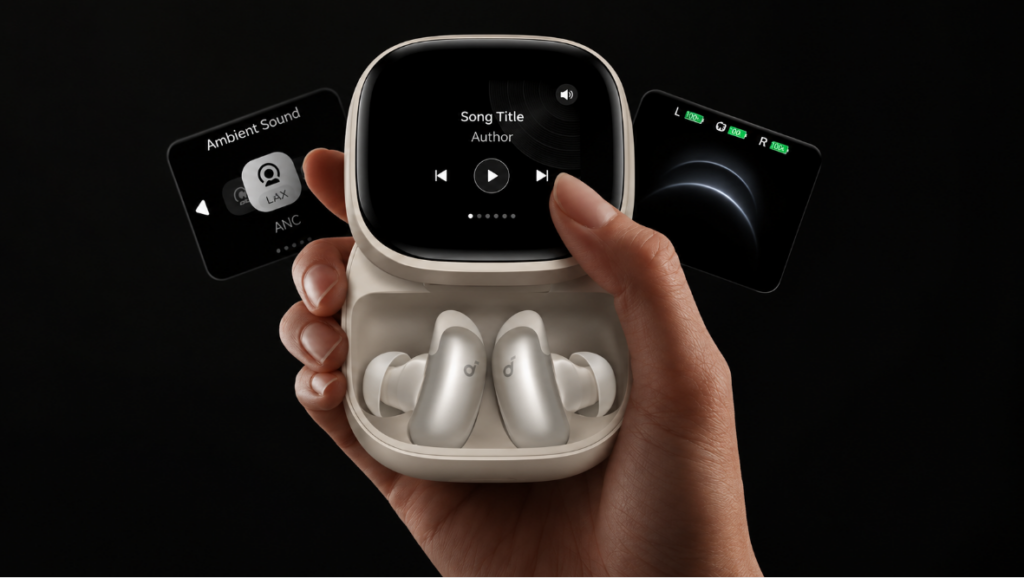
The soundcore Liberty 5 Pro Max is a practical example of this approach. Its call system combines 8 microphones with 2 VPU bone-conduction sensors and the Anker Thus™ AI Chip for voice clarity, delivering strong call performance before the recording function even comes into play. It also delivers Adaptive ANC 4.0, and up to 28 hours of total battery life for everyday use, while the charging case records meetings via a 1.78-inch AMOLED touchscreen for one-tap starts. Recording is free, with transcription requiring the AI Note-Taker subscription. Eligible buyers receive 120 minutes per month for 24 months under the Free Starter plan, with paid tiers at $15.99 per month for Pro or $239.99 per year for Unlimited.
Recording earbuds are a natural fit if any of these describe your workday:
- You move between offices, client sites, or coffee shops and want one device that does it all
- Most of your meetings are informal one-on-ones or quick check-ins rather than formal boardroom sessions
- You already rely on earbuds for calls and want meeting recording as an added layer, not a separate purchase.
AI Voice Recorders: Advantages and Best Use Cases
A standalone AI voice recorder exists for one reason, and that focus shows in how it performs. This single-purpose approach delivers real advantages in the right setting:
- Higher transcription accuracy: microphone arrays built specifically for room audio tend to outperform the case-mounted mics found on recording earbuds, especially in noisier or larger spaces
- Better multi-speaker pickup: place a device like the Plaud AI at the center of a conference table and it captures all participants with roughly equal fidelity, including speakers at the far end of the room
- Longer dedicated battery: with no power drawn by ANC, Bluetooth audio streaming, or other earphone functions, standalone recorders are better suited to extended recording sessions
A widely referenced device in this category is the Plaud Note by Plaud AI ($159). It is a credit-card-sized standalone recorder that lies flat on a table or attaches magnetically to a notebook, with up to 30 hours of continuous recording, 64 GB of on-device storage, and AI transcription in over 112 languages. Every purchase includes 300 minutes of free transcription per month — no subscription required unless you need more. Worth noting: viaim also makes AI recording hardware under the RecDot line ($199.99), though that product is actually true wireless earbuds with built-in AI recording rather than a standalone device, placing it in the same general category as the Liberty 5 Pro Max.
A standalone recorder tends to be the stronger choice in these situations:
- Formal boardroom meetings with multiple speakers spread around a large table
- High-stakes sessions where a word-for-word record is required, such as legal depositions, medical consultations, or compliance reviews
- Full-day workshops or back-to-back schedules where battery endurance matters
- Professionals who have no use for wireless earbuds and prefer not to pay for bundled features they will never use
Recording Earbuds: Real Limitations
The microphone position is the most practical constraint to understand. In the Liberty 5 Pro Max, recording happens through the charging case’s built-in microphone, which sits at a fixed point on the desk. For a small meeting with two or three people nearby, this works well. In a larger boardroom with participants spread around the table, a standalone recorder like the Plaud AI, placed at the center of the table, picks up everyone more evenly. It is not a dealbreaker for informal use, but it matters in formal multi-speaker settings.
Transcription accuracy and battery endurance are also worth keeping realistic expectations about. No independent benchmarks compare the Liberty 5 Pro Max’s transcript quality directly against dedicated recorders, so the safer assumption for high-stakes content is that a purpose-built device has the edge.
On battery, enabling all smart features simultaneously — ANC, Dolby Audio, and smart voice control — drops total battery life from 28 hours down to 17 hours. Storage is also finite: the case holds roughly 12 hours of audio total, and each individual recording session is capped at 3 hours, after which you need to upload to the app to free space. For back-to-back full-day schedules, these limits matter more than they would with a dedicated recorder.
Cost Comparison
Here is a quick side-by-side of where the three devices stand:
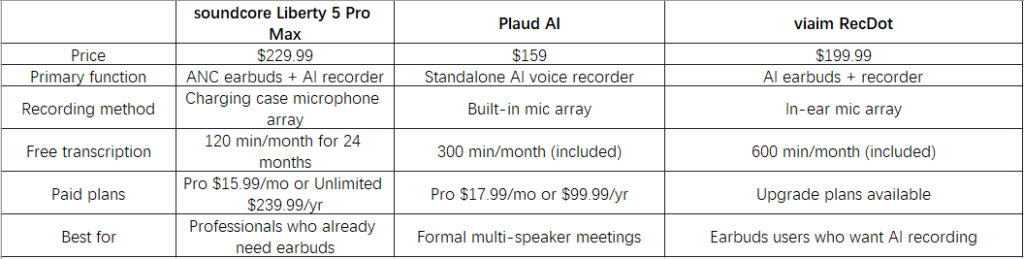
The financial case for recording earbuds is strongest when they replace two separate purchases. Someone who needs both a quality pair of ANC earbuds and a meeting recorder would spend at least $200 on a mid-range pair of earbuds plus $159 on a Plaud AI, putting the combined cost near $360 before any subscription fees. The Liberty 5 Pro Max at $229.99 covers both functions and comes with 120 free transcription minutes per month for 24 months, which meaningfully reduces the early subscription burden.
That math flips if you already own earbuds you are happy with. In that case, a standalone recorder like the Plaud AI at $159 is simply cheaper, and you are not paying for earphone features you will not use. Recording earbuds offer better overall value when they consolidate two purchases into one, not when they compete against a single-purpose device on price alone.
| Disclaimer:Plaud and viaim are trademarks of their respective owners. soundcore is not affiliated with, endorsed by, or sponsored by these trademark owners. All comparisons are based on publicly available specifications and internal assessments as of June 2026. |
How to Decide: Five Clear Scenarios
The best voice recorder for meetings is not the same device for every professional. The right answer depends almost entirely on how your workday actually looks.
- If you already rely on noise-canceling earbuds for calls and commutes, upgrading to a model like the Liberty 5 Pro Max is a natural next step. You are buying a device you needed anyway, and meeting recording comes along for the ride without adding a second item to your bag or budget. Similarly, if most of your meetings are informal, quick, or happen while you are moving between locations, recording earbuds are a practical fit.
- The picture shifts when meetings become more formal or more demanding. If you attend structured sessions where a word-for-word record matters, such as legal consultations, compliance reviews, or high-level client briefings, a standalone AI voice recorder like the Plaud AI is the more defensible choice. When six or more people are seated around a large table, an omnidirectional recorder placed at the center captures all voices with consistent fidelity. A case-mounted microphone sitting at the desk edge simply cannot cover the full room the same way.
- Finally, if you have no real use for wireless earbuds and are only looking for a meeting recorder, there is no reason to pay the premium on a 2-in-1 device. A standalone recorder gets the job done at a lower price, without the earphone hardware you would never use.
Conclusion
Neither category is the wrong answer — they are built for different people with different daily realities. If you already rely on noise-canceling earbuds for calls, commutes, and focused work, a device like the soundcore Liberty 5 Pro Max lets you add meeting recording without buying or carrying anything extra. If your meetings are formal, multi-speaker, and demand the highest possible transcription accuracy, a standalone AI voice recorder like the Plaud AI is purpose-built for that job and costs less upfront.
The decision comes down to one honest question: are you upgrading a device you already need, or buying hardware exclusively for recording? Your answer to that will point clearly to the right form factor and to the ai meeting note taker that actually fits your workflow.
FAQs
What is the difference between recording earbuds and regular wireless earbuds with a built-in microphone?
The difference is significant. Nearly all wireless earbuds include a call microphone, but it captures only your voice and is not designed to record a full room conversation. Recording earbuds like the soundcore Liberty 5 Pro Max add a separate microphone array inside the charging case specifically for meeting capture, along with on-device storage and an AI transcription pipeline — a standard call mic simply cannot do this.
Can recording earbuds transcribe multiple speakers as accurately as a standalone AI voice recorder?
Not reliably in large-group settings. The Liberty 5 Pro Max records through the charging case microphone at a fixed point on the desk, which works well for small meetings but loses consistency when participants are spread across a large conference table. A standalone AI voice recorder like the Plaud AI handles multi-speaker scenarios more evenly, making a dedicated device the more dependable choice when accurate attribution matters.
Do I need a subscription to use the AI transcription features on recording earbuds?
Yes, though recording audio itself is free on the Liberty 5 Pro Max with no usage cap. Transcription and AI summaries require the AI Note-Taker subscription, and eligible buyers receive 120 minutes per month free for 24 months after purchase. Paid plans start at $15.99 per month for Pro or $239.99 per year for Unlimited — and standalone recorders like the Plaud AI include 300 free minutes per month but also have paid tiers for heavier use, so the subscription model is a category-wide reality, not a drawback unique to recording earbuds.