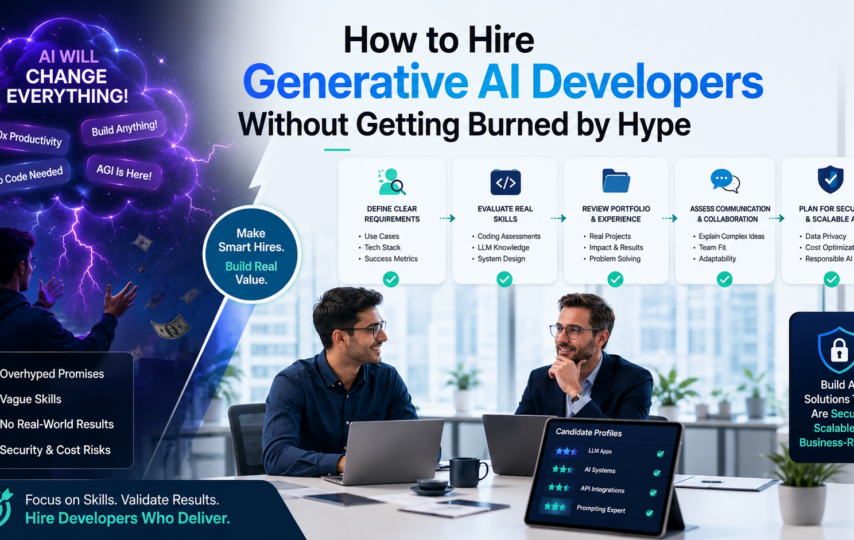

Generative AI is creating new opportunities for companies that want to automate repetitive work, improve customer experiences, build intelligent products, or streamline internal operations. However, the market is also full of inflated claims, vague technical promises, and developers who present basic API integrations as advanced AI engineering. Businesses looking to hire generative AI developers need a practical evaluation process that separates genuine technical capability from impressive-sounding sales language.
The right developer can help a company build reliable AI assistants, document-processing systems, workflow automations, recommendation tools, content applications, and custom internal platforms. The wrong developer may deliver an expensive prototype that performs well during a demonstration but fails when exposed to real users, company data, security requirements, or everyday operational pressure.
Companies such as Mindrind operate in a market where business leaders increasingly need AI solutions tied to measurable outcomes rather than experimental features. Before selecting a developer or development partner, decision-makers should understand what generative AI can realistically do, what skills the project requires, and how to evaluate whether a proposed solution will create lasting value.
Start With a Real Business Problem
The first step is not choosing a model, framework, or development agency. It is defining the business problem clearly.
Many weak AI projects begin with a broad statement such as, “We need an AI chatbot,” or “We want to add generative AI to our platform.” These statements describe a technology preference, not a business need.
A stronger project brief explains:
- Who will use the system
- What task currently takes too much time
- What information the system needs
- What successful output should look like
- Which risks must be controlled
- How the company will measure improvement
For example, instead of asking for a general chatbot, a company might need an internal assistant that helps support staff find approved answers in product manuals. That definition immediately clarifies the users, data sources, expected behavior, and quality standards.
Developers who ask detailed questions about the workflow before discussing technology are usually more reliable than those who immediately recommend a popular model.
Understand What Generative AI Development Includes
Generative AI development is more than connecting an application to a large language model. A production-ready system may require several technical layers working together.
Common Components of an AI Application
A serious generative AI project may include:
- Model selection
- Prompt and instruction design
- Retrieval-augmented generation
- Data preparation
- Vector search
- API development
- User authentication
- Database integration
- Monitoring and logging
- Output evaluation
- Security controls
- Human review workflows
- Cost management
Some projects may also require fine-tuning, multimodal processing, agent-based workflows, or integration with existing business software.
A developer who only understands prompting may be able to create a simple demonstration. However, a business application often requires experience in software architecture, data engineering, backend development, security, and quality assurance.
Look Beyond AI Buzzwords
The generative AI industry changes quickly, and many technical terms are used loosely. Developers may describe ordinary automation as an autonomous agent or present a basic search interface as a complete knowledge system.
Do not evaluate a candidate based on how many AI terms they use. Ask them to explain the proposed solution in plain language.
Questions That Reveal Real Understanding
Ask:
- Why is generative AI necessary for this use case?
- What parts should use deterministic software instead?
- How will the system access company information?
- What happens when the model is uncertain?
- How will incorrect answers be identified?
- How will sensitive data be protected?
- What will the system cost at higher usage levels?
- How will performance be measured after launch?
Experienced developers should be able to discuss both the benefits and limitations of the technology. Be cautious when someone claims an AI system will be completely accurate, fully autonomous, or capable of replacing an entire team without supervision.
Review Relevant Project Experience
A long list of AI tools on a résumé does not necessarily prove that a developer can build a reliable product. Relevant experience matters more than familiarity with every new framework.
Ask candidates to present previous projects that are similar in complexity to yours. They do not need to have built the exact same product, but they should have experience with comparable workflows, integrations, data requirements, or user risks.
What to Examine in a Portfolio
Look for evidence of:
- Real users rather than only demos
- Integration with business systems
- Handling of private or structured data
- Evaluation and monitoring processes
- Performance improvements after testing
- Clear explanations of technical trade-offs
- Measurable outcomes
Ask what went wrong during previous projects and how the developer corrected it. Strong developers can usually explain failures, limitations, and lessons learned. Weak candidates often discuss only features and successes.
Test Their Ability to Control Hallucinations
Generative AI systems can produce confident but incorrect information. This is one of the most important risks in business applications.
A qualified developer should not promise to eliminate hallucinations entirely. Instead, they should explain how they will reduce, detect, and manage them.
Practical Risk-Control Methods
Depending on the application, the solution may use:
- Approved source documents
- Retrieval-augmented generation
- Citations or source references
- Structured output formats
- Confidence thresholds
- Restricted response rules
- Human approval steps
- Automated evaluation tests
- Fallback responses
- Audit logs
For high-risk uses, such as financial, legal, medical, or compliance-related workflows, human oversight may be essential. A developer should understand that an impressive answer is not necessarily a trustworthy answer.
Evaluate Data and Security Knowledge
Generative AI applications often work with customer records, internal documents, contracts, communications, or operational data. This creates security and privacy responsibilities.
Ask exactly where data will be sent, processed, stored, and logged. You should know whether the system uses third-party model providers, what information those providers retain, and whether sensitive data can be excluded or anonymized.
Security Questions to Ask
Discuss:
- Data encryption
- Access controls
- User permissions
- Logging policies
- Retention periods
- API key management
- Vendor data policies
- Private deployment options
- Compliance requirements
- Protection against prompt injection
A developer who treats security as a final-stage feature may create expensive problems later. Security should influence the architecture from the beginning.
Ask for a Small Paid Discovery Phase
Do not begin with a large contract based only on a proposal and sales presentation. A small paid discovery phase gives both sides a chance to test the working relationship.
During discovery, the developer should examine the workflow, data, technical environment, risks, and success criteria. The deliverable may include a solution architecture, implementation plan, cost estimate, risk assessment, and prototype.
What Discovery Should Clarify
A useful discovery phase should answer:
- Is generative AI suitable for the problem?
- Which model or provider is appropriate?
- What data preparation is required?
- Which integrations are needed?
- What could cause the project to fail?
- What level of human review is necessary?
- What will the first production version include?
- What ongoing costs should be expected?
This approach reduces the risk of paying for a large build before the technical assumptions have been tested.
Avoid Choosing on Hourly Rate Alone
A cheaper developer is not always a less expensive choice. Poor architecture, weak testing, and rushed integrations can create high costs after launch.
At the same time, a high price does not guarantee advanced capability. Some providers charge premium rates because AI is currently in demand, not because their work is better.
Compare proposals based on scope, technical clarity, ownership, testing, support, and expected business value.
Review the Full Cost
Consider:
- Development fees
- Model usage charges
- Hosting
- Database costs
- Monitoring tools
- Maintenance
- Security reviews
- Future feature changes
- Data updates
- Support
Ask how costs may change if usage grows by five or ten times. A solution that is affordable during testing may become expensive at production scale.
Confirm Ownership and Documentation
The contract should clearly explain who owns the code, prompts, workflows, datasets, documentation, and custom components.
Your company should also receive enough documentation to maintain or transfer the system later. Avoid arrangements that create unnecessary dependence on one developer.
Documentation Should Cover
Request:
- System architecture
- Setup instructions
- API documentation
- Data flow
- Environment variables
- Deployment process
- Testing procedures
- Monitoring process
- Known limitations
- Recovery steps
Good documentation is a sign that the developer is building a maintainable product rather than a temporary demonstration.
Use Clear Milestones and Acceptance Criteria
Large AI projects should be divided into smaller stages. Each milestone should have a clear deliverable and acceptance criteria.
Possible stages include:
- Discovery and architecture
- Data preparation
- Prototype
- Internal testing
- Integration
- Pilot launch
- Production deployment
- Monitoring and optimization
For each stage, define what must work before payment or approval. Avoid vague milestones such as “AI system completed.” Use measurable criteria such as response accuracy on an approved test set, maximum response time, successful integration with a specific platform, or correct handling of restricted questions.
Watch for Common Red Flags
Some warning signs appear repeatedly in weak AI proposals.
Be cautious if a developer:
- Guarantees perfect accuracy
- Recommends a model before understanding the problem
- Cannot explain failure cases
- Avoids discussing security
- Has only chatbot demos
- Provides no evaluation plan
- Uses vague pricing
- Offers no documentation
- Claims full autonomy without human review
- Cannot explain ongoing costs
- Treats every workflow as a generative AI problem
A trustworthy developer should be comfortable saying when AI is unnecessary or when a simpler system would be safer.
Final Thoughts
Hiring generative AI developers requires more than reviewing technical buzzwords or impressive demos. The strongest candidates understand software engineering, business workflows, data quality, security, evaluation, and model limitations.
Start with a clearly defined problem, ask for relevant evidence, test the relationship through a small discovery phase, and use measurable milestones. A responsible developer will help you understand where generative AI adds value and where conventional software is the better choice.
The goal is not to hire the person making the boldest promise. It is to choose a development partner who can build a secure, maintainable, and useful system that performs reliably after the excitement of the initial demonstration has passed.