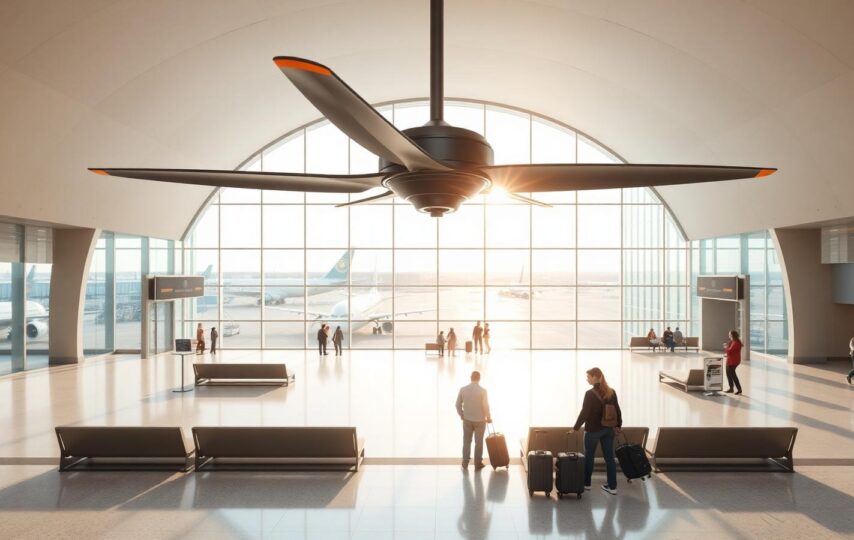

High-volume, low-speed (HVLS) fans are commonly used in warehouses, manufacturing plants, distribution centers, aircraft hangars, gyms, agricultural buildings, large retail stores, schools, arenas, and other spacious commercial or industrial facilities.
What these buildings usually have in common is not simply their industry. They tend to have large floor areas, high ceilings, open layouts, or occupied zones that need air movement over a much wider area than a conventional small fan can conveniently cover.
HVLS fans rotate relatively slowly while moving a large volume of air. Instead of producing a narrow, concentrated stream of high-speed air, they are designed to create broad air circulation across large spaces.
That makes them particularly useful in facilities where occupant comfort, air distribution, and temperature stratification are ongoing concerns.
What Types of Spaces Commonly Use HVLS Fans?
HVLS fans can appear in very different environments, from a distribution warehouse to a basketball gym or dairy barn. However, suitable applications tend to share several characteristics.
They often have:
- Large open floor areas
- High ceilings
- Wide occupied or working zones
- Uneven air movement
- Warm air accumulating near the ceiling
- Workers, customers, athletes, or animals spread across a large space
- Existing heating or cooling systems that may benefit from better air distribution
The building type alone does not determine whether an HVLS fan is appropriate.
Ceiling height, mounting structure, fan diameter, nearby lighting, sprinklers, racks, cranes, ductwork, HVAC outlets, and other obstructions can all affect fan placement and performance.
Here are some of the most common applications.
1. Warehouses and Storage Facilities
Warehouses are among the most recognizable HVLS fan applications.
They often combine several conditions that make large-area air circulation important: tall ceilings, long aisles, large storage areas, loading zones, and employees working throughout the building.
In warm conditions, increased air movement can improve comfort for employees working on warehouse floors, packing stations, loading areas, and other occupied zones.
High-ceiling warehouses can also experience temperature stratification. Warm air naturally rises and may accumulate near the ceiling while cooler air remains closer to floor level. Depending on operating conditions and fan settings, an HVLS system can help mix these air layers more evenly.
Warehouse layout still matters. Tall pallet racks, mezzanines, partitions, and equipment can interfere with airflow, so fan selection should consider more than total square footage.
2. Manufacturing Plants
Manufacturing facilities are another common application because they frequently contain large production floors with workers and heat-generating equipment.
Typical locations can include:
- Assembly areas
- Fabrication facilities
- Production lines
- Workshops
- Processing areas
- Large industrial work bays
Machinery and manufacturing processes may create localized warm areas, while employees can be positioned across a large floor.
Broad air movement can help improve comfort across these occupied areas.
However, manufacturing plants are often more complicated than empty open buildings. Overhead cranes, production machinery, mezzanines, lighting, utility lines, and other structures may affect where a large fan can safely be installed.
As a result, fan diameter alone should never determine the final layout.
3. Distribution Centers and Logistics Facilities
Distribution centers share some characteristics with warehouses but usually have a different operational pattern.
Instead of primarily storing products, these facilities may include constant:
- Sorting
- Packing
- Picking
- Loading
- Unloading
- Parcel movement
- Employee traffic
Large fulfillment and logistics centers can contain broad working areas where people remain active throughout the day.
HVLS fans are useful in these environments because they can circulate air across large sections of the operational floor rather than concentrating airflow around a single workstation.
Loading doors and changing indoor conditions should also be considered when planning the fan layout.
4. Aircraft Hangars and Aviation Facilities
Aircraft hangars are particularly well suited to large-diameter air movement systems because they can have exceptionally high ceilings and very large open interior volumes.
Maintenance technicians generally work close to floor level, while substantial amounts of warm air can accumulate much higher in the building.
Large hangar doors may also cause indoor conditions to change significantly as they open and close.
Installing an HVLS fan in an aviation facility requires careful planning. Important considerations can include:
- Aircraft clearance
- Hangar door travel
- Lighting
- Fire protection systems
- Structural mounting points
- Maintenance equipment
- Other overhead obstructions
The building may be large enough for an HVLS fan, but adequate physical clearance remains essential.
5. Gyms and Fitness Centers
HVLS fans are not limited to industrial buildings.
They are also commonly found in:
- Commercial gyms
- Indoor basketball courts
- Fitness centers
- Recreation centers
- Training facilities
- Indoor sports halls
These environments contain active occupants who generate body heat while exercising.
The purpose of the fan is generally not to refrigerate the room or directly lower the actual air temperature. Instead, increased air movement around occupants can improve perceived comfort by supporting convective and evaporative heat transfer from the body.
Large indoor courts and gyms also tend to have tall ceilings and relatively open layouts, making broad air circulation particularly useful.
6. Shopping Malls, Retail Stores, and Showrooms
Large commercial spaces may also use HVLS fans.
Examples include:
- Shopping malls
- Furniture showrooms
- Big-box stores
- Home improvement stores
- Exhibition spaces
- Large retail halls
In these applications, the goal is often to provide broad, relatively gentle air movement across customer and employee areas.
HVLS fans may also operate alongside a building’s heating or cooling system to support more even air distribution.
This illustrates an important point: HVLS technology is not exclusively an industrial solution. The same principle of moving a high volume of air over a broad area can also be useful in public-facing commercial buildings.
7. Schools, Universities, and Public Buildings
Schools and other public facilities frequently contain spaces that resemble commercial or industrial buildings in scale.
Examples include:
- School gymnasiums
- University recreation centers
- Cafeterias
- Large assembly rooms
- Churches
- Community centers
- Multipurpose halls
These spaces may contain large groups of people and have high ceilings that make conventional small ceiling fans less practical for broad coverage.
Noise, occupant comfort, ceiling layout, fire protection equipment, and other building systems should all be evaluated when selecting and positioning fans.
8. Auditoriums, Arenas, and Large Event Spaces
Auditoriums and event venues often need airflow across wide occupied areas.
Large indoor venues can include:
- Arenas
- Convention spaces
- Event halls
- Indoor sports venues
- Exhibition centers
- Large assembly buildings
Because these facilities may accommodate many occupants at the same time, broad air movement can contribute to a more comfortable environment.
Fan location must still account for lighting rigs, audiovisual equipment, scoreboards, fire protection systems, and other ceiling-mounted equipment.
9. Barns and Livestock Facilities
Agriculture is another established application for large air-circulation fans.
HVLS fans may be found in:
- Dairy barns
- Livestock buildings
- Equestrian facilities
- Poultry buildings
- Riding arenas
- Agricultural work areas
In these environments, moving air through broad animal-occupied areas can help support comfort and reduce stagnant air zones.
Air movement can also assist evaporation from animals and surfaces.
However, an HVLS fan should not be described as a dehumidifier. Humidity management may require ventilation, environmental controls, or other systems depending on the facility.
Agricultural environments can also expose equipment to dust, moisture, and other challenging conditions, so equipment suitability should be evaluated for the specific installation.
10. Greenhouses and Other Agricultural Buildings
Some greenhouse and agricultural facilities can also benefit from controlled air circulation.
Potential applications include:
- Greenhouses
- Agricultural storage buildings
- Equipment storage structures
- Large farm workshops
- Selected crop-processing areas
Greenhouses require more careful consideration than a conventional warehouse because plants may have specific temperature, humidity, and airflow requirements.
An HVLS fan should therefore be selected as part of the facility’s broader environmental strategy rather than installed simply because the building has a large floor area.
Why Are HVLS Fans Used in So Many Different Industries?
A warehouse, gym, aircraft hangar, and dairy barn may seem unrelated, but from an airflow perspective they often share similar challenges.
Moving Air Across Large Areas
Small high-speed fans generally create more concentrated airflow.
HVLS fans are intended to distribute air across a much broader area, making them suitable for large rooms and facilities where occupants are spread across the floor.
Improving Occupant Comfort
Air movement can make warm environments feel more comfortable even when the fan does not reduce the actual room temperature.
This principle can apply to warehouse employees, manufacturing workers, athletes, shoppers, students, and other occupants.
Reducing Temperature Stratification
High ceilings can allow warm air to collect well above the occupied zone.
Appropriate fan operation can help mix warmer upper-level air with cooler air closer to the floor, reducing the difference between ceiling and floor temperatures.
Working With Existing HVAC Systems
HVLS fans and HVAC systems do not necessarily perform the same function.
An HVAC system may heat, cool, ventilate, or condition the air. An HVLS fan primarily moves and mixes air.
Depending on the building, the two systems may operate together to support more even air distribution.
Common HVLS Fan Applications at a Glance
| Application | Why HVLS Fans Are Used | Key Installation Consideration |
| Warehouses | Wide-area circulation and destratification | Racks and aisle layout |
| Manufacturing | Worker comfort and air distribution | Machinery and cranes |
| Distribution centers | Broad airflow across active work areas | Loading and sorting zones |
| Aircraft hangars | Air movement in large high-bay spaces | Aircraft and door clearance |
| Gyms | Air movement around active occupants | Fan height and coverage |
| Retail spaces | Broad customer-area circulation | HVAC and ceiling layout |
| Schools | Comfort across large occupied spaces | Noise and obstructions |
| Event venues | Large-area circulation | Lighting and overhead equipment |
| Livestock facilities | Animal-area air movement | Environmental conditions |
| Greenhouses | Controlled circulation | Crop and ventilation requirements |
Where Might an HVLS Fan Not Be the Best Choice?
Despite their versatility, HVLS fans are not suitable for every building.
A very small room generally does not need the coverage offered by a large-diameter fan.
Low ceilings may also prevent adequate mounting clearance, while highly obstructed ceilings can make safe placement difficult.
A facility that needs concentrated directional airflow at a single workstation may benefit more from another type of fan.
It is also important to distinguish air circulation from ventilation. Moving indoor air around a building is not the same as introducing outdoor air or removing contaminants. Facilities that require exhaust ventilation, process ventilation, smoke control, or other specialized systems should not assume that an HVLS fan replaces those requirements.
Specialized or hazardous environments may also require equipment with specific electrical, environmental, or safety characteristics.
How Do You Know Whether an HVLS Fan Fits Your Space?
Before choosing a fan, consider the building as a complete airflow environment.
Important factors include:
- Total floor area
- Ceiling height
- Open versus divided floor plan
- Fan diameter
- Desired airflow coverage
- Mounting structure
- Racking
- Machinery
- Mezzanines
- Lighting
- Sprinklers
- HVAC supply and return locations
- Electrical supply
- Indoor or outdoor conditions
- Required clearances
- Number of fans required
Two buildings with identical square footage can require very different fan layouts because their ceiling heights, equipment, obstructions, and airflow goals are different.
When reviewing available HVLS Fans, it therefore makes more sense to compare fan diameter, mounting requirements, motor configuration, electrical requirements, intended application, and expected coverage together rather than selecting a model based only on size.
For buyers comparing multiple configurations, collections of Best HVLS Fans can provide a starting point, but the final choice should still be matched to the building itself.
Frequently Asked Questions
Where are HVLS fans most commonly used?
HVLS fans are most commonly used in large warehouses, manufacturing plants, distribution centers, aircraft hangars, gyms, agricultural buildings, retail spaces, schools, arenas, and other large commercial or industrial facilities. They are especially relevant to spaces with high ceilings, broad floor areas, and a need for wide-area air circulation.
What are the main uses of HVLS fans?
Their primary uses include moving air across large areas, improving occupant comfort, reducing stagnant air zones, helping mix stratified air in high-ceiling buildings, and supporting more even air distribution alongside existing heating or cooling systems.
Are HVLS fans only used in warehouses?
No. Warehouses are a major application, but HVLS fans are also used in factories, logistics centers, gyms, aircraft hangars, shopping areas, schools, event venues, barns, equestrian facilities, and some greenhouse or agricultural environments.
Can HVLS fans be used in gyms?
Yes. Large gyms, indoor courts, and fitness centers are common applications because they often have high ceilings and large occupied areas. Increased air movement around active occupants can improve perceived comfort without necessarily lowering the actual room temperature.
Are HVLS fans used in barns?
Yes. HVLS fans are used in some dairy barns, livestock facilities, equestrian buildings, riding arenas, and other agricultural structures. The specific fan should be suitable for the environmental conditions of the facility.
Can an HVLS fan be used in a home?
It can be, particularly in unusually large residential spaces with very high ceilings. However, conventional residential ceiling fans are usually more appropriate for standard bedrooms, living rooms, and other typical household spaces.
How do I know what HVLS fan size I need?
Fan size depends on more than square footage. Ceiling height, floor layout, obstructions, required airflow coverage, mounting location, nearby building systems, and the intended use of the space should all be evaluated before choosing a diameter.
Conclusion
HVLS fans are commonly associated with warehouses and factories, but their applications extend much further. Distribution centers, aircraft hangars, gyms, retail buildings, schools, arenas, barns, and agricultural facilities can all benefit from broad air movement when the building conditions are suitable.
The deciding factor is not simply whether a building is labeled “industrial” or “commercial.” Large floor areas, high ceilings, airflow obstructions, mounting conditions, occupied zones, and the building’s overall ventilation and HVAC strategy all influence whether an HVLS fan is appropriate.
For organizations evaluating large-airflow solutions, Breezary provides an additional resource for exploring HVLS fan configurations and other large ceiling fan options.