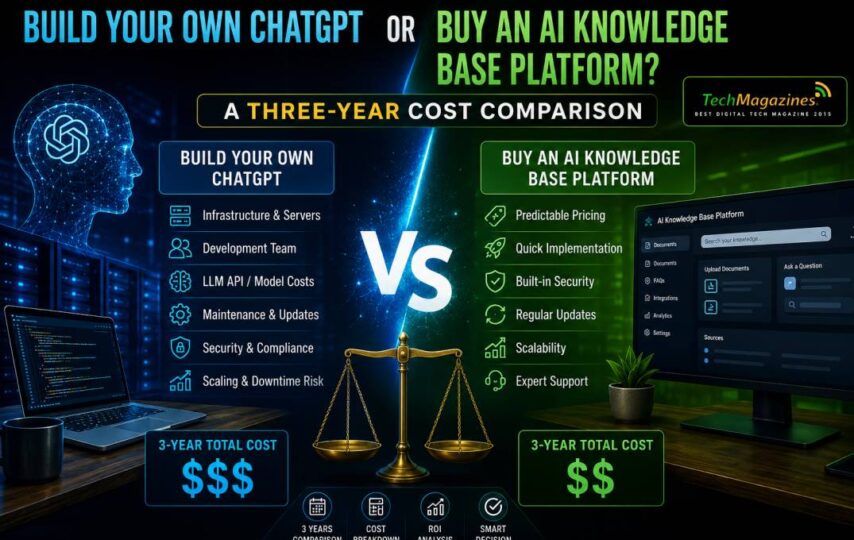

When a company decides to build an internal AI assistant, one question appears very early: should we build our own ChatGPT-like system, or should we buy an AI knowledge base platform? At first, building looks attractive. The company may already have engineers, cloud accounts, internal documents, and access to large language models. A prototype can often be assembled quickly: upload files, split them into chunks, create embeddings, store vectors, retrieve relevant text, and send the results to a model. In a demo, this can feel almost complete.
The difficult part is that a demo is not the same as an enterprise knowledge product. A working prototype may answer a few test questions, but a production system must handle document updates, retrieval quality, permissions, logs, citations, workflow integration, model changes, security reviews, user feedback, and ongoing operations. The three-year cost of an AI knowledge base is therefore not only the cost of model tokens or cloud servers. It is the cost of turning scattered enterprise knowledge into a reliable, maintainable service.
This article compares the build and buy paths from a three-year perspective. It does not use fixed market prices, because pricing changes by vendor, region, deployment model, model provider, usage volume, and service level. Instead, it focuses on the cost categories that executives, IT leaders, and AI project owners should include before making the decision. In many cases, the best choice is not “build everything” or “buy everything.” The better question is which layers should be owned internally and which should be handled by a mature platform such as FastGPT.
Product Design Costs
The first cost category is product design. A basic retrieval-augmented generation system sounds simple, but the user experience has many decisions hidden inside it. How should users upload documents? How should administrators organize knowledge bases? Should different departments have separate spaces? How should the assistant behave when the answer is not found? Should it cite sources by paragraph, document, or section? Can users give feedback on bad answers? Can administrators inspect retrieval results and improve them? These are not minor interface details. They determine whether the system becomes a daily tool or remains a technical experiment.
If the company builds from scratch, product managers and engineers must define these behaviors, design the interface, and maintain it as user expectations evolve. During the first three months, this may feel manageable. Over three years, it becomes a steady product workload. Every new department will ask for small differences: approval flows, private documents, answer templates, usage reports, multilingual support, workflow triggers, and API access. Buying a knowledge base platform does not remove all product work, but it reduces the amount of generic infrastructure the company must invent before focusing on business-specific use cases.
Document Processing Costs
The second cost category is document processing. Enterprise documents are rarely clean. They include PDFs, Word files, spreadsheets, Markdown files, web pages, screenshots, tables, diagrams, scanned files, policy manuals, technical documents, contract templates, and legacy exports from internal systems. A simple text extraction pipeline may work for plain documents, but it often fails on tables, headings, footnotes, page breaks, duplicated headers, and mixed-language content. Poor parsing becomes poor retrieval, and poor retrieval becomes poor answers.
In a self-built system, the team must decide how to parse each document type, how to preserve structure, how to chunk content, how to remove noise, how to handle updates, and how to debug failed ingestion. This work is easy to underestimate because users only see the final answer. If the answer is wrong, they may blame the model, even when the real problem is that the relevant section was parsed badly or indexed in the wrong place. A platform path can be valuable when it gives administrators a more complete knowledge management workflow, including document upload, indexing, retrieval adjustment, and quality review.
Retrieval Quality Costs
The third cost category is retrieval quality. Many internal AI prototypes use a simple pattern: embed the user question, retrieve the top chunks from a vector database, and ask the model to answer. This can work for simple cases, but enterprise questions often require more control. Some questions need exact keyword matching. Some require semantic search. Some need reranking. Some need metadata filtering by department, document type, product version, customer segment, or permission level. Some require the assistant to refuse when the retrieved evidence is weak.
Retrieval quality is a long-term cost because it must be improved continuously. New documents appear. Old documents expire. Employees ask questions in unexpected ways. Similar policies may conflict. A self-built team needs evaluation sets, retrieval logs, manual review tools, and a way to tune the pipeline without rewriting the whole system. Over three years, this maintenance becomes one of the biggest hidden costs. Buying a platform can shorten the path if it already includes knowledge base management, retrieval configuration, and application-level controls that business teams can operate without waiting for engineers every time.
Traceability and Security Costs
The fourth cost category is answer traceability. In consumer chat, a fluent answer may be enough. In enterprise work, people need to know where the answer came from. Customer service agents must verify product claims. HR teams must point employees to the correct policy. Finance and legal teams need confidence that the assistant is not improvising. Managers need a way to inspect why a bad answer happened. Traceability includes citations, source previews, retrieval records, answer logs, and review workflows.
Building traceability from scratch is not impossible, but it is more complex than adding links at the end of an answer. The system must preserve source metadata during ingestion, keep chunk references stable, display the right source in the interface, and record enough detail for administrators to investigate failures. If the company later adds workflow automation or API access, traceability must follow those paths too. A platform designed for knowledge applications can reduce this burden by treating citations and retrieval visibility as part of the product rather than an afterthought.
The fifth cost category is security and permissions. This is where many build-versus-buy discussions become serious. An internal AI assistant may touch confidential documents, employee policies, customer information, technical architecture, financial material, and operational procedures. The system needs user authentication, role-based access, document-level or knowledge-base-level permissions, secure model configuration, secret management, audit logs, and sometimes private deployment. If tools or workflows are connected, the risk expands to API permissions and action safety.
For a self-built system, these capabilities require experienced engineering and security review. The team must decide how documents are isolated, how prompts are protected, how model providers are called, how logs are stored, and how administrators can audit usage. These decisions have long-term consequences. A shortcut taken in the first prototype may become expensive to correct when more departments join. Buying a platform does not eliminate security responsibility, but it can provide a clearer operating model for permission boundaries, application management, and deployment choices.
Integration and Operations Costs
The sixth cost category is integration. A basic knowledge assistant may only answer questions from uploaded documents. A valuable enterprise assistant often needs to connect with existing systems: OA, CRM, helpdesk, HR systems, internal APIs, databases, and notification channels. But integration should be approached carefully. The AI layer should not casually replace systems of record. It should guide, summarize, retrieve, classify, draft, and trigger controlled workflows where appropriate. Transactional actions should remain governed by the systems designed to own them.
If a company builds from scratch, integration work can quickly dominate the roadmap. Each system has its own authentication, API design, permission model, error behavior, and maintenance cycle. The cost is not only building the first connector; it is keeping it reliable. A platform that supports application workflows can help teams move faster, especially when the goal is to combine knowledge Q&A with repeatable business processes. For example, an assistant may answer a policy question, ask follow-up questions, and then guide the user toward a request workflow, instead of leaving the user with a paragraph and no next step.
The seventh cost category is operations. Once employees depend on an AI knowledge base, someone must keep it running. Operations include monitoring availability, tracking usage, handling model provider failures, managing token costs, responding to bad answer reports, updating documents, reviewing logs, backing up configurations, and planning upgrades. There is also a human operations layer: training administrators, defining content ownership, communicating changes, and building trust with users.
Self-built systems often hide operations cost until the first production incident. A model response changes. A document update breaks retrieval quality. An internal API fails. Token consumption rises unexpectedly. A department uploads conflicting material. A security team asks for audit evidence. These are ordinary production realities, not rare edge cases. Over three years, operations can cost more than the initial build. A platform can be valuable if it reduces the number of custom components the company must monitor and gives non-engineering teams enough control to maintain their own knowledge areas.
Opportunity Cost and Strategic Fit
The eighth cost category is opportunity cost. Engineers assigned to build a generic AI knowledge base are not building business-specific advantages. If the company is a technology vendor with unique AI infrastructure requirements, building core components may be strategic. But if the company mainly wants better customer support, HR self-service, sales enablement, internal policy Q&A, or process navigation, then rebuilding common knowledge base capabilities may delay the business value. The opportunity cost is measured in months of slower rollout, fewer use cases, and more internal dependency on a small technical team.
This does not mean buying is always better. A company should consider building when it has unusual requirements that platforms cannot support, deep in-house AI engineering capability, strong security or deployment constraints, and a long-term plan to treat the knowledge system as a core internal product. Building can also make sense when the company needs full control over retrieval architecture, model orchestration, data residency, or custom integrations. The key is honesty: if the organization chooses to build, it should budget for a real product team, not a one-time prototype.
Buying is usually more attractive when the company wants to move from pilot to adoption quickly, when knowledge quality is more important than infrastructure ownership, and when business teams need to operate the system without waiting for engineering on every change. It is also attractive when the organization wants a tested path for knowledge base management, AI application creation, workflow orchestration, and private or controlled deployment options. In these cases, the value of a platform is not that it magically solves every enterprise problem. The value is that it gives the team a more complete starting point.
What a Fair Three-Year Comparison Should Include
A three-year comparison should therefore include at least ten line items. For the build path, estimate product design, frontend development, backend development, document parsing, vector storage, retrieval tuning, model orchestration, permission design, security review, integration work, logging, evaluation, monitoring, infrastructure, maintenance, and internal support. For the buy path, estimate platform subscription or deployment cost, model usage, implementation services, internal administrator time, integration work, content preparation, training, and governance. The categories differ, but neither path is free.
The most common mistake is comparing only the visible software cost of a platform with the visible cloud cost of a self-built prototype. That comparison is incomplete. A prototype may look cheap because it ignores the salaries, maintenance, security review, quality assurance, and ongoing roadmap required to make it trustworthy. A platform may look more expensive at first because its price includes capabilities that the company would otherwise need to build, operate, and support internally. The fair comparison is total cost of ownership, not initial engineering expense.
Another mistake is assuming that model quality alone determines success. A stronger model can improve answer fluency, reasoning, and tolerance for messy questions, but it cannot fix outdated documents, missing permissions, poor chunking, weak citations, or unclear ownership. Whether the company builds or buys, the project still needs knowledge governance. Someone must decide which documents are authoritative, how updates are handled, who reviews bad answers, and how success is measured. Without that operating model, both paths can fail.
How to Decide with a Controlled Pilot
For many companies, the best first step is a controlled pilot rather than a permanent architecture decision. Choose one use case, such as customer support Q&A, HR policy assistant, sales enablement, or OA process navigation. Build a realistic question set. Include easy questions, ambiguous questions, outdated-document traps, and questions that should be refused or escalated. Measure answer accuracy, citation quality, time saved, administrator workload, and user satisfaction. Then compare how much effort it takes to reach a production-ready standard on the build path versus the platform path.
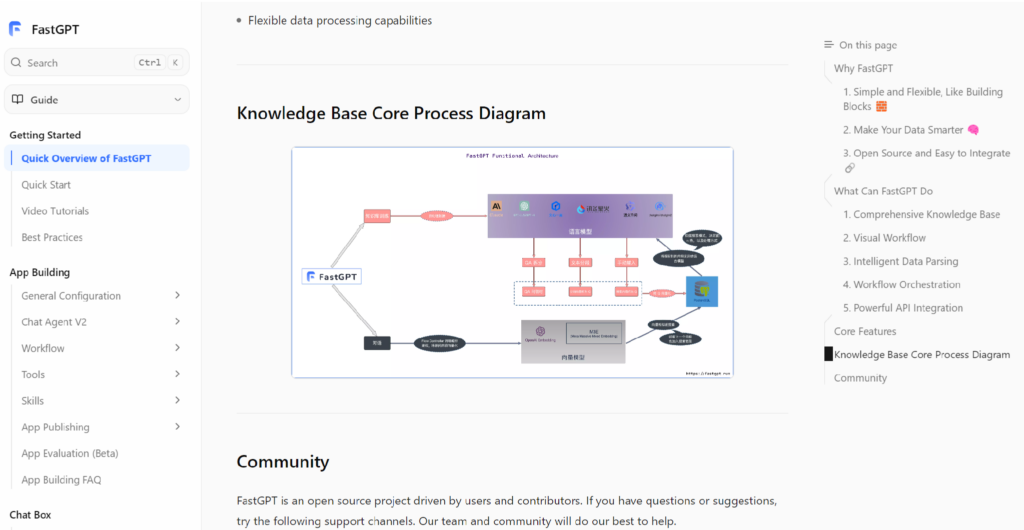
FastGPT’s official documentation can help teams understand the platform route and evaluate how knowledge bases and applications are organized. During evaluation, teams should look beyond the first chat demo. Test document ingestion, retrieval adjustment, citation behavior, workflow design, permission needs, and operational management. Ask who will maintain the knowledge base after launch. Ask how quickly a business team can update content. Ask how failures will be reviewed. These questions reveal the real three-year cost more clearly than a single model benchmark.
Final Recommendation
The final decision should match the company’s strategic intent. If the organization wants to become an AI platform builder, has strong engineering capacity, and needs deep architectural control, building may be justified. If the organization wants to make enterprise knowledge easier to use, reduce repeated internal questions, improve customer and employee support, and launch dependable AI applications faster, buying or adopting a mature knowledge base platform will often produce a better return. The three-year cost comparison is not about pride in building or comfort in buying. It is about paying for the right work.
The cheapest option on day one is not always the cheapest option after three years. A self-built prototype can become expensive when every missing feature becomes internal engineering work. A platform can become cost-effective when it lets the company focus on content, workflows, governance, and adoption instead of rebuilding generic AI infrastructure. The smartest choice is the one that turns enterprise knowledge into a reliable operating asset with the least unnecessary drag. That is the real benchmark for build versus buy.