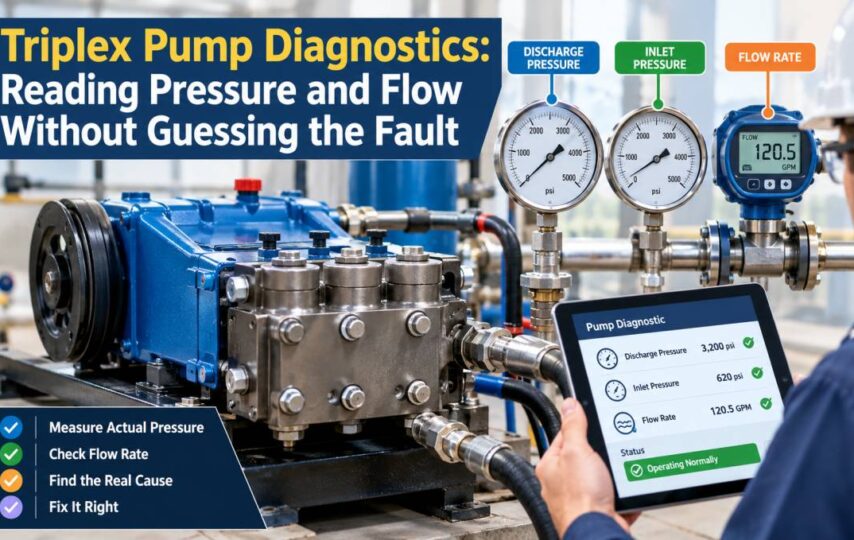

A pressure trace begins to wander and a monitoring system labels the event “pump wear.” That label may be premature. Pressure fluctuation can accompany inlet problems, a regulating fault or worn internal components. Flow diversion through a bypass creates another reason to ask where the liquid is going before blaming the pump.
For a triplex pump with ceramic plungers and forced lubrication, useful diagnostics begin with the hydraulic circuit and the operating state. More sensors do not automatically produce a better diagnosis. Their readings need a common context, a known measurement location and a way to check whether the instruments themselves are telling the truth.
Start with the reciprocating machine behind the trace
In a triplex plunger pump, sequential plunger motion draws liquid through inlet valves and pushes it through discharge valves. BBP describes ceramic plungers for its range and explains that the triplex arrangement smooths combined delivery compared with a single-plunger machine. Pressure fluctuation still needs interpretation; smoother delivery does not mean a completely flat trace.
Establish the local baseline. Use the installed system operating acceptably with its documented nozzle, speed and controls to distinguish expected behavior from a change needing investigation, rather than importing a trace from another pump whose piping, measurement position and working configuration may differ from the equipment under review. Record those differences explicitly.
Record the configuration with the data. Include the working tool, liquid condition and relevant control settings. Without that context, a later comparison can confuse a changed operating arrangement with deterioration. Begin fault analysis by asking whether the compared records describe the same task under comparable conditions.
Verify the pressure instrument before trusting the alarm
Cat Pumps includes pressure-gauge malfunction in its troubleshooting guidance and advises checking pressure with a working replacement gauge where appropriate. It also lists poor inlet conditions, a malfunctioning regulating device and worn seals or valves as possible reasons for fluctuating pressure. The signal is evidence of a symptom, not a unique fault code.
Locate the measurement physically. Document whether the gauge or transducer reads at the pump outlet or farther along the circuit, then verify it through the site’s approved method using equipment suitable for the service instead of assuming that an electronic display makes the measurement trustworthy. Never improvise a pressure connection.
When an instrument is replaced or its setup changes, retain that event in the trend record. A discontinuity caused by measurement work should not be interpreted as sudden pump recovery. Establish confidence in the measurement before tuning an alarm threshold around it.
Give every flow measurement a location
Cat Pumps’ unloader listings distinguish flow ranges and bypass connections alongside pressure limits. Those separate fields reflect a circuit with more to consider than pressure at the pump. A flow reading must identify which path it measures before it can explain useful delivery to a tool.
Name the measured path. Label whether a meter observes feed, discharge, bypass return or flow reaching the working process, and record the bypass state alongside it so that flow diversion is not mistaken for useful cleaning delivery simply because a plausible-looking value remains on the display. Location changes what a reading means.
Do not infer internal leakage solely from the difference between unrelated readings. Confirm that the measurements describe the same operating period and that their positions account for relevant branches. Where the installation lacks enough information, report the diagnosis as unresolved rather than filling the gap with an assumed component failure.
Interpret pressure fluctuation alongside inlet conditions
Restricted or collapsing inlet lines can starve a pump and produce low or fluctuating pressure, according to Cat Pumps. Its guidance also directs attention to clogged filters, air leaks and demand elsewhere on the supply line. Looking only at the discharge trace misses several plausible causes upstream.
Look upstream of the pressure fluctuation. Compare the event with tank level, supply activity and observed filter condition, using a recurring symptom when another process starts as a reason to inspect the shared feed against the pump’s inlet requirements rather than as proof that the other process caused the fault. Timing supplies a lead, not a verdict.
Keep starvation and component damage separate in the analysis. An inlet problem can explain a symptom and can also leave damage that remains after the supply is corrected. Restore suitable feed conditions, then evaluate whether pressure behavior and leakage return to an acceptable state under the approved test procedure.
Recognize flow diversion as a control question
Cat Pumps warns that regulating and relief devices must cover the system’s performance range and that contamination or worn internal parts can disrupt their operation. A pressure complaint can therefore involve a control device rather than the pumping elements themselves. Checking the valve’s identity and documented range belongs in diagnosis.
Mark the operating state. Associate each trend segment with spraying, permitted bypass operation or shutdown, and retain the relevant control events so an active delivery trace is not compared with a waiting-period trace as though the liquid followed the same route throughout the recording. A continuous line can conceal a changed circuit.
Where the expected response is unclear, obtain the package supplier’s description before changing settings. The correct bypass behavior depends on the selected equipment and circuit. Cat’s troubleshooting categories help organize questions; they do not authorize a particular adjustment on a different manufacturer’s assembly.
Distinguish nozzle wear from lost pump capacity
A worn nozzle is among the low-pressure causes identified by Cat Pumps. Its guidance warns against compensating by increasing the regulating setting because that can overpressurize the system. A falling pressure trend cannot establish lost pump capacity until the working restriction and controls have been checked.
Log the working tool. Keep nozzle identity and replacement history with the operating data because, in a cleaning circuit, the tool is part of the hydraulic configuration and a comparison that spans an unrecorded nozzle change can suggest pump deterioration where the operating arrangement actually changed. Preserve the context before interpreting the trend.
Inspect and replace the nozzle through the approved procedure, then compare operation in the documented configuration. If the symptom remains, continue the investigation with better evidence. Do not declare the pump healthy merely because a changed nozzle or pressure setting made the display look familiar.
Map monitoring channels to the parts they protect
BBP’s product page describes monitoring of lubrication and water-supply conditions, together with ceramic plungers, stainless high-pressure wetted parts and forced lubrication. These details suggest different questions for a monitoring plan: is the drive properly supported, is liquid available, and does the pumping end remain in acceptable condition?
Confirm what the delivered package actually measures and how each alarm behaves. A low-supply indication does not directly measure plunger wear. Likewise, a lubrication alarm addresses a different problem from a clogged feed filter. Keep those distinctions visible to the people interpreting the display.
Use the manufacturer’s limits and commissioning records for alarm decisions. A product page introduces available features; it is not a complete control specification. Ask for the applicable channel descriptions, settings and response instructions before treating an alarm as proof of a particular mechanical defect.
Use model-specific information to close the evidence gap
The information for BBP triplex plunger pumps distinguishes compact and heavy-duty configurations and describes forced lubrication alongside selection for the requested operating duty. A diagnostic baseline must follow that actual configuration, including drive, liquid conditions and pressure-flow requirements, rather than treating every triplex machine as interchangeable.
Make the event record readable. Send the supplier the operating state, verified measurements and maintenance history together with the changes preceding the fault and the checks that ruled out alternative explanations, so the reader does not have to guess at units, measurement locations or tool identity from an unexplained data export. Include the missing evidence too.
Request a response tied to the installed model: the next inspection, the relevant acceptance criteria or the component that needs examination. That produces a testable decision. A general assurance that the machine is heavy duty adds little to a fault investigation.
Turn a trend into a bounded maintenance decision
Cat Pumps separates low pressure, pulsation, seal problems, unloader trouble and lubrication issues into troubleshooting categories. Their overlapping causes explain why a dashboard should support an investigation rather than pretend that every pattern identifies a unique failed part.
State the observed symptom, the conditions under which it appeared and the checks already completed. Then distinguish confirmed defects from plausible causes. Schedule the next inspection to resolve a specific uncertainty, using the maker’s procedure and qualified personnel. Do not run a damaged or inadequately supplied pump merely to collect a longer trace.
Retain the evidence after correction. Compare operation in the relevant approved configuration, with measurement locations, timing and operating state understood, so the maintenance decision addresses the original pressure fluctuation rather than merely showing that a dashboard returned to a familiar value under different conditions. Leave uncertainty visible where the measurements cannot settle the cause.