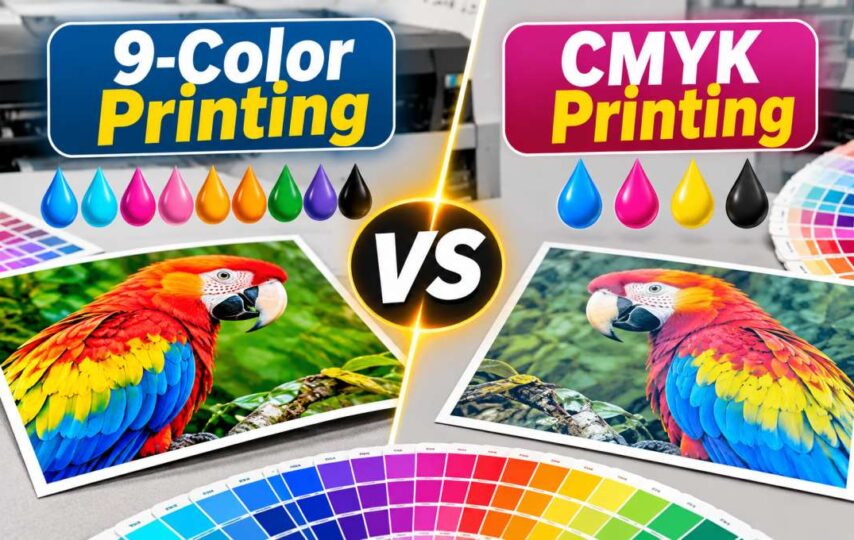

Color accuracy plays an important role in digital printing, especially when reproducing detailed artwork and complex designs. Traditional CMYK printing uses four process colors, while 9-color systems introduce additional ink channels to expand the range of reproducible colors.
Understanding these differences helps designers and businesses choose the right printing technology for their projects.
What Are CMYK and 9-Color Printing?
CMYK and 9-color printing are two approaches to reproducing digital artwork using physical inks. The main difference is the number and type of ink channels, which influence color gamut, tonal transitions, and print reproduction.
CMYK Printing
CMYK stands for cyan, magenta, yellow, and key (black). These four inks are combined in different proportions to reproduce a wide range of colors. CMYK remains a standard printing process for commercial printing, packaging, and many digital textile applications.
9-Color Printing
Nine-color printing uses additional ink channels beyond the conventional four-color process. Extended-gamut printing can reproduce certain colors that are difficult to achieve using CMYK alone. The exact results depend on the ink configuration, printer, substrate, and color management system.
Key Differences Between CMYK and 9-Color Printing
| Feature | CMYK Printing | 9-Color Printing |
| Ink channels | Four process colors | Nine ink channels |
| Color gamut | Standard process-color range | Potentially wider color range |
| Vibrant colors | Limited by CMYK gamut | Can reproduce additional saturated colors |
| Gradients | Depends on printer and processing | May offer improved tonal reproduction |
| Fine details | Depends on resolution and equipment | Depends on resolution and equipment |
| Color management | Standard CMYK profiles | Requires profiles for the specific ink system |
| Equipment complexity | Generally simpler | More complex ink configuration |
| Typical applications | Commercial and textile printing | Specialized digital printing and apparel decoration |
How Does 9-Color Printing Improve Color Reproduction?
Additional ink channels allow printers to reproduce colors that may fall outside the range of conventional CMYK systems. The benefits depend on the artwork and printer configuration, rather than the number of inks alone.
1. Wider Color Gamut
Every printing system has a limited range of colors it can reproduce. Additional inks can expand this gamut into areas that standard CMYK cannot accurately reach. This is particularly useful for artwork containing highly saturated colors.
2. Better Reproduction of Vibrant Colors
Bright oranges, greens, and certain other saturated shades can be challenging for standard CMYK systems. Extended-gamut inks may reproduce these tones more accurately when the printer includes suitable additional color channels. The improvement depends on the original artwork and the capabilities of the printing system.
3. Smoother Color Transitions
Gradients require a printer to create gradual changes between different tones. Additional ink options can improve certain transitions by giving the color management system more combinations to work with. However, resolution, screening, and software settings also affect gradient quality.
4. Improved Color Matching
Businesses often need consistent colors across logos, promotional products, and branded clothing. A wider color gamut can help reproduce difficult brand colors, provided the artwork is prepared and profiled correctly. It does not guarantee an exact match across different fabrics or printing methods.
5. Greater Flexibility for Complex Artwork
Detailed illustrations may contain multiple shades, subtle transitions, and saturated highlights. Extended-gamut printing offers additional color possibilities for reproducing these designs. Fine-line sharpness still depends primarily on resolution, artwork quality, and the transfer process.
6. More Options for Digital Textile Printing
Modern direct-to-film printing systems can use different ink configurations depending on the equipment. Products such as 9 Color DTF Transfers demonstrate how expanded ink configurations are being applied to apparel decoration. These transfers allow compatible designs to be printed on transfer film before heat application to fabric.
Why Is CMYK Still Widely Used in Printing?
CMYK remains an important printing standard despite advances in extended-gamut technology. Its established workflows and broad equipment compatibility make it practical for many commercial and textile printing applications.
1. Established Printing Technology
CMYK has been used in commercial printing for decades. Printers and designers understand its capabilities, making it easier to prepare artwork and manage production. Many design applications also support CMYK-based workflows.
2. Suitable for Everyday Designs
Not every design requires an expanded color gamut. Simple graphics, text, and many standard illustrations can be reproduced effectively using CMYK. Additional ink channels may offer little visible benefit when the artwork already falls within the standard gamut.
3. Familiar Color Management
CMYK workflows commonly use established ICC profiles and printing standards. Color management helps control reproduction across compatible devices and materials. Accurate results still require suitable profiles, calibration, and proofing.
4. Broad Equipment Availability
Many commercial and digital printing systems support CMYK. The availability of compatible equipment gives print providers several production options. This can be useful when businesses need printing services from multiple suppliers.
5. Simpler Ink Configuration
Four-color systems generally require fewer process-color channels than nine-color configurations. A simpler ink arrangement can reduce maintenance complexity, although actual operating costs depend on the equipment. Additional channels introduce more components that require monitoring and calibration.
6. Practical for High-Volume Production
CMYK can support efficient production across many established printing technologies. Its suitability for large print runs depends on the equipment, job requirements, and production workflow. Nine-color systems are not automatically slower, but they may require more specialized setup and management.
When Should You Choose 9-Color Printing Instead of CMYK?
The right printing method depends on the artwork, desired appearance, and available equipment. Nine-color printing is most useful when additional color reproduction capabilities provide a meaningful advantage.
Consider the following factors before choosing a printing process:
- Artwork colors: Check whether the design contains colors outside the standard CMYK gamut.
- Brand requirements: Determine whether particular colors need close reproduction.
- Gradient complexity: Evaluate designs containing subtle transitions or saturated blends.
- Printing material: Consider how fabric, paper, or other surfaces affect color appearance.
- Production quantity: Compare costs and availability for the required order size.
- Artwork preparation: Use suitable image resolution and color profiles.
- Proofing: Request a sample when color accuracy is important.
- Budget: Compare the expected improvement with the additional production cost.
Does 9-Color Printing Always Produce Better Results?
A larger number of ink channels does not automatically mean every print will look better. Printer calibration, ink quality, color profiles, and substrate compatibility all influence the final result. A well-managed CMYK system can produce better results than a poorly configured nine-color printer.
Can 9-Color Printing Reproduce Every Digital Color?
Digital displays use light to create colors, while printers reproduce colors through inks on physical materials. Some screen colors remain outside the printable gamut, even with additional ink channels. Designers should use appropriate soft proofing and physical samples to understand these limitations.
Is 9-Color Printing Suitable for Custom Apparel?
Extended-gamut printing can be useful for apparel designs containing saturated colors, detailed illustrations, or complex gradients. DTF printing adds another consideration because the image is transferred onto fabric, which can influence the final appearance. Fabric color, transfer quality, pressing conditions, and finishing all affect the result.
How to Prepare Artwork for Accurate Color Printing
Good artwork preparation matters regardless of the printing system. A consistent design and proofing workflow helps reduce unexpected color differences between the screen and the finished product.
- Use high-resolution artwork: Prepare images at an appropriate resolution for the final print size.
- Preserve original files: Keep editable source files for future adjustments.
- Check color profiles: Follow the print provider’s recommended file settings.
- Avoid unnecessary conversions: Repeated color-space changes can alter artwork.
- Review gradients: Inspect smooth transitions for banding or unwanted changes.
- Confirm print dimensions: Prepare the design at the correct physical size.
- Request samples: Test important colors before placing large orders.
- Follow supplier instructions: Use the required file format and transfer application settings.
Conclusion
CMYK printing uses four process colors, while nine-color systems introduce additional ink channels to expand color reproduction possibilities. Extended-gamut printing can improve certain saturated colors and tonal transitions, but results depend on the equipment, artwork, and printing conditions. CMYK remains effective for many everyday applications. The best choice depends on the colors a design requires, the material being printed, and the level of accuracy needed.