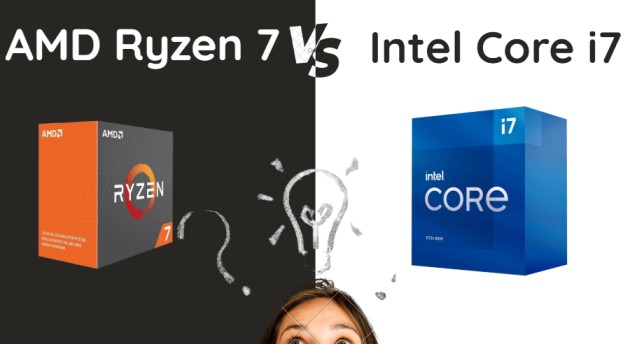

If you need a powerful computer that can manage most tasks with ease, two leading options are the AMD Ryzen 7 and Intel Core i7. Both deliver strong results without the high prices of top-tier models. While they don’t belong to the most elite range, they still offer more than enough strength for most users. Choosing between them can be difficult, and that is understandable. This article aims to explain the differences clearly, looking at speed, energy use, cost, and overall performance.
When placing the AMD Ryzen 7 beside the Intel Core i7, it becomes clear that they perform at similar levels. Yet your specific needs will guide the better choice. For gaming, the Ryzen 7 holds an edge since its larger cache gives smoother results in many titles. On the other hand, if your focus is on heavy workloads like editing videos, or if you want to push your system’s limits through overclocking, the i7-12700K is likely the more suitable pick, thanks to its extra cores and tuning potential.
AMD Ryzen 7 vs Intel Core i7: Speed & Power Comparison
When comparing the Ryzen 7 and Intel Core i7, it is plain that both perform well in games and tasks that demand strong graphics. The Ryzen 7 comes with eight cores and can reach a boost speed of 3.80GHz. The Intel i7-12700K, though slightly lower at 3.6GHz, remains more than capable for most purposes.
Pushed beyond their base limits, both the Intel i7 and AMD 5800X can rise to a maximum of 4.7GHz. However, Intel’s i7-12700K carries an extra advantage in its Turbo Boost Max 3.0, allowing it to climb to 5.0GHz under certain single-threaded loads.
Both chips can be overclocked, meaning that their true performance may go well beyond what standard figures suggest. In the end, though, Intel continues to hold a slight edge over the Ryzen 7, especially in tasks that reward raw clock speed.
AMD Ryzen 7 vs Intel Core i7: Which CPU Handles Editing Better?
The AMD Ryzen 7 line is a competent and reasonable option, in case you work with photos or video editing. Independent creators and designers tend to prefer it, as it has a stable performance and a reliable build. Ryzen 7 can handle large files and heavy tasks very well, and it can even beat most of the other processors in its category. It has a large core count and good output, which makes it suitable to edit high-definition content.
It provides effective consistent results whether using 4K footage or detailed imagery. It also multitasks a number of tasks without straining much and this makes it an easy experience even when under pressure. The Ryzen 7 is real value in terms of cost. It provides good performance at an affordable cost and is a smart option to consider when you require power and have to keep a tight budget. It is economical in terms of energy consumption; it remains cool and efficient despite long working hours.
This feature is particularly handy to those who spend long durations using their machines. It is constructed to perform contemporary editing software without any hassle and is prepared to handle the future tasks. Combined with a good graphics card, it is not only an editing tool, but also a game and 3D tool. The Ryzen 7 is difficult to ignore by any person who is assembling a custom build with a small budget and big expectations. Its price and performance combination makes it one of the most feasible ones.
Which Processor Saves More Battery?
When it comes to battery life, the Ryzen 7 holds a clear lead over the Intel i7. It consumes less power, drawing no more than 100 watts even under heavy workloads. This lower demand on energy allows it to run for as long as sixteen hours on a single charge, though actual time will vary depending on how the machine is used.
Though the Intel i7 can outperform the Ryzen 7 in select areas, the latter stands ahead in several crucial respects. It stays cooler, needs less power, and as a result, its battery lasts longer. On top of that, the Ryzen 7 is usually offered at a lower price, making it a better investment for many. That said, heat remains a concern, particularly during long or intense sessions. A fuller examination of thermal performance will follow.
AMD Ryzen 7 vs Intel i7 for High-Performance Gaming
The Core i7-12700K gives a stronger showing in games than the Ryzen 7 5800X. Thanks to its hybrid core system, it can divide its tasks between performance and efficiency cores, allowing for smoother play and quicker response. This structure sharpens its strength in demanding titles.
In fact, the i7-12700K’s performance in games is nearly on par with the higher-priced Core i9-12900K. The two match closely when it comes to performance cores, though the i9 has an edge in managing background operations with its greater efficiency core count.
Cost Breakdown & Affordability
If you are familiar with the cost of the earlier Core i7-11700K, you will not be surprised to learn that the new i7-12700K is priced at roughly ₹41,000. In contrast, the AMD Ryzen 7 5800X comes in at around ₹32,000 and is widely available, often for less than its Intel counterpart. This makes the Ryzen 7 the more sensible choice for those who are looking at cost alone.
Neither chip includes a cooling unit, which means you must buy one separately unless you already have a suitable model. And if you intend to overclock, investing in a stronger cooling system will give better results. Fortunately, both processors are currently easy to find, and there is little concern that they will vanish from the shelves anytime soon.
Final Words
Choosing between the AMD Ryzen 7 and Intel i7 is no simple matter. It depends chiefly on what you value most. On the matter of performance, if your focus is multitasking or creating digital content, the Ryzen 7 will serve you better. But for single-threaded software or games, the Intel i7 holds the advantage.
In terms of cost, the Ryzen 7 is the more affordable of the two and gives better value for money. As for compatibility, Ryzen chips make use of AM4 sockets which are widely supported and likely to last. Intel’s i7, however, relies on LGA1151 sockets, which may limit your choices. In the end, the decision rests on your own needs. What you value most, peed, price, or future-proofing, will guide the choice.