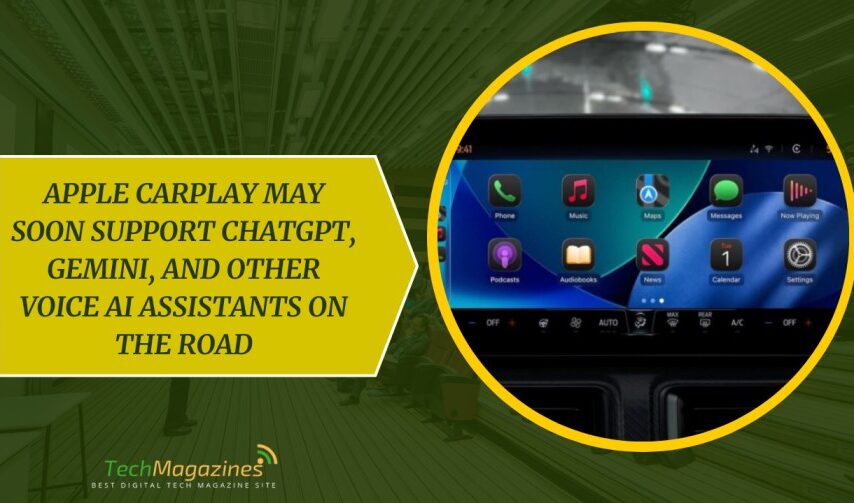

Apple is reportedly about to make a minor yet significant change to the regulations that govern CarPlay. Individuals familiar with the project report that it is planned to allow external artificial-intelligence applications, which are voice-controlled, to run directly in the system. Should this materialize, this would enable conversational devices that are not created by Apple to speak to the drivers via the car display and speakers, which has not been permitted before.
Hitherto, Siri has been the only person who can listen to the driver and respond, the only voice that is supposed to be heard. Allowing other AI models to participate would expand the range of requests that drivers can make: what to eat, a brief description of a query, or even general advice, and all of these would be provided by voice and without the necessity to touch a phone. According to those who are conversant with the schedule, the expansion might be available in the coming months. Apple, on the other hand, has not provided any assurance.
Apple’s Plan to Retain Core Control Over the Experience
Bloomberg’s Mark Gurman was tipped that Apple intends to keep a firm hand on the essential points of control. The familiar word that summons Siri, and the button that calls it into action, are not to be handed over. Drivers, in other words, will not be able to substitute another assistant in Siri’s place or awaken it by a different command.
Those who prefer an outside voice assistant will have to begin by opening its application. Developers are expected to design these apps so that, once launched, they slip at once into a listening state, reducing the effort required for routine use and making the exchange feel less deliberate than it truly is.
For years, CarPlay has functioned as Apple’s intermediary between the iPhone and the automobile, overseeing calls, messages, maps, and music. Siri has managed most of the spoken exchanges within this system. Yet a growing number of users have turned to newer forms of artificial intelligence, drawn by answers that range more widely and adapt more readily to the questioner.
Until now, using such tools on the road has meant resorting to awkward arrangements: speaking to a chatbot on the phone itself, passing the sound through the car’s speakers, or setting up manual shortcuts. Direct support within CarPlay would remove the need for these small improvisations and replace them with something closer to a settled routine.
Apple’s Parallel Efforts to Reinvent Siri
Although even a cautious opening of CarPlay’s boundaries carries some weight, Apple has not abandoned its own efforts to reshape Siri. The company is said to be testing a feature known internally as “World Knowledge Answers,” intended to widen Siri’s reach by drawing in information from the web and presenting it in condensed form. The idea closely resembles the appeal of modern chatbots, and the improvement is expected to appear before the year is out.
Recent Design Changes and the Arrival of CarPlay Ultra
CarPlay itself has not stood still. Its most substantial recent change arrived with iOS 26, which introduced a cleaner arrangement of widgets and a polished visual style described as “Liquid Glass.” Alongside this, Apple unveiled CarPlay Ultra, a more ambitious version that reaches further into the car’s systems, allowing drivers to adjust temperature, seating, and other settings from within Apple’s own interface.
Yet CarPlay Ultra has advanced slowly. Each manufacturer must tailor it to its vehicles, a requirement that limits how quickly it can spread. Aston Martin has already adopted it, and a model from Kia or its parent company, Hyundai, is expected to follow later in the year.
Why Standard CarPlay Remains Nearly Ubiquitous
Ordinary CarPlay, however, is everywhere. For many buyers it has become a basic expectation rather than a luxury. Even Tesla, which has long resisted Apple’s presence in its cars, is reported to be preparing support for the system in future models, a sign of how difficult it has become to remain outside its reach.
Final Words
So Apple is reluctantly opening the gates of CarPlay, but just a crack. Siri is still the bouncer, the doorman, the house band, yet competitors are fighting to be in the backseat. It is a cautious tradeoff: Apple does not ignore the fact that drivers desire smarter voices, but not to give up the kingdom. Whether this gambit will please anybody is yet to be determined.
The limitations will be complained by power users. The question that will be raised by the Apple loyalists is why the change was necessary. At this point, the history of CarPlay is still being written, one cautious software update at a time, always fashionable, sometimes obstinate and always uniquely Apple.