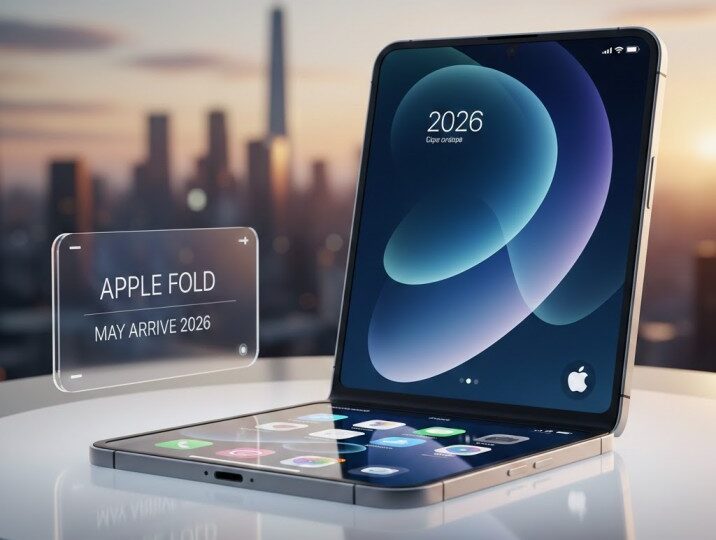

Although Samsung and Google now stand at the forefront of foldable phones, Apple has moved more slowly, almost as if watching from the sidelines. Yet the company is neither idle nor indifferent. Reports suggest that work on its first foldable handset is well underway. Speaking recently, respected analyst Ming-Chi Kuo offered a clearer view of when the device might reach the market and what features we may expect from it.
Apple’s Hardware-Led Comeback Plan Gains Momentum
Kuo argues that Apple, conscious of falling behind in artificial intelligence, hopes to regain momentum through striking hardware advances. The iPhone Air, launched earlier this year, is said to have disappointed in sales. In response, Apple has altered its plans: development of the next Air model will slow, while resources are being channeled toward the foldable iPhone with greater urgency.
Kuo remarked that Foldable iPhones are planned for next year. “Despite rumors of a delay until 2027, our industry surveys from the past few weeks indicate that Apple has not changed its original goal,” he said.
Revised Manufacturing Plans Point to 2026 Reveal
Apple had first intended to bring the next iPhone Air to market in late 2026, followed in due course by two Pro variants and a foldable model. Yet internal forecasts have changed. Production estimates, once set at eight million units for the current cycle, have fallen to under six million for the incoming Air. Thus the company has moved its launch to 2027, freeing time and labor for work on the foldable iPhone, which is now rumored for a public unveiling in the autumn of 2026.
Kuo warned, however, that an announcement does not mean plentiful stock. Early output is expected to be modest, and the hurried timeline suggests that full-scale production may not begin until well after its first appearance. It is even possible that certain features remain undecided, still passing through design rooms and testing benches.
Foldable iPhone Positioned as Apple’s Most Advanced Device Yet
Kuo expects the foldable iPhone to stand in the uppermost tier of Apple’s catalogue, built as a luxury item rather than a device for the masses. He estimates that its price will climb well beyond $2,000, close to Rs 1.80 lakh, and that the handset will measure near 9.2 mm when open, with only a fraction more thickness when folded.
Apple’s push toward a folding design, he says, is not merely about novelty. The firm imagines a future in which artificial intelligence sits at the center of personal computing, and believes that broader screens will serve as the natural vessels for such systems. These displays are expected to offer the space needed for multimodal processing and on-device AI, making the foldable phone a platform on which the company may test its next great ambition.
Final Words
So Apple, the one that gave us years of waiting before it kindly gave us USB-C on our iPhones, is now scrambling to keep up in the foldable market. It could be described as fashionably late, but that would be a stretch to say that fashionably is generous when Samsung is already on its sixth generation. The actual question is not whether or not Apple can make a phone that bends, but whether the consumers will bend over backwards to spend Rs 1.80 lakh to be beta testers.
To refer to it as an AI carrier is, as it were, to refer to a Ferrari as a commuter car, which is technically correct but grossly naive in terms of its practicality. Nevertheless, as history has shown us, Apple is good at showing up late at the party and making everyone believe that they made it.