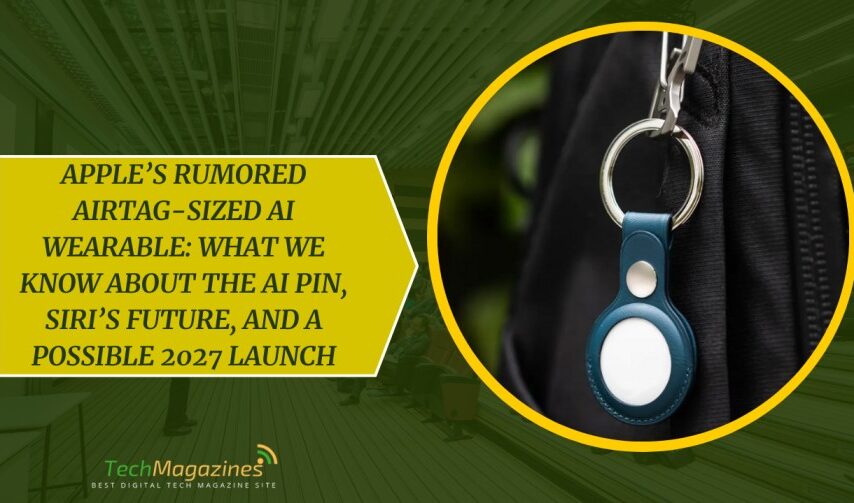

Apple is reportedly working on the idea of a small wearable device driven by artificial intelligence, one that would quietly register the sights and sounds around its user. According to The Information, the object would be compact, comparable in size to an AirTag, and built in a thin, flat, circular form, using a mix of aluminum and glass for its outer shell.
The report suggests that the device would be equipped with two cameras, one intended for ordinary use and another with a wider field of view, as well as three microphones. A speaker would be built in, alongside a physical button on the side, and the device would recharge wirelessly. The project is said to be at an early and uncertain stage, though it could reach the market around 2027 if development continues.
These plans appear to fit into a larger shift in Apple’s thinking about artificial intelligence. The company is said to be working with Google to make Siri more adaptive and individually tailored in the months ahead. At the same time, Bloomberg reports that Apple intends to recast its voice assistant as a conversational AI system, embedded across the iPhone, iPad, and Mac, with these changes expected to arrive later this year, possibly in September.
The Wearables Race: AI Everywhere, But Not Always Successful
Many companies are now threading artificial intelligence into familiar wearable objects like glasses, watches, headphones and hoping to make them seem more attentive and more useful. At the same time, a smaller group has attempted to build devices devoted almost entirely to AI itself, with mixed and often disappointing results. Humane, for instance, abandoned its AI Pin after it failed to justify its promises. OpenAI, working alongside former Jony Ive, is also said to be developing an AI-focused device, though little is known about it beyond speculation.
Why an AI Pin Doesn’t Feel Like a “Very Apple” Move
Rumors about Apple often arrive with a sense of anticipation, the assumption being that the company will eventually reveal something careful and well considered. The idea of an Apple-made AI pin, however, produces the opposite reaction. It is puzzling rather than intriguing, and it carries an air not of confidence but of haste.
Apple has long been known for entering new product categories late, and then only after shaping them into something coherent. Yet in this case, it appears to be pursuing the outline of an idea rather than a proven need, seemingly influenced by an unreleased device from OpenAI.
This is strange, given that OpenAI has not yet demonstrated the ability to ship consumer hardware, and that its prominence in AI arose more by circumstance than by design. It is stranger still when one recalls the swift collapse of Humane’s AI pin, a product that struggled to function and seemed unnecessary even before it failed. In that light, the notion of Apple following the same path feels less like strategy and more like unease.
Competitive Pressure Is Mounting From Meta, Google, and the Smart Glasses Boom
Apple has little appetite for further public missteps in artificial intelligence, particularly after the postponement of its long-promised Siri overhaul and the muted, sometimes faulty, arrival of Apple Intelligence. Pressure does not come from one direction alone. Beyond OpenAI, there is competition from Meta’s Ray-Ban smart glasses, which place the company’s AI at the center of their appeal.
There is also the less defined but persistent threat of whatever AI hardware Meta may attempt next, especially in the wake of job cuts in its virtual reality division. Google, for its part, has yet to produce much of substance from Android XR, an effort to project its Gemini AI quite literally onto the user’s face, though Samsung’s Galaxy XR suggests at least a tentative beginning. More recently, demonstrations of Google’s experimental AR glasses and Xreal’s Project Aura have shown ideas that appear both workable and persuasive.
Do People Really Need Another Siri Device When They Already Have iPhone, AirPods, and Watch?
If Apple’s proposed AI pin is meant chiefly as another channel for Siri, it is fair to ask what real advantage it would offer over tools people already carry. An iPhone, a pair of AirPods, or even an Apple Watch can already perform much the same role. Apple is said to have abandoned plans to place cameras in the watch, and Bloomberg reports that the company is instead concentrating on developing its own smart glasses in the near term.
Yet it requires little imagination to see how more capable hardware could allow the watch itself to handle a greater share of Siri and AI tasks. Even now, it functions with notable independence: users can ask simple questions, open apps, and listen to music without an iPhone nearby. Models with cellular support go further still, managing calls and messages on their own. In this context, the need for yet another intermediary device is not self-evident.
The Real Problem: The “AI Pin” Concept Still Hasn’t Proved Itself
At its most generous, an Apple AI pin would amount to little more than a convenient shortcut to Siri for those unwilling to wear an Apple Watch, insert AirPods, or keep an iPhone close enough to answer a call. Yet those existing devices, whatever their limits, justify themselves by doing many other things besides relaying voice commands. The same can be said of Meta’s Ray-Ban glasses and the smart eyewear that is likely to follow. Even without their AI features, they remain useful objects: they play music, handle calls, and, for many people, serve the simple purpose of helping them see.
Although The Information notes that Apple’s AI pin may never reach the market, its eventual appearance would hardly be shocking. This is, after all, the same company that turned to OpenAI merely to give Siri a modest impression of improvement with the launch of Apple Intelligence. Rather than relying solely on its own models, Apple is also said to be placing its faith in Google’s Gemini to drive Siri’s major AI transformation and to underpin its future foundation models. In matters of artificial intelligence, Apple appears willing to go to considerable lengths to avoid being cast as slow or behind the curve, and to shield itself from further unease in the markets.
Final Words
The firm that has led us to reconsider phones, tablets and watches now seems to be preparing to pursue a trend that has already face-planted with a spectacular failure with Humane and its ill-fated gadget. Perhaps, Apple will show the cynics wrong and turn a dubious idea into something that cannot be done without.
More Likely, this pin will become the next addition to the long list of products that appeared to be inevitable until the moment when they were not, such as the Facebook phone. Until we get the smart glasses that could make sense, the strongest case in favor of an Apple AI pin is that it provides tech journalists with something to write about as we wait.