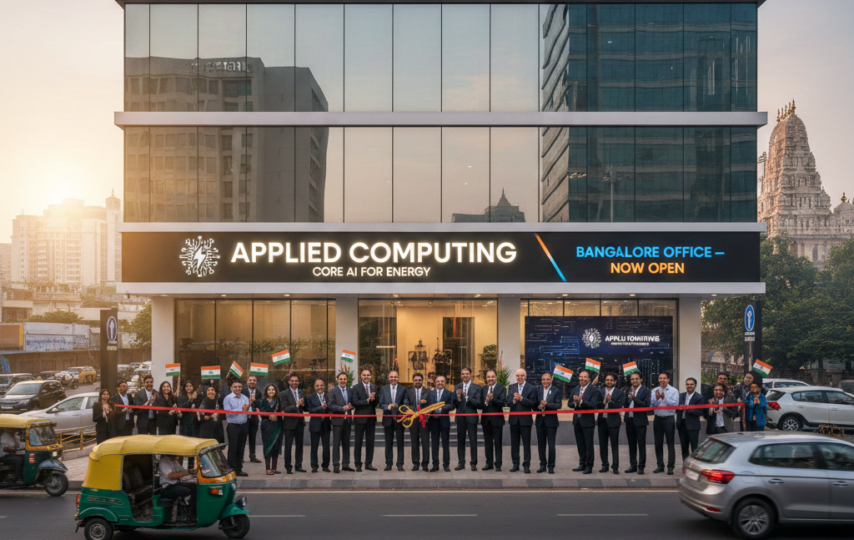

Applied Computing, a British company engaged in building core artificial intelligence systems for the energy sector, has announced the launch of a new office in Bangalore. The step marks the company’s formal entry into India and reflects a growing commitment to a market that has become increasingly important to the world’s energy future. As part of this expansion, the company expects to create fresh roles across AI research, engineering, energy modeling, and commercial functions.
Entering the Indian Market with Proven Momentum
The decision comes after notable momentum in India, where the company’s technology has already been tested in large refining settings and is now being rolled out with major operators. Its main platform, Orbital, is presented as the first foundational model designed solely for energy operations, applying physics-based intelligence to the optimization of some of the most demanding industrial systems in use today.
In parallel with this growth, Applied Computing has established a senior leadership base in India. Among these appointments is Dan Jeavons, a former Shell executive and a prominent figure in industrial AI, who moved from London to Bangalore several years ago. After joining the company earlier this year, he chose to continue living and working in India, underscoring the firm’s long-term focus on the region.
A Career Formed by Data, Analytics, and Energy Systems
Jeavons formerly directed Shell’s worldwide work in artificial intelligence and brings with him close to twenty years of experience across upstream operations, downstream activity, and integrated gas. I spoke with him to understand more about the country, the reasons it has begun to show real momentum where earlier ventures struggled, and how the company has approached its expansion into India.
He spent nearly two decades at Shell in a range of roles, consistently working in data and analytics. Over time, as the industry changed, this work naturally shifted into artificial intelligence, following the broader direction in which technology was moving.
For the past thirteen years, he led Shell’s central AI effort, and his final position there was Vice President for Computational Science and Digital Innovation. It was this background that made his decision to move on especially notable.
The Turning Point That Led to Orbital
What drew a long-serving Shell executive to Orbital was a meeting with Tukra, who had assembled a research group from Imperial and entered into partnership with Callum Adamson, the company’s chief executive, co-founder, and an Entrepreneur-in-Residence at Imperial. What convinced Jeavons, he said, was Orbital’s capacity to bring physics, time-based data, and language together within a single foundational model.
Why Early Industrial AI Fell Short
Industrial IoT, in practice, did not live up to the hopes placed in it. Most factories rest on machinery installed many years ago, bound together by closed protocols and systems where safety cannot be compromised. Linking these parts together was often difficult and expensive, and the cost of doing so rarely justified the return. Many projects were further weakened by uncertain and delayed results: heavy spending on sensors, connectivity, integration, and security produced only modest efficiencies, and so pilot efforts seldom grew beyond their initial trials.
At the same time, although IIoT created large volumes of data, organisations were ill-prepared to make proper use of it. The analytical tools required to convert raw information into clear decisions were not yet available, and effective outcomes depended on forms of artificial intelligence that had not been developed. Only in recent years, with the arrival of foundation models, edge computing, and intelligence built for specific domains, has it become realistic to reconsider how industrial systems might be organised.
Jeavons concedes that, during his own decade working on Industry 4.0 initiatives, data-led approaches tended to influence only the outer edges of operations rather than the core itself.
The Limits of Physics-Only Operational Models
Jeavons explains that most essential infrastructure is still run through simulations grounded in physics. These models are built at the design stage and continue to guide operations, because the systems themselves obey fixed physical laws. In this sense, the equations come first and everything else is expected to follow.
What this approach does not do, however, is make full use of the steady stream of data a plant produces each day. That information is collected, but it is usually set aside for investigating failures or tracing incidents after they occur. It remains fragmented and largely separate from day-to-day operations. Around the plant, different engineering teams work with their own portions of the data, drawing conclusions that operators might find useful but rarely see in a unified form.
A Unified Intelligence Layer for Industrial Operations
Orbital, he says, starts from a different assumption. It brings the physics of the simulator together with operational data of all kinds – not only numerical time-series, but also written material such as reports, work orders, and inspection records from years past. Jeavons likens the result to the relationship between an aircraft and its control tower, each incomplete on its own, but effective only when linked.
Rapid Transition from Experimentation to Live Deployment
From trial to full operation in less than a year, the company has moved with unusual speed. Still early in its life, it is already placing its systems inside live customer settings and reporting results that justify further rollout.
A second focus lies in how the technology is taken to market. The firm has brought in specialists with deep industry experience, on the view that building a powerful model is only the first step. The harder task, as Jeavons puts it, is to place it in real conditions, address the problems users actually face, and earn the confidence needed to widen its use within an organization. He regards his own role as a link between the technical work and industrial reality, shaping both the story and the manner of deployment so that the technology produces tangible effect.
India’s Energy Growth Creates a Unique Opportunity
This expansion comes at a moment of change in India’s energy system. While much of the world is pressed by policy to reduce emissions, India’s demand for energy continues to climb, driven by industrial expansion and a population that is still growing. In Jeavons’s assessment, India now stands as the fastest-growing energy economy in the world.
Why India Is Poised to Lead the Industrial AI Wave
India’s refining and petrochemical industries are expected to expand markedly in the coming years. Much of this sector depends on facilities that were built long ago, where carefully applied, AI-led optimization can produce results far greater than would be possible in newer systems.
At the same time, India has shown a notable readiness to adopt new technology and to apply artificial intelligence at the level of everyday operations. This willingness, combined with the scale at which such systems can be deployed, places the country among the most significant markets in the world for industrial intelligence.
Taken together, rising demand, intricate infrastructure, and a habit of technological trial create conditions well suited to Orbital’s approach, allowing it to deliver benefits across entire systems without delay. Alongside Jeavons, the company is joined by Hari Ramani, Vice President of Commercial Markets, who will oversee customer relationships and guide the development of its global market presence.
Final Words
The timing feels deliberate. Whereas western economies are anxiously considering the concept of degrowth and carbon footprint, India is merely expanding – period. Its old refineries, instead of being a liability, happen to be ideal laboratories to optimize AI. It is ironic that way: the more advanced and complicated your infrastructure is, the more an intelligent system must be able to work with. The question of whether Orbital will fulfill its high promises or not is yet to be answered.
However, Applied Computing has placed one bet very clearly: the future of industrial AI will not be coded in Silicon Valley boardrooms. It will be tested, installed and tested on the floors of Indian refineries, where the stakes, as well as the possible returns, are very real. What is evident though is the bet that Applied Computing has made. The next chapter of industrial AI will be tried on working plants, perfected by experience, and tried in such places as the refineries of India, where failure is expensive, and success rewarded.