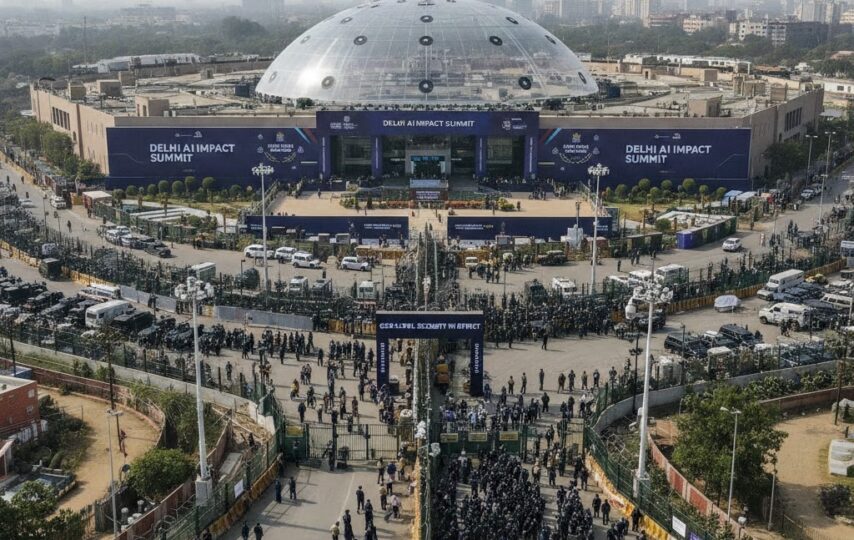


A security operation on a scale familiar from international summits is being readied for the five-day AI Impact Summit, which opens on Monday at Bharat Mandapam. Anti-drone equipment, large police deployments, and extensive traffic controls together form the outward shape of these preparations. Each of the ten hotels designated for visiting delegates will have close to a hundred police personnel assigned to it, while some five thousand traffic officers will manage movement across the city.
Airspace Defense and Counter-Drone Measures Strengthen Venue Safety
Officials say the venue itself will be protected by a layered air-defense arrangement, including five anti-drone systems intended to locate, pursue, and disable hostile devices as soon as they enter the airspace. Air-defense guns will also be stationed nearby. Comparable measures were put in place during the G20 leaders’ meeting held at the same site in September 2023.
The building and its surroundings will also be subject to constant electronic observation. More than five hundred CCTV cameras are to be installed, most of them fitted with analytical software that allows them to do far more than simply watch. These systems can identify faces and match them against a central criminal database, and can read vehicle number plates and compare them with records of stolen or suspicious cars. Surveillance, in this arrangement, is no longer confined to recording events after they happen; it operates continuously, sorting and judging information as it is gathered.
Intrusion Detection, Suspicious Object Tracking, and Real-Time Command Control
Further measures are being added to close what officials describe as the remaining gaps in security. Systems for detecting unauthorized entry and identifying unattended or suspicious objects are being introduced as part of this effort. Inside the venue, a small control room will function as the center of observation, watching for signs of irregular activity.
From here, operators will have access to every camera feed and the ability to alert police units at once, so that action can be taken without delay. In addition, between twenty and twenty-five anti-sabotage units, supported by bomb detection and disposal squads, will carry out regular and repeated security checks.
Bomb Disposal Teams, NDRF Units, and Continuous Threat Inspection
These teams have already begun a detailed inspection of the site, moving through every corridor and open space, as well as the surrounding area, in order to uncover and remove any possible threat. Five units of the National Disaster Response Force will be stationed on standby to respond to emergencies of any kind, with two more held back as reserves.
At the same time, arrangements are being made to prevent protests or demonstrations in the vicinity of the venue. Twenty-five mobile teams, equipped with wireless communication and transport, will be assigned to this task; if a gathering appears likely, they are to reach the location immediately and take the protesters into custody.
Delegate Accommodation Security Managed by Senior Police Officials
Officials said that visiting delegates would be lodged across ten hotels in and around the city. Each property will come under the charge of a senior officer of deputy commissioner rank, tasked with overall responsibility for security within the premises. To carry out this duty, roughly a hundred police personnel will be stationed at every hotel. Their work will include controlling entry and exit, keeping watch over movement inside the building, and ensuring that access remains orderly at all times, a source explained.
Student Assistance Measures During Exam Season Traffic Restrictions
Because the summit coincides with the school examination season, police have also been instructed to extend assistance to students who may be delayed by traffic restrictions or road closures. . “If students risk being late for their exams, cops will take steps to transport them safely and promptly to their respective examination centres. Nodal officers have been appointed to ensure smooth coordination and effective management of such situations,” a senior official said.
To manage the wider security and traffic demands of the event, about five thousand traffic police personnel will be deployed. According to additional commissioner of police (traffic) Dinesh Gupta, the department has added eighty-one vehicles, three thousand light bars, and two hundred and fifty wireless sets to reinforce traffic control operations.
Final Words
Delhi is organizing an AI summit where security measures are being made to indicate that the robots might be planning something. Five anti-drone systems, half a thousand cameras with facial recognition, and enough police officers to fill a small town, all to make sure that the discussion of artificial intelligence will go on without any accidents. It is ironic to say the least that such highly analog solutions are implemented to secure a meeting devoted to the digital future.
It is obvious to the would-be troublemakers: stay home. The students who are attempting to get to their exams are given a little more hopeful message: when the traffic is jamming your morning commute, at least you will have a police escort. It is yet to be seen whether the summit itself will yield breakthroughs in AI governance or just show that India is capable of hosting a highly secured conference. In any case, the drones will not be crashing this party.