
Advanced LED display technology has become one of the foundations of contemporary visual communication. It has changed the way brands, institutions, and public spaces convey messages and construct stories around them. In places as varied as immersive retail settings and large architectural surfaces, LED displays have proved their worth through strong illumination, adaptability, and durability – advantages that older display methods rarely offer in equal measure. This shift is visible in the work of companies like Nanolumens, which focus on made-to-measure direct-view LED systems rather than off-the-shelf solutions.
Products such as the Nixel Series are designed to create striking visual results while remaining firmly rooted in the practical demands of real, built environments.
Understanding Modern LED Display Technology
At its simplest level, LED display technology works by arranging light-emitting diodes in carefully ordered grids to form images and moving pictures. Unlike LCD screens, direct-view LED displays have no need for a separate source of backlighting. Each individual pixel produces its own light, which results in stronger contrast, greater brightness, and more reliable performance in both enclosed spaces and open air. When designed with care, this self-lit structure also means a longer working life and fewer demands for upkeep.
During the last ten years, steady improvements in pixel spacing, colour calibration, and manufacturing methods have made high-definition LED screens suitable for viewing at close range. Because of this, the technology has gradually left its old home of stadiums and roadside hoardings and entered quieter, more controlled settings like corporate reception areas, television studios, museums, transport terminals, and shops. These are all settings where clarity and consistency matter as much as scale.
The Shift Toward Custom and Architectural Displays
One of the clearer shifts in advanced LED display technology has been the move away from the neat, standard rectangle toward displays shaped to fit the buildings that hold them. More and more organizations now prefer visual systems that follow the logic of their space, instead of reshaping that space to suit a screen.
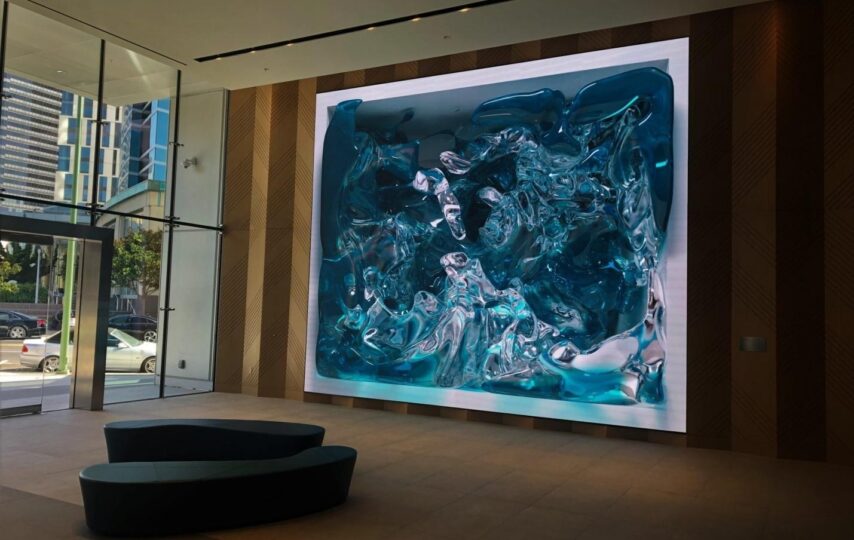
It is here that custom-built direct-view LED solutions become essential. With flexible panels, curved LED display, and mounting systems designed as part of the structure, displays can bend around pillars, trace long architectural lines, or rise across several floors at once. In doing so, LED screens cease to be mere devices for passing on information and become permanent features of the space itself, as deliberate and considered as the walls that surround them.
Nanolumens and the Nixel Series: Pushing Design Boundaries
Nanolumens has become one of the pioneers of this more design-oriented approach to thinking about LED displays. Its Nixel Series demonstrates how it is possible to go beyond what direct-view LED technology can do with careful engineering. The heart of this design is what the company calls its patented “True Curve” system, which is a method that enables screens to curve in a continuous and uninterrupted line and has had an impact on industry practice more than ten years. The outcome is a curved presentation with no visible joints, which introduces the possibility of forms that are hard to create using rigid panels.
The Nixel Series also allows more than just curvature: it can be configured with unusual geometry layouts, installations that rise across multiple stories, and even screens that display content on both sides. The characteristics render the technology particularly appropriate in locations where visual impression counts the most like flagship stores, immersive brand experiences, and high-profile architectural locations. All these are locations where a display has to be eye catching as well as informative.
Engineering for Real-World Environments
The high-end LED displays are not just supposed to create an immediate impression, but they should also be reliable to operate in a large variety of conditions. The light around, the air moisture, variations in temperature, etc. can all reduce the life of a display or undermine its performance unless they are taken into consideration. Nanolumens reacts to this fact by a series of technical improvements in the Nixel Series, which provide high-brightness choices in brightly-lit interiors, and protection against humidity and other more hostile conditions.
Another area of difference is the patented skin-and-frame topology of Nanolumens. This approach integrates the display surface and mounting structure into a system as opposed to viewing the screen and support as two distinct components.
Visual Communication Beyond the Screen
The technology of advanced LED display is not only about the equipment, but also about the manner in which images convey meaning. Direct-view LED screens with high definition provide intense color, consistent movement, and consistency in clarity across large areas which are characteristics that are conducive to narrative, data presentation, branding and navigation.
Such displays in public spaces can show live information in a format that is easy to read and difficult to overlook. They are used in corporate offices and cultural institutions to convey complex ideas in the form of moving images which are more attention-grabbing compared to fixed signs. Since LED systems are versatile, the content they present can evolve over time, which makes the display much more useful.
Quality, Longevity, and Total Value
The main issues in any sophisticated LED installation are strength and durability. The selection of materials, precision of production, and the rigor of testing are all involved in the assurance of stable performance in a span of several years.
Nanolumens lays special emphasis on this principle, where high-grade materials such as gold wiring are used, though there is always a choice that can be made to meet different financial constraints. This focus is supported by the Nixel-to-Pixel Warranty of the company, that lasts 6 years and is extended down to the level of a single LED.
Conclusion
Despite the fact that technology is at the heart of these systems, experience and collaboration are usually the keys to the success of innovative LED display projects. Nanolumens poses its position as a dedicated partner, collaborating with the clients at every phase of the process, starting with the initial idea and ending with installation and further maintenance. The result is an exhibit that has a great visual appeal but is reliable in day-to-day applications.