
Google is adjusting its Veo 3.1 video model in a manner that suggests greater discipline rather than novelty. The system is now required to attend more carefully to the reference images from which a video is supposed to be derived, reducing the gap between what is supplied and what is produced.
Google Veo 3.1 now creates vertical videos from images with improved consistency, marking a shift toward tighter visual control and more predictable AI-generated results. At the same time, the company is rolling out a series of visual refinements to its “Ingredients to Video” feature, first unveiled last year, while also extending support for vertical formats and adding tools that improve the sharpness and scale of generated footage.
How Reference Images Now Shape AI-Generated Video Outputs
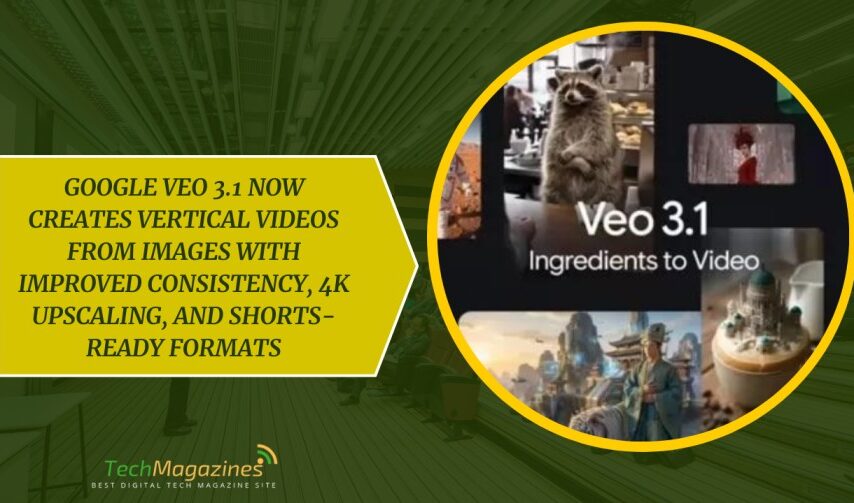
The Ingredients to Video feature allows users to build short videos from as many as three reference images. From these images, the model extracts its essential components like characters, settings, surfaces, and visual patterns, giving the user a firmer grip on the final appearance. Google claims that the revised system will result in work that feels more lively and inventive, with stronger dialogue and a clearer sense of story.
Fixing Visual Drift and Maintaining Consistency Across Scenes
More practically, the update aims to correct earlier inconsistencies. Veo 3.1 is now expected to preserve the appearance of a character across different scenes and conditions, and to allow the repeated use of objects, backgrounds, and textures without their gradually drifting into something unrecognizable. This improvement underlines why Google veo 3.1 now creates vertical videos from images with improved consistency
Native Vertical Video Support for Shorts-First Platforms
Clips produced through Ingredients to Video will now also appear in a vertical form. This change follows Google’s earlier decision, made last year, to allow developers to generate upright videos in Veo when working from text alone, without any visual references. Users may now choose a native 9:16 format, suitable for immediate posting on platforms such as TikTok and YouTube Shorts, rather than trimming the image later with separate editing tools. This workflow change reinforces how Google veo 3.1 now creates vertical videos from images with improved consistency
Deeper Integration Across Gemini, YouTube Shorts, and Creator Tools
At the same time, Google is introducing the updated Ingredients to Video system and its portrait-oriented features into the Gemini app, with the rollout beginning today. For the first time, these tools are also being built directly into YouTube Shorts and the YouTube Create app, bringing them closer to the spaces where the videos are meant to be used.
Upscaling to 4K and Refining Visual Clarity
The update also extends the technical limits of the model. Veo 3.1 can now enlarge its generated videos to a 4K resolution, an increase from the earlier ceiling of 1080p. Google adds that standard 1080p output has been refined as well, producing images that are cleaner and more precise. This is not the true 4K generation that Google suggested Veo might one day achieve in 2024, a promise that has yet to be fulfilled in any public release, but the ability to upscale within the platform is, at least, a practical improvement.
Final Words
The recent Veo improvements imply that Google has realized that glitzy claims about AI-generated video creation do not matter much when the resulting image looks like a fever dream instead of the image you took a lot of time to pick out. The move towards vertical formats is not really a matter of innovation but rather the recognition that the majority of people are watching video as they scroll their phones at 2 a.m. when they are likely to be asleep. The 4K upscaling, which is not a native 4K generation, as Google had previously hinted, is a kind of a consolation prize to those who are still awaiting that specific breakthrough.
Nevertheless, cleaner 1080p output and enhanced consistency of characters are truly beneficial features. Since Veo is built into YouTube Shorts and the Gemini app, Google appears to be betting that convenience will prove more important than state-of-the-art features. Probably, that is the correct choice to make by creators who are exhausted of their AI-generated characters turning into unrecognizable blobs in the middle of the scene.
FAQs
Q1: What is Google Veo 3.1’s “Ingredients to Video” feature?
Consider it as a recipe to create an AI video, only that in place of flour and eggs, you are adding up to three reference images. The system identifies characters, settings, and other visual objects in your photos and tries to bring them to life in a short video. Ideally, your character will not turn into an entirely different person halfway through, an issue that the previous versions apparently had issues with.
Q2: Why is vertical video support such a big deal?
Since no one watches videos in the usual way. We are all scrolling through Tik Tok and YouTube Shorts in portrait mode, phone in hand, and it is held like a digital security blanket. The new 9:16 native format of Google allows creators to omit the clumsy cropping process and instead go directly to the post, which fits the way people actually consume media.
Q3: What’s the difference between 4K upscaling and true 4K generation?
It is the difference between blowing a smaller image bigger and making something huge. Google has been promising real native 4K generation as early as 2024, which is yet to be seen. Rather, Veo 3.1 provides upscaling, i.e. using lower-resolution footage and refining it to 4K. It is not really a revolution as they promise, but it is much better than straining at blurry output.