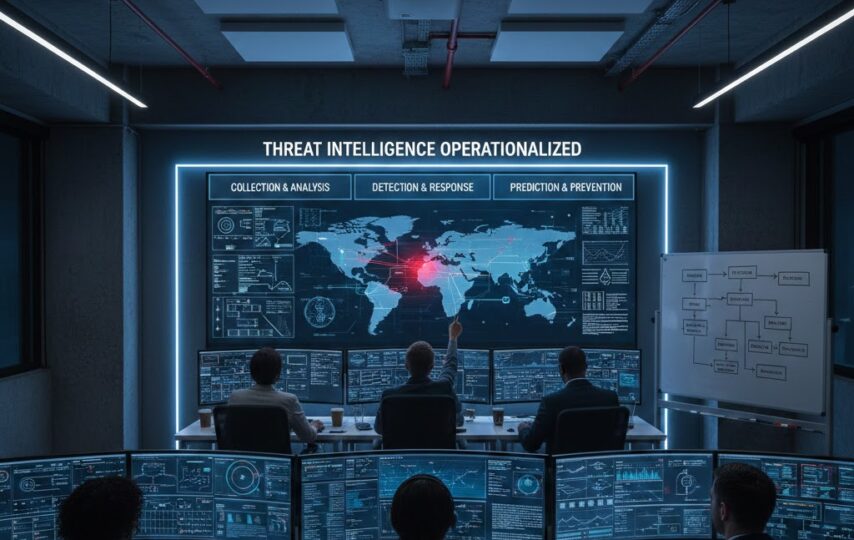

To operationalize threat intelligence means to convert raw signals into remediation work. Not briefings. Not reports. Tickets, detections, and configuration changes.
Most teams collect ample intelligence. Feeds run. IOCs accumulate. Analysts compile summaries. Yet exposure remains static. The friction is familiar: noise drowns signal, tools operate in isolation, and no clear mechanism maps external threats to internal assets.
This article describes a practical workflow. It focuses on execution, not acquisition. Teams that follow it spend less time curating intelligence and more time reducing risk.
Why Threat Intelligence Fails to Drive Action
The failure is operational, not informational. Organizations subscribe to premium feeds. They staff threat research functions. They generate daily threat briefings. None of this produces fixes.
Intelligence does not arrive as tickets. It does not specify which dependency to upgrade or which cloud resource exposes the organization. Engineers receive context-free indicators and are expected to infer the rest.
What “Operationalize” Actually Means in Practice
Operationalized threat intelligence produces concrete outputs. Detection rules deployed to SIEM. Blocklists updated at the perimeter. Patch decisions communicated to engineering. Remediation tickets assigned and tracked.
Actionable Outputs Security Teams Should Produce
Operationalization is observable. You know it works when intelligence consistently results in actions that reduce exposure. These actions should be repeatable, assigned to clear owners, and verified after completion.
Detection engineering consumes IOCs and behavioral indicators to update monitoring coverage. Vulnerability management receives prioritized intelligence about actively exploited flaws. Engineering teams get remediation tickets with specific upgrade instructions. Security validation confirms that implemented fixes actually mitigate the reported risk. Typical outputs include:
- Updated detections in SIEM and EDR;
- Prioritized patch and dependency upgrades;
- Risk-driven remediation tickets for engineering;
- Validation checks that confirm fixes actually reduce exposure.
The remainder of this article describes how to build the pipeline that produces these outputs consistently.
A Practical Workflow to Turn Threat Intel Into Remediation
The workflow should begin with intake but terminate with verification. Each stage requires a clear owner and a defined handoff. The loop runs continuously, not only during active incidents.
A 5-Step Operationalization Loop
The workflow design should prioritize speed and consistency. Intelligence ages quickly. Indicators observed today may be obsolete next week. Teams that take days to operationalize intelligence are not operationalizing it at all.
Collection normalizes intelligence from multiple sources into a consistent format. Enrichment maps generic indicators to specific organizational assets, technologies, and versions. Prioritization applies exploitability and business context to raw severity scores. Execution routes validated findings to engineering workflows through tickets or automated controls. Verification confirms remediation and feeds lessons back into the process. A practical loop looks like this:
- Collect and normalize intel from trusted sources;
- Enrich signals by mapping to assets and technologies;
- Prioritize using exploitability and business exposure;
- Execute actions through tickets, controls, and fixes;
- Verify impact and tune the process.
Most security organizations break down at enrichment and prioritization. They possess intelligence. They possess asset inventories. The two datasets never intersect.
Prioritization That Matches Real Risk
Prioritization fails when teams rely on raw severity scores. CVSS base scores describe intrinsic vulnerability characteristics. They do not describe whether the vulnerability is reachable, whether it is being actively exploited, or whether it affects your specific configuration.
Teams drowning in critical-rated findings often have minimal exposure to actual breach risk. The converse is also true.
What to Prioritize First
Effective prioritization requires a small set of criteria that both security and engineering teams understand and accept. The criteria should connect external threat intelligence to internal exposure and likely business impact.
Evidence of active exploitation in the wild elevates any finding regardless of its CVSS score. Presence in your stack, code, dependencies, or deployed workloads confirms the issue is not theoretical. External reachability and privilege impact determine worst-case consequences. Ease of remediation and availability of fixes influence sequencing decisions. A lightweight rubric includes:
- Evidence of active exploitation in the wild;
- Presence in your stack, code, or dependencies;
- External reachability and privilege impact;
- Ease of remediation and availability of fixes.
This rubric is difficult to apply when threat intelligence, vulnerability data, and asset context live in separate tools. Teams spend more time cutting and pasting than remediating.
How Aikido Helps Operationalize Threat Intelligence
Aikido functions as the execution layer between threat intelligence and remediation. It does not replace threat intelligence sources. It makes them operational.
The platform correlates intelligence feeds with what actually exists in your codebase, dependencies, secrets, and cloud environments. Generic indicators become specific findings. Theoretical risks become assigned tickets.
From Intelligence to Fixes With Less Triage
Operationalization succeeds when engineers receive fewer, higher-quality tasks that clearly connect to real exposure. This requires consolidating signals that currently arrive through disconnected tools.
Aikido ingests findings from multiple security domains and normalizes them into a single workflow. It applies reachability analysis and exploitability context to filter out findings that cannot be triggered in your specific environment. Automated triage removes manual classification steps. Integration with CI and ticketing systems routes verified findings directly to engineering teams. Practical ways Aikido supports operationalization include:
- Consolidates AppSec signals into one workflow;
- Highlights exploitable issues instead of noisy findings;
- Automates triage so engineers get clearer priorities;
- Connects remediation to CI and developer workflows.
This does not eliminate the need for threat intelligence sources. It ensures that intelligence, once acquired, reliably produces remediation work.
Choosing Threat Intelligence Inputs and Getting Started
Organizations new to operationalizing threat intelligence should resist the urge to purchase every available feed. Breadth without workflow yields noise without action.
Start with a small set of trusted sources that align to your technology stack and threat profile. Define clear owners for each stage of the operationalization loop. Measure time from intelligence receipt to ticket creation and from ticket creation to fix deployment.
Security teams often start by reviewing top threat intelligence tools to understand what inputs they can reliably operationalize.
This review helps teams distinguish between intelligence they can act upon immediately and intelligence that requires additional context. Begin with one or two sources. Establish the workflow. Expand coverage only after you can consistently close the loop.
Conclusion
Threat intelligence only matters when it changes what security and engineering teams actually do. Collection without execution is overhead.
Fragmentation remains the primary obstacle. Intelligence in one system, assets in another, remediation in a third. Teams that consolidate these functions reduce triage time and increase fix rates.
Aikido helps teams close the gap. Not by supplying intelligence. By ensuring that intelligence, once acquired, reliably results in remediated risk.