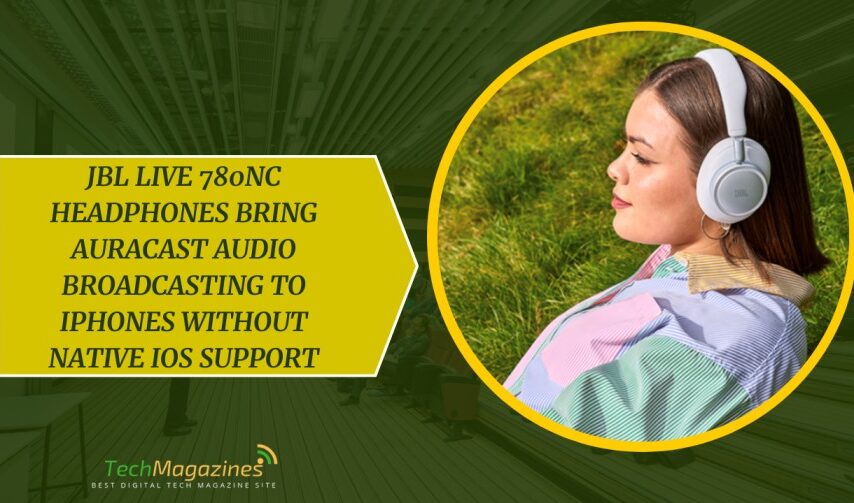

JBL’s Live 780NC over-ear headphones come with an innovative idea. Through its companion app, the company allows users to access Auracast broadcasts, which in practice brings the feature to iPhone owners even though Apple’s operating system still offers no native support for it. The approach is straightforward but shrewd: the headphones themselves take on the task of locating and managing Auracast streams, leaving the phone to play only a secondary role.
Auracast, a standard presented by the Bluetooth Special Interest Group as part of LE Audio, makes it possible for a single device to send audio to many listeners at the same time. The uses are easy to imagine such as television sound shared quietly across a gym, museum tours delivered in several languages, or a song passed around a small group of friends without the bother of pairing devices one by one. Apple’s iPhones already include Bluetooth 5.3 hardware capable of supporting LE Audio, yet the company has not enabled Auracast in iOS. JBL, for its part, has chosen to move ahead and fill that empty space.
App-Based Workaround Lets iPhone Owners Discover Auracast Streams
With the Live 780NC, JBL places Auracast discovery, and even the option to begin a broadcast of one’s own, inside its companion app. The method avoids the usual route through a phone’s Bluetooth settings, which on iOS reveal nothing about Auracast in any case. Rather, the app instructs the headphones to scan the air and find broadcasts nearby and connect to them. The outcome is a kind of simple workaround: the headphones perform the job themselves, and the iPhone user is not left standing outside the door.
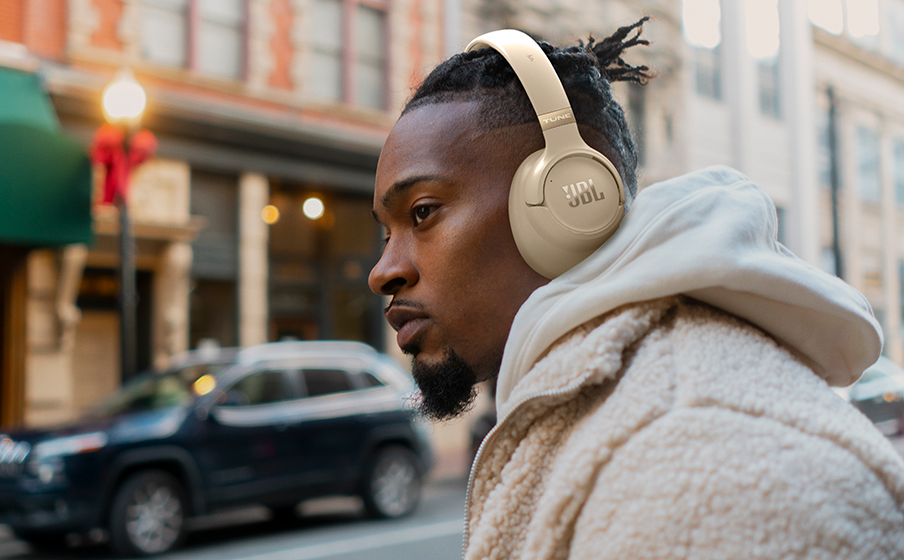
Other more recent models that are compatible with Auracast include Sony WH-1000XM6, Google Pixel Buds Pro 2, and Samsung Galaxy Buds 4 Pro, which will take the user through the phone system menus before accessing the feature. This setting is good enough on devices where Auracast is already known by the operating system.
On iOS, though, there is no road to it. JBL takes a different route and goes around the operating system altogether and puts the control in the easy reach of the app, regardless of which phone the user just happens to have in his or her pocket.
Previous indications have been given that an app-based strategy to Auracast would help in closing the platform gap. Another recent television-oriented offering by Sennheiser enabled iPhone users to search through local broadcasts using its own software as opposed to the phone.
The variant of JBL is different in one aspect: it is presented in a pair of everyday headphones, which also have active noise cancellation, sound adjustment tools, and better microphones. That way the feature is not confined to the living room, but goes wherever the listener goes.
How Auracast Could Transform Shared Audio in Public Spaces
The potential applications are spreading.
- Live commentary can be delivered to the listeners by public venues without special headsets.
- Gyms can transmit the sound from every TV set.
- A group of friends can share music in one device to a multitude of ears.
The Bluetooth Special Interest Group has already promoted the testing of the system in big open areas like arenas and transport centers, with Auracast being a kind of a shared wireless layer of sound, a concept similar to how Wi Fi is used to transmit data. The commercial drive of the technology is also getting more evident.
With the increasing number of platforms that are prepared to support Auracast, the next focus is on platforms that have not yet implemented the feature on an operating-system level. Another minor challenge is eliminated by JBL choosing to put control within its application.
It can be confusing to many users to manage Auracast using the settings of a phone even in systems where it is already in use. It is simpler and more straightforward to maintain discovery and connection within a well-known headphone application. It also implies that no additional transmitter is needed, but optional JBL SmartTx can be utilized to enhance audio of televisions and old devices.
JBL Live 780NC Features, Pricing, and Market Competition
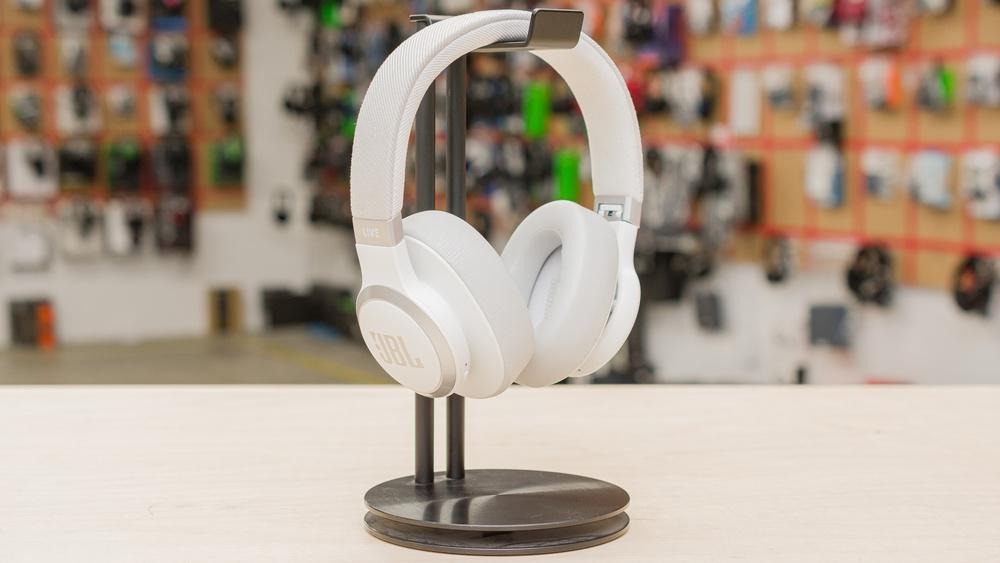
The JBL Live 780NC is in the upper mid-range line of the company’s products, and they come with a number of additions. The design is updated, Bluetooth has been enhanced, and the battery life has been extended compared to previous Live models. They also have adaptive noise cancellation, adjustable sound by a custom EQ, and better beamforming microphones that are designed to make calls sound better. The headphones are priced at approximately $250 and come in Blue, Green, Champagne, Black and White.
In the case of Apple, the issue has a broader meaning. It already offers a feature known as Audio Sharing between the Apple AirPods and some models of Beats that enables two listeners to listen to the same source. Auracast, though, takes the concept far further, expanding the concept of shared audio into open spaces and into devices made by other manufacturers.
Counterpoint Research has proposed that Apple gathers approximately a third of the worldwide income in the true-wireless audio sector. In case Auracast becomes widespread, the benefit of remaining in one brand ecosystem might be undermined, as other headphones might share listening and accessibility features, which work anywhere, even with an iPhone.
Android support for Auracast is also starting to be supported on recent flagship phones and newer televisions. This allows brands such as Sony, Samsung, and Google to depend largely on the operating system’s own menus to manage the feature. JBL’s decision hints at another strategy. By placing control inside its app, the company can offer much the same experience to iOS users at once, without waiting for the platform itself to catch up.
Early Limitations and What to Expect as Auracast Expands
This arrangement still depends largely on the quality of the firmware and the care taken with the companion app. The experience will stand or fall on small things: whether the headphones reconnect without fuss, whether public broadcasts are named clearly enough to recognise at a glance, and whether the LC3 audio codec holds its stability at a reasonable distance. The option to begin a broadcast from the app itself may sound impressive, yet the result will naturally differ with the kind of audio being sent and the conditions of the place in which it is used.
Even so, the general direction is plain. If more headphone makers choose to place Auracast controls inside their own apps, iPhone owners may no longer need to wait for support to appear at the operating-system level. That change could in turn encourage public spaces, from airports and stadiums to hospitals and universities, to install Auracast systems sooner. The more people who are able to listen, the stronger the case becomes for making the broadcasts available in the first place.
Final Words
Ultimately, the JBL Live 780NC does not seem like another set of noise-cancelling headphones, but rather an experiment of how audio ecosystems may be developed. JBL has successfully provided iPhone users with a backstage pass to a feature that their operating system continues to overlook by simply adding Auracast controls to its companion app. It is a smart reminder that innovation does not necessarily have to wait patiently until the platform is approved.
Naturally, the larger success of Auracast will be preconditioned by more practical specifics: stable connections, well-marked broadcasts, and locations that will install the required infrastructure. But the direction is difficult to miss. Provided that other manufacturers follow suit with similar workarounds, shared wireless audio would become as ubiquitous as open Wi-Fi.
In the meantime, the move of JBL is both practical and evidence that there are occasions when the simplest way to get around a closed door is to simply built another one.