
The vast majority of us go on with our days with the gray predictability of a nine-to-six schedule, and occasionally we dream of escaping but we never do. It is in this context that a statement of a young boy in the mountains appears to be almost incredible. According to him, he sold Maggi in one day worth INR 21,000. The statement was posted on his social media, and it was attached to a video titled ‘Selling Maggi in Mountains for a Day.’
He called it an experiment. The video is explained by a simple fact: Maggi has become a kind of necessity in the mountains.
Spotting Demand in the High Hills
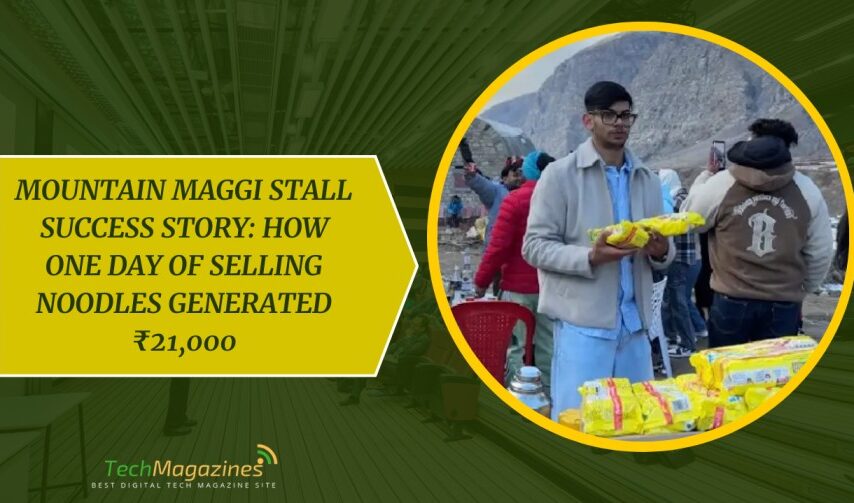
Badal Thakur did not go out there with a plan or a refined concept of success. It had no shopfront, no signage and no expansion talk. He had only what he could carry with him, an LPG stove, a few utensils, and instant noodles. Every person who ever spent some time in the mountains will understand the worth of this arrangement. Hot food there has a weight which it has seldom in the plains. A cup of hot tea or a bowl of freshly cooked Maggi is more than food.
When Comfort Becomes a Premium Product in Cold Weather
The air is thin, cold is constant and weariness creeps into the body. Hunger comes earlier and is more cumbersome. When food is presented hot, spiced and steaming, it provides more than just nourishment. It warms, calms the mind, and makes the climb bearable.
And, finally, the most decisive element was the people themselves. Tourists could afford to spend nearly anything to have a temporary feeling of comfort. Badal noticed one of those patterns, which is not new to any person who observes travellers attentively. Some spent hours walking, and some of them were not well prepared and they got to a stage where they could not get food or the food was very expensive.
A plate of Maggi would cost INR 70 is hardly cheap. But at this point, when the cold air and the fatigue were present all around, the price did not appear unreasonable anymore. What seemed extravagant in other places seemed reasonable in the hills.
In the video, there is a small stall, barely bigger than a table on which the ingredients were placed. Next to it was an LPG cylinder, which was emitting a low hiss as a huge pot of water boiled. The menu was concise and straight to the point. It had the regular Maggi at INR 70 and a cheese one at INR 100. There was no more to be said, and there was no more to be desired. Customers were attracted not so much by novelty as by the mere promise of something hot to eat.
The tourists increased to a big number as the day went on, but Badal kept up with them. He boiled, stirred and transferred the hot noodles to disposable dishes and served them hot to individuals who were exhausted. He later on in the video provided an estimate of his sales. According to his reckoning somewhere between 300 and 350 plates of Maggi had been served.
Sales, Costs, and the Reality Behind ₹21,000

The bill amounted to approximately INR 21,000 at seventy rupees a plate. This was the pay of one day labor, all in the mountains. The video attracted various reactions, most of which were humorous. Some of the viewers even called it their retirement plan half-jokingly, and some of them joked that they would stop working altogether. Some made the calculations and indicated that such a vendor could earn six lakh rupees in a month.
The numbers did not carry away everyone. Some of them pointed out that the gross figure was just INR 21,000. Opposing it should be the price of food materials, the expendable dishes, gas, and the labor of carrying the goods to an unknown and distant place. The work itself too was not to be disregarded the physical effort of long hours of labor in thin air and cold weather.
Beyond Viral Numbers
It is not only the amount of money that Badal earned that makes his story interesting. It is instead in the silent attractiveness of possibility itself. No fancy scenery was involved, just the mountains in the background and the choice to do something new. The episode talks of curiosity and of utilizing what is available, of simple stuff used to useful purposes, of hot dishes of Maggi in cold weather. Badal was not waiting to be approved or instructed. He just waited until the right time came and then he did it.
Where others saw inconvenience, scarcity and distress, he saw demand. Such little glimpses of insight can bear actual results in areas where resources are scarce and stable employment is difficult to locate. Badal was not the cause of hunger; it already existed. He was aware of it and decided to react. His struggle is also a reminder that success does not necessarily involve a big plan or a big scheme. It usually starts with a simple chance, which is evident and taken immediately, and turns out to be much bigger than one can reasonably imagine.
Conclusion
If nothing else, the mountain-side Maggi experiment by Badal Thakur demonstrates that opportunity sometimes comes in a disposable bowl, steaming. What started as a simple setup, an LPG stove, a pot of boiling water, and packets of noodles, became INR 21,000 worth of sales in one day. It is not a bad business model that has no business plan. Naturally, the gross total is not the pure profit. These involved expenses, physical exertion and the less glamorous side of preparing hours of meals in thin air. But that does little to mar the interest of the story.