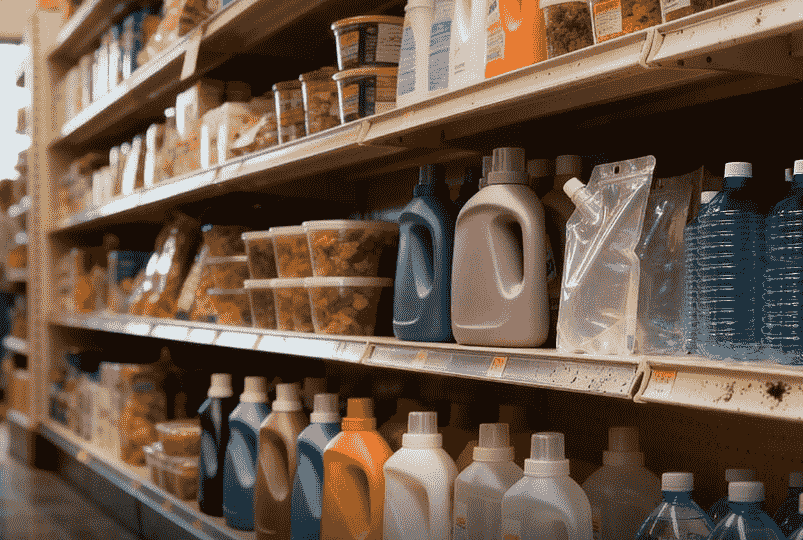

PCR most commonly means post-consumer recycled resin. It’s plastic that has already been used by end consumers, collected as waste, and processed back into usable resin for new products. ISO-aligned definitions describe “post-consumer” material as waste generated by households (and also by commercial/institutional end-users) that can no longer be used for its intended purpose.
You may also see PCR expanded as “post-consumer recyclable,” but in packaging, the sustainability value comes from the recycled part: replacing some virgin resin with recovered material.
In this guide: what PCR plastic means, how it’s made, where it fits in packaging, and the checks that keep your claims honest.
PCR vs PIR (and why the difference matters)
“Recycled content” can mean two different sources:
- PCR: from consumer-used waste (bottles, tubs, containers)
- PIR / pre-consumer: manufacturing scrap that never reached consumers
If you’re setting targets or writing packaging claims, PCR is usually treated as the stronger proof point because it diverts real post-use waste from disposal streams.
Why PCR matters (and what it doesn’t solve)
PCR helps keep plastics in circulation and reduces dependence on virgin plastic made from fossil feedstocks—key ideas in a circular economy.
It also matters because recycling rates are still low: the OECD estimates that only about 9% of plastic waste is recycled globally.
Still, PCR isn’t a substitute for reducing unnecessary packaging or building reuse models where they work. The best strategies do all three: reduce, reuse, and then use PCR for what remains.
How PCR plastic is made: from waste to resin
Turning post-consumer waste into PCR resin is a controlled chain:
- Collection (municipal systems, take-back, verified networks)
- Sorting (by polymer type and often colour)
- Cleaning (removing labels, residue, contamination)
- Shredding into flakes
- Extrusion + pelletising into uniform resin pellets
These are the same core steps outlined in Banyan Nation’s PCR explainer, with emphasis on quality control and traceability from collection to conversion.
Common types of PCR plastics (and where they fit)
PCR is supplied in the same major polymer families used for virgin resin:
- PCR PET: beverage bottles and rigid packs; in some markets, it can be produced for food-contact use under approved processes
- PCR HDPE: rigid bottles for home care and personal care
- PCR PP: caps, closures, moulded parts
- PCR LDPE: films/flexibles (often harder to collect and recycle consistently)
The “right” PCR is the one that matches your performance spec and end-use rules—not just the one with the highest recycled percentage.
Trade-offs to plan for (so the rollout doesn’t stall)
Most virgin-to-PCR projects hit predictable friction points:
- Colour/clarity variation (clear grades are toughest at scale)
- Odour risk if washing/decontamination isn’t strong
- Property variation (melt flow, impact strength, processing window)
- Supply variability (collection/sorting infrastructure + demand spikes)
A practical approach: start with forgiving applications (tinted packaging, non-food items, thicker walls), validate performance, then raise PCR % in steps.
A simple rollout plan for brands (5 steps)
- Pick one packaging format and define success: defect rate, performance, and customer experience (not just “% PCR”).
- Choose the first SKU carefully: aim for low-risk designs (non-clear colour, non-food, fewer components).
- Write a resin spec before you request quotes: target melt flow range, odour limits, contamination thresholds.
- Pilot on-line, not just in a lab: run your real moulds, your real filling line, your real distribution conditions.
- Scale with data: lock supplier documentation, batch testing frequency, and a clear claim statement for each pack component.
How to source PCR responsibly: a 6-point checklist
- Define PCR clearly in your spec using ISO-aligned wording.
- Ask for material data (MFI, density, contamination limits, mechanical properties).
- Verify traceability and documentation (batch records, chain of custody, calculation method).
- Use third-party validation where possible (UL’s recycled content validation to UL 2809 is one example).
- Confirm suitability for the application (especially for regulated uses).
- Run line trials + finished-product testing before you scale.
How to talk about PCR without greenwashing
The safest claim is specific and measurable:
- State the % and basis (by weight) and name the part (bottle vs cap vs label).
- Avoid vague “eco-friendly” language unless you can tie it to a defined standard and evidence.
Independent verification helps reduce ambiguity. SCS Global Services explains why third-party recycled-content certification matters, and UL frames validation as a way to avoid confusing eco-labels and build trust.
Does PCR actually reduce emissions?
In most cases, yes—because recycling avoids some energy-intensive steps involved in producing virgin resin. But the size of the benefit varies by polymer, recycling method, electricity grid, transport distance, and the amount of sorting/cleaning required. Use credible life-cycle references rather than a single “universal %.”
Can PCR be recycled again?
Often, yes. Many PCR polymers can undergo multiple recycling loops, though quality can degrade over time and depend on contamination control and recyclability-by-design.
Regulation signals: expectations are rising
- EU: policy direction under the Packaging and Packaging Waste Regulation includes making packaging recyclable by 2030, supported by clearer labelling and better sorting. t
- India: FSSAI has issued guidance on the acceptance of recycled PET for food-contact applications (FCM-rPET) and maintains a list of approved rPET manufacturers—important for food and beverage brands.
What big brands are doing
Major brands are already scaling PCR:
- The Coca-Cola Company announced that 500-mL sparkling beverage bottles in Canada would be made with 100% recycled plastic (excluding caps and labels) by early 2024.
- Unilever reports progress toward increasing the use of recycled plastic in its packaging as part of its plastics strategy.
Bottom line
PCR plastic can reduce virgin plastic demand and keep materials in circulation—when it’s sourced responsibly, verified properly, and paired with packaging designs that are actually recyclable in the real world. Start with the right use cases, set clear specs, validate performance, and communicate transparently.