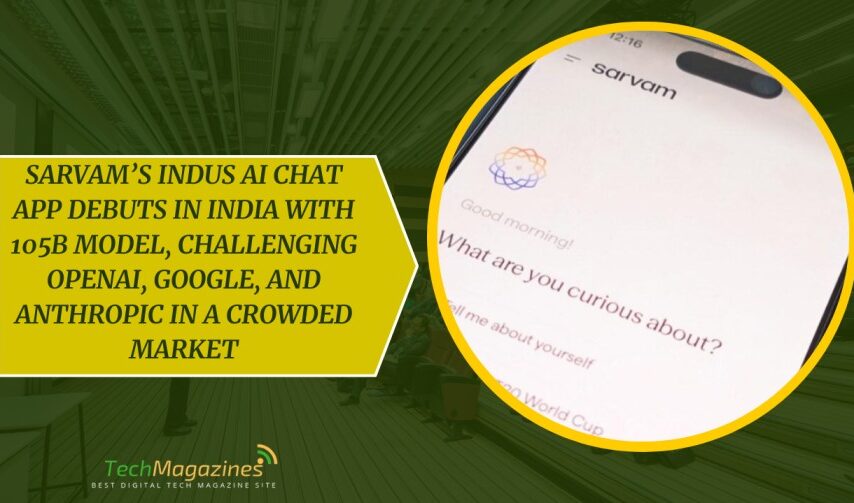

Sarvam AI, a young artificial intelligence company, announced on Friday the release of its chat application, Indus, for users on the web and on mobile phones. The product is being offered in a limited beta and serves as a gateway through which users may converse with the company’s own AI systems.
The company said it has chosen restraint over spectacle. Rather than racing to build ever larger models, Sarvam claims its present concern is with accuracy, practical usefulness, efficiency, and a closer fit with Indian conditions. This approach comes at a moment when India has become a major prize for global AI companies.
Firms such as OpenAI, Anthropic, Google, and X are all seeking to deepen their reach in the country. OpenAI’s chief executive recently stated that India accounts for more than 100 million weekly users of ChatGPT, while Anthropic has said that India represents 5.8 per cent of total usage of its Claude chatbot, second only to the United States.
These companies have also signalled their long-term intentions by announcing plans to open offices in India and to work with large domestic groups, including Infosys and the Tata Group. Against this backdrop, Sarvam has been careful to describe Indus as an early experiment rather than a finished product. Because its computing resources are limited, the rollout will be gradual, and some users may find themselves placed on a waiting list until capacity increases.
Sarvam has also framed the project in broader terms. Sovereign artificial intelligence, it argued, cannot be built by a single firm acting alone. It must be shaped collectively, with the involvement of developers, researchers, local specialists, creators, artists, and ordinary users—those who, by virtue of living in the country, are best placed to understand what India requires from its machines.
Inside Sarvam 105B: The Large Language Model Powering Indus
The Indus app is built on Sarvam’s newly announced large language model, a system of considerable scale known as Sarvam 105B, named for the size that gives it its weight. Alongside it, the company has also presented a smaller 30B version, both of which were made public earlier this week at the India AI Impact Summit in New Delhi. The unveiling was orderly rather than theatrical, suggesting an effort to establish capacity rather than to impress by spectacle.
Indus has been shaped with Indian users in mind. It allows questions to be put either by typing or by speech, and it replies in written words as well as in voice. This double form of exchange widens its reach beyond those comfortable with keyboards alone. Entry to the app is straightforward: a phone number will do, as will an existing Google or Microsoft account, or an Apple ID. At present, its use seems confined to India.
The application remains in beta and is offered on iOS, Android, and the web. It is, in effect, a work still being tested in public, released widely enough to be used, but not yet fixed into its final shape.
Capabilities, Constraints, and Rollout Strategy
At present, users have little control over their past conversations. Chat records cannot be erased without closing the account itself, and there is no way to turn off the reasoning feature, even when it slows the pace of replies. Sarvam has also warned that access may not be immediate for everyone, as some users could be placed on waiting lists while the company expands its computing resources.
Pratyush Kumar, a co-founder of Sarvam, has said that the release will proceed in stages. He added that the company is paying close attention to how people use the service, and that feedback from early users will be used to correct faults and make improvements.
Can a Homegrown AI Platform Compete in India?
Sarvam was set up in 2023 and has since raised $41 million from investors such as Lightspeed Venture Partners, Peak XV Partners, and Khosla Ventures. Its stated purpose is straightforward: to build AI systems that suit the languages, habits, and practical needs of India, rather than adapting tools made elsewhere.
With the arrival of Indus, competition in India’s AI chatbot market is likely to grow sharper. Each new entrant narrows the space, and makes it harder for any one system to claim the field as its own.
Final Words
At the core of Sarvam AI is a 105-billion-parameter model that the company describes as sovereign in character. The application, however, does not yet possess the breadth or polish of the tools produced by larger foreign firms whose consumer chat services have already become familiar to millions.
With big companies like ChatGPT, Claude, and Gemini already competing in India, Sarvam AI has its work cut out for it. However, one of the biggest plus point for Sarvam AI is the fact that it excels at understanding and speaking the Indian languages.