
For decades, computer design followed a predictable blueprint: a large motherboard acting as a crowded city square, with the CPU, GPU, and RAM living in separate “buildings,” connected by data-heavy “highways” called buses. In 2026, with the official debut of the M5 Pro and M5 Max, Apple has fundamentally redefined this geography, moving from simple integration to a revolutionary Fusion Architecture.
The secret to the 2026 performance leap isn’t just a faster processor; it’s a total reimagining of the logic board macbook pro owners rely on for high-intensity workflows.
1. The Era of Fusion Architecture
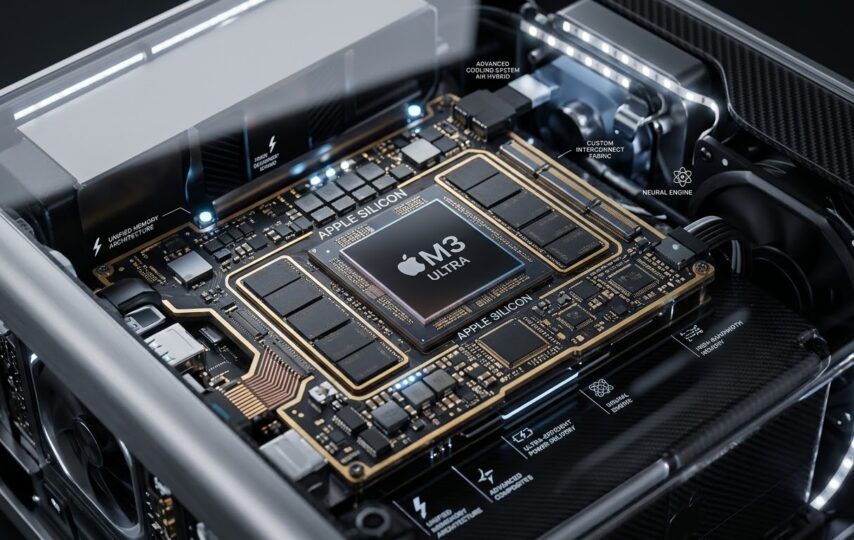
The headline advancement for 2026 is Fusion Architecture. Unlike previous generations that relied on a single-die design, the M5 Pro and M5 Max utilize advanced 2.5D packaging to bond two third-generation 3nm dies into a single, massive System on a Chip (SoC).
- Eliminating Latency: By bonding these dies, Apple has removed the physical distance data must travel between the CPU and GPU. This creates a low-latency interconnect that functions as a single, cohesive unit.
- Super Cores: The logic board now hosts a new “Super Core” tier, delivering the world’s fastest single-threaded performance. This is achieved through a redesigned cache hierarchy sitting directly on the silicon fabric.
2. Neural Accelerators: AI in the GPU
In a significant departure from traditional GPU design, the 2026 architecture integrates a dedicated Neural Accelerator into every single GPU core.
- Beyond the Neural Engine: While the 16-core Neural Engine still handles general AI tasks, these GPU-level accelerators allow for a 4x increase in peak AI compute.
- Impact on Professional Work: For video editors and 3D artists, this means local Large Language Model (LLM) processing and AI-driven rendering happen directly on the graphics hardware without taxing the main CPU.
3. Thunderbolt 5 and I/O Sovereignty
The 2026 MacBook Pro logic board has solved a long-standing “bandwidth bottleneck.” While previous models shared controllers across ports, the new M5 architecture provides each Thunderbolt 5 port with its own dedicated controller on the chip
- 120Gbps Bandwidth: This allows all three ports to run at full 120Gbps bandwidth simultaneously, supporting up to four high-resolution external displays without compromising data transfer speeds from external NVMe drives.
4. Unified Memory: The 614GB/s Breakthrough
Unified Memory Architecture (UMA) remains the cornerstone of Apple’s efficiency, but 2026 brings a massive increase in bandwidth. The M5 Max now supports up to 614GB/s of memory bandwidth.
- Shared Pool: Because the CPU and GPU share the same memory pool, there is zero “data copying.”
- Capacity: With support for up to 128GB of unified memory, the logic board can handle massive 3D datasets that would normally require a high-end desktop workstation with dual discrete graphics cards.
Comparison: Traditional vs. 2026 Fusion Architecture
| Feature | Intel-era Architecture | 2026 M5 Fusion Architecture |
| Component Layout | Discrete CPU, GPU, and RAM | Dual-Die Unified SoC |
| AI Processing | Software-based or discrete NPU | Neural Accelerators in every GPU Core |
| Memory Bandwidth | ~50–100 GB/s | Up to 614 GB/s |
| I/O Management | Shared Controllers | Dedicated Thunderbolt 5 Controllers |