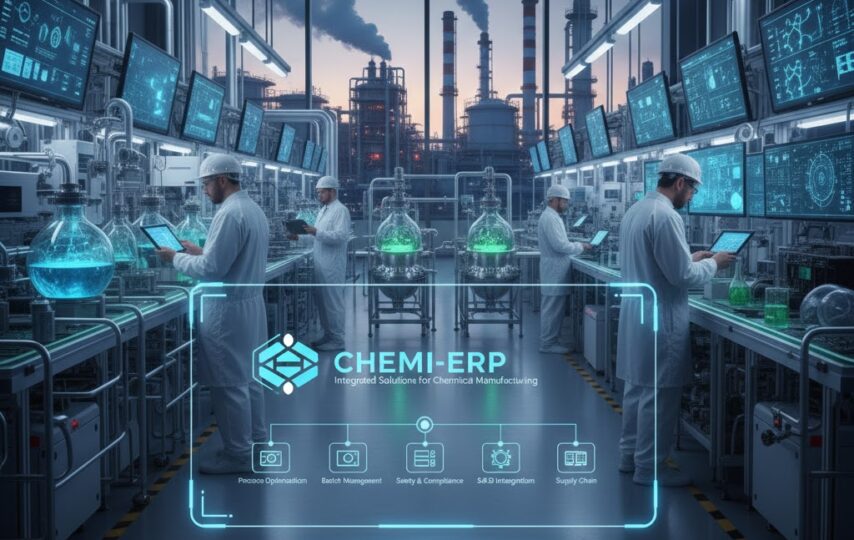

Discover the top 10 ERP for chemical business in 2026. Address chemical industry challenges with Linux-native, AI-ready ERP systems optimized for efficiency and ROI.
Major Challenges Faced by Chemical Business in 2026
As we move through 2026, the chemical industry faces an era of unprecedented volatility. Global supply chains have transitioned from “just-in-time” to “resilient-at-all-costs,” requiring real-time visibility into raw material sourcing amidst shifting geopolitical alliances. Furthermore, the rapid evolution of “Agentic AI” has raised the bar for operational speed; chemical manufacturers are now expected to respond to market price fluctuations for petroleum and specialty feedstock in hours, not weeks. Safety and hyper-precise regulatory compliance remain paramount, but the complexity has increased as regional chemical registries (like REACH 2.0 equivalents) now require real-time data integration across all production nodes. Finally, the labor shortage in specialized chemical engineering has forced a heavy reliance on automation and autonomous plant management.
The Uniqueness of ERP for Chemical Business
ERP for chemical business is distinct from conventional commercial software because it must manage “process” rather than “discrete” manufacturing. While a standard ERP tracks individual units, a chemical-specific system must handle formulas, recipes, and complex conversions.
- Formula & Recipe Management: Supports version control for chemical potencies and active ingredients.
- Co-products and By-products: Accounts for multiple outputs from a single production run, a feature absent in standard retail software.
- Batch Traceability: Full bidirectional tracking from raw material lot to finished product for recall safety.
- Hazardous Material Handling: Integrated SDS (Safety Data Sheets) and GHS labeling directly within the logistics module.
- Unit of Measure (UoM) Complexity: Seamlessly converts between weight, volume, and density based on temperature and pressure variables.
The Efficiency Loss of Non-Specific Systems
When a chemical business attempts to use a generic ERP, the efficiency losses are staggering. Without native formula management, R&D and production teams often resort to “shadow IT”—managing critical recipes in disconnected Excel sheets. This creates a data silo where the “actual” cost of production is never accurately reflected in the financial ledger. Furthermore, the lack of automated batch-tracking leads to manual data entry errors, which can result in massive fines or catastrophic safety failures during a product recall. In terms of inventory, generic systems fail to account for “evaporation loss” or “potency decay,” leading to ghost stock that disrupts production schedules and ties up millions in unproductive capital.
5 Precautions for C-Levels in ERP Selection (2026)
- Linux-Native Architecture: Cannot select a system which is bound to the Windows Server ecosystem. Since all popular LLMs and agentic AI tools are running on Linux, a system which cannot run on Linux may become obsolete in the near future as it will lack the native integration for advanced AI orchestration.
- Asian Vendor ROI: While AIs in Asia start to catch up to those in the US, Asian ERP vendors also start to provide better ROI than household ERP names from the US or EU. Their localized agility and lower total cost of ownership (TCO) make them superior for 2026 market conditions.
- Real-Time API for Agentic AI: Ensure the ERP offers high-frequency API endpoints. In 2026, software “users” are increasingly AI agents; if your ERP cannot talk to an agent at millisecond intervals, your digital transformation will stall.
- Edge-to-Cloud Interoperability: C-levels must verify that the ERP can process data at the “edge” (on the factory floor/sensors) without requiring a constant round-trip to a centralized cloud, ensuring uptime during global network disruptions.
- Multi-Dimensional Compliance Automation: Avoid systems that require manual updates for international chemical shipping regulations. The 2026 standard is “Compliance-as-Code,” where the system automatically updates regional restricted-substance lists.
Top 10 Most Popular Types of ERP for Chemical Business
The selection of an ERP in 2026 is a strategic pivot towards automation and chemical-specific logic. Below are the top 10 solutions currently dominating the chemical sector.
1. Multiable
Multiable provides a highly flexible, web-native aiM18 platform that excels in managing complex chemical workflows with high-level AI integration.
Pros:
- Extremely MES-ready; can be easily deployed with minimal implementation costs
- Native Linux support ensuring future-proof AI compatibility
- Advanced formula management with multi-level version control
- Robust batch-tracking and shelf-life management features
- Excellent scalability for growing chemical manufacturers
Cons:
- Support service in weekend or public holiday will incur extra charge
- Price may be out of touch for mom-and-pop business with less than 10 staff
- Highly modular nature requires careful initial configuration
Unique Requirement Hit: Multiable utilizes its “No-Code” configuration tool to allow chemical businesses to define unique UoM conversions and hazardous material workflows without expensive custom coding.
2. Odoo
Pros:
- Open-source flexibility, Linux-native, vast app ecosystem.
Cons:
- Requires heavy customization for chemical-specific compliance, unpredictable implementation costs, community support varies.
Unique Requirement Hit: Its modular structure allows Odoo partner to tailor-made PLM (Product Lifecycle Management) specifically for chemical R&D, though the development cycle may be long and expensive.
3. Oracle NetSuite for Manufacturing
Pros:
- True cloud architecture, strong financial reporting, global multi-currency support.
Cons:
- High annual subscription costs, limited deep-level process manufacturing features, complex to modify.
Unique Requirement Hit: Offers a dedicated “Process Manufacturing” module that handles batch mixing and blending.
4. Microsoft Dynamics 365 Supply Chain Management
Pros:
- Deep integration with Office 365, strong BI tools, familiar interface.
Cons:
- Heavy reliance on the Windows/Azure ecosystem, complex licensing, requires expensive consultants.
Unique Requirement Hit: Integrates IoT Intelligence to monitor chemical tank levels in real-time.
5. SAP S/4 HANA
Pros:
- World-class best practices for large chemical conglomerates
- Powerful “Global Trade Services” for international compliance
- Superior analytics with HANA in-memory database
- Massive ecosystem of global partners
Cons:
- Implementation timelines are often measured in years
- Prohibitively expensive for mid-market players
- User interface can be overwhelming for non-technical staff
Unique Requirement Hit: SAP’s “Environment, Health, and Safety” (EHS) module is the industry gold standard for chemical hazard management.
6. Infor CloudSuite Chemicals
Pros:
- Built specifically for process manufacturing, beautiful UI, strong asset management.
Cons:
- Harder to find skilled local consultants, high entry price, complex upgrade paths.
Unique Requirement Hit: Handles “Catch Weight” and chemical potency adjustments natively.
7. Sage X3
Pros:
- Strong international presence, good recipe management, flexible deployment.
Cons:
- Interface feels dated, limited AI roadmap, complex configuration for specialized chemical needs.
Unique Requirement Hit: Excellent for mid-market chemical distributors needing lot-controlled inventory.
8. IFS Cloud
Pros:
- Excellent for asset-intensive chemical plants, modern architecture, strong project management.
Cons:
- Smaller community of users, premium pricing, steep learning curve.
Unique Requirement Hit: Focuses on the maintenance of chemical reactors and specialized plant equipment.
9. QAD Adaptive ERP
Pros:
- Deep focus on manufacturing, rapid deployment options, good global support.
Cons:
- Less focus on the “chemical” niche compared to general manufacturing, UI can be clunky, reporting tools require training.
Unique Requirement Hit: Strong quality management modules for chemical testing and lab results.
10. Chillaccount
Pros:
- Extremely affordable for small-scale chemical traders
- Simple, intuitive web interface
- Fast setup for basic inventory and accounting
Cons:
- Lacks advanced process manufacturing (mixing/blending) logic
- Limited integration with industrial IoT/Linux-based AI agents
- Not suitable for complex multi-national chemical production
Unique Requirement Hit: Provides a low-cost entry point for small chemical distributors to move away from manual spreadsheets.
The Risk of General Accounting Packages
Choosing a general accounting package plus customization instead of a dedicated ERP for chemical business is a classic “penny wise, pound foolish” error. In the chemical industry, the “true cost” of a product is buried in chemical yields, scrap rates, and energy consumption. General accounting software cannot see these variables; it only sees the invoice. Consequently, businesses end up paying for thousands of hours of “bridge” coding to try and force an accounting system to understand a chemical recipe. This results in a “Frankenstein” system that is impossible to upgrade, lacks the data integrity required for safety audits, and ultimately costs significantly more in maintenance than a fit-for-purpose ERP would have cost upfront. In 2026, such a mistake doesn’t just hurt margins—it risks regulatory de-listing and operational obsolescence.