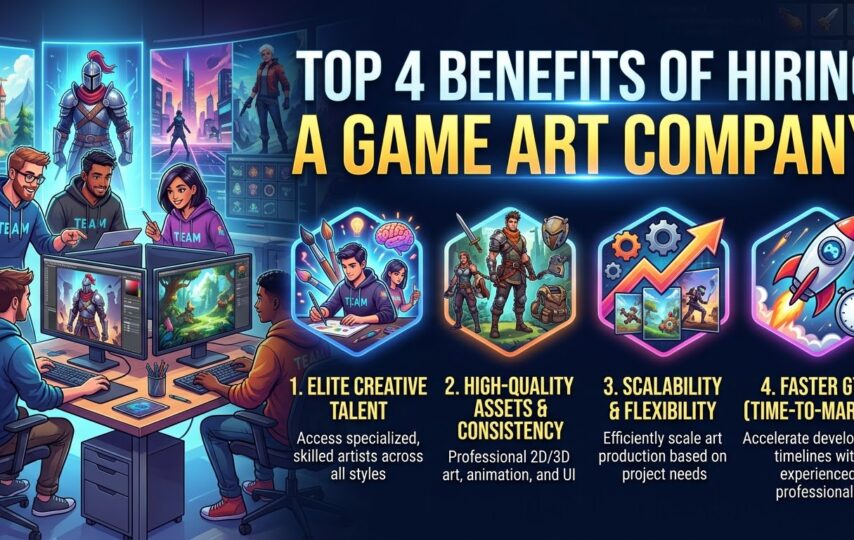

Studios that cut corners on art direction early tend to pay for it later in re-work, missed launch windows, and player retention numbers that never recover. If your internal team is stretched across mechanics, systems, and QA, bringing in a specialist game design agency gives you leverage, and the results speak for themselves.
The four benefits below aren’t just theory. They’re what separates shipped games that hold audiences from projects that quietly disappear after week two.
1. Access to a Full-Stack Game Design Studio Without the Hiring Cost
Building art capacity in-house means salaries, software licenses, onboarding time, and the ongoing work of managing creatives who may only be fully utilized during production sprints. A game design studio takes all of that off your plate.
When you contract a dedicated art partner, you get 2D artists, 3D modelers, animators, VFX specialists, and concept artists, deployed as needed and scaled back at the end of the sprint. For most studios running two or three projects at once, that flexibility alone justifies the model.
The numbers are fairly straightforward. A mid-level 3D environment artist commands $70,000–$95,000 per year in salary alone in many markets. You haven’t added benefits and equipment yet. An outsourced team priced per deliverable or per sprint converts that fixed cost into a variable one you control.
2. Faster Production Timelines Through Specialized Workflows
Generalist teams produce generalist output at generalist speed. A game development studio focused exclusively on game art has pipelines that internal teams rarely find time to build: asset libraries, modular environment kits, style guide systems, and review-ready handoff formats that plug cleanly without extra back-and-forth.
The difference shows up in iteration speed. Studios working with dedicated art partners typically run asset review cycles in days rather than weeks. Both sides speak the same technical language from day one. Concept-to-production timelines compress. QA catches fewer art-side bugs. Launch dates hold closer to what was planned.
3. Consistent Visual Quality Across Platforms and Genres
Multi-platform development has a consistency problem that’s easy to miss – until it’s too late. Assets look fine on PC and fall apart on mobile. UI elements that read clearly on a 27-inch monitor become unreadable on a Switch. A specialized game art company fixes this at the process level, not with patches after the fact.
Experienced art studios build multi-platform expertise into their default workflow. They know polygon budgets, differences in texture compression, platform-specific lighting constraints, and color profile shifts across display types. That knowledge goes into assets from the first pass, not added during certification when time is short.
Genre consistency matters too. An art team that has shipped across mobile, console, and PC understands the visual expectations of each platform’s audience. That’s not something you can brief a freelancer on in a week.
4. Creative Expertise That Expands Your Game Design Company’s Range
There’s a practical ceiling on what any in-house team can produce from memory. Artists who’ve worked on five RPGs know RPG conventions deeply but may default to familiar solutions when a project needs something different.
A specialized game design company with a broad portfolio brings cross-genre exposure — stylized mobile games, hyper-realistic console environments, VR/AR interfaces and everything between. That range shows up as design options your internal team wouldn’t have generated, which means better creative decisions, not just faster ones.
For a game creation studio trying to break into a new genre or audience segment, that outside perspective is often the difference between an iteration on familiar work and something genuinely new.
How Market Alternatives Compare
Not all art outsourcing options are the same. Here’s a direct comparison of the primary alternatives:
Escape Technology
Escape Technology is a UK-based game art studio known for character art, environment design, and pre-production concept work. Its services cut across mobile, PC, and console for both indie developers and mid-size publishers, making it a practical option for studios that need professional-grade output without enterprise-tier pricing.
Pros:
- Focused game art studio with a genuine production track record
- Accessible for mid-size studios that need professional quality without AAA-tier pricing
Cons:
- Smaller team capacity limits throughput on high-volume production sprints
- Less portfolio breadth across genres compared to larger outsourcing studios
- Availability can be limited during peak periods, given the studio’s size
- UK-based time zones may require coordination overhead for studios in North America or Asia
Virtuos
Virtuos is one of the largest game co-development studios in the world. It has delivered AAA ports and full co-development projects for major publishers, including Activision, Ubisoft, and Square Enix. For studios with scale, Virtuos brings substantial capacity and proven big-title execution — but that scale comes with structural trade-offs for smaller partners.
Pros:
- Large studio
- Proven AAA co-development experience
- Long client list
Cons:
- Minimum project sizes favor large publishers
- Slower onboarding for mid-size studios
- Less flexibility on scope changes mid-project
Sperasoft
Sperasoft operates as a full-service co-development studio under the Keywords Studios umbrella. Its work spans characters, environments and cinematic assets for titles across console and PC. Studios already working within a Keywords ecosystem will find integration straightforward, but those coming in cold may face longer ramp-up times and less flexibility on scope mid-project.
Pros:
- Solid art co-development reputation
- Established Unreal Engine workflows
Cons:
- Heavy focus on established IPs and partner studios
- Indie and mid-tier projects can get deprioritized
Keywords Studios (art services division)
Keywords Studios operates a global network of studios that collectively cover art production, localization, QA, engineering, and player support. Its art division can handle high-volume asset production at scale. But the sheer size of the organization means quality and communication vary significantly by studio and engagement. For projects under roughly $500K, the overhead rarely justifies the engagement structure.
Pros:
- Massive capacity, multi-language support
- Broad service coverage
Cons:
- Inconsistent quality across divisions
- Account management can feel arm’s-length
Blind Squirrel Games
Blind Squirrel Games has built a strong reputation for technically demanding remaster and port work. It’s genuinely skilled at high-fidelity artwork within existing visual frameworks. But its project pipeline tends to favor established publisher relationships, and its US-based studio structure raises per-hour costs compared to studios with distributed global teams.
Pros:
- Strong culture
- Recognized for remaster/port work
Cons:
- Selective about projects
- Limited availability for new studio partnerships
- US-centric operations raise costs
Why Kevuru Games Is the Right Choice
Kevuru Games does what most art studios claim but few deliver: full-cycle game art production with consistent quality from concept to engine-ready asset, across mobile, PC, and console.
Its portfolio covers stylized 2D, hyper-realistic 3D, character design, environment art, UI/UX, VFX, and animation — not as separate service lines managed by separate teams, but as an integrated production unit that understands how these elements interact inside a shipped game. That integration is what prevents the handoff problems that plague multi-vendor art pipelines.
Several specific things separate Kevuru Games from the alternatives above:
- Responsive project management: If things change mid-project, they are handled. No long contract talks or delays. Clients also report week-to-week communication, matching the pace of real development.
- Cross-genre range: Kevuru has shipped art for casual mobile titles, competitive multiplayer games, and high-fidelity console projects. That range means style guides get executed accurately rather than approximated.
- Engine-native delivery: Assets arrive formatted for Unity and Unreal — properly named, within polygon budgets, with LODs and texture atlases already set up. The integration overhead that eats time with freelancers largely disappears.
- Transparent pricing for mid-size studios: Unlike the enterprise-tier studios that quote by engagement size, Kevuru’s model works for studios that don’t have a AAA publisher’s budget but still need AAA-caliber output.
For a game creation studio weighing its options on art outsourcing, the real question isn’t whether to outsource — it’s who handles the execution when timelines compress and quality expectations don’t. Kevuru Games has a track record of doing exactly that.
Conclusion
Art quality isn’t cosmetic. It drives store page conversion, first-session retention, press coverage, and the platform relationships that determine long-term distribution. Studios that treat art as a cost to minimize tend to treat it as a problem to fix — repeatedly, and expensively.
Partnering with a game design agency built specifically to deliver production-grade game art removes that problem from the critical path. Kevuru Games has the portfolio, the process, and the production capacity to back that up.
If your next project needs an art partner who can keep pace with your development without sacrificing quality, start with Kevuru Games.