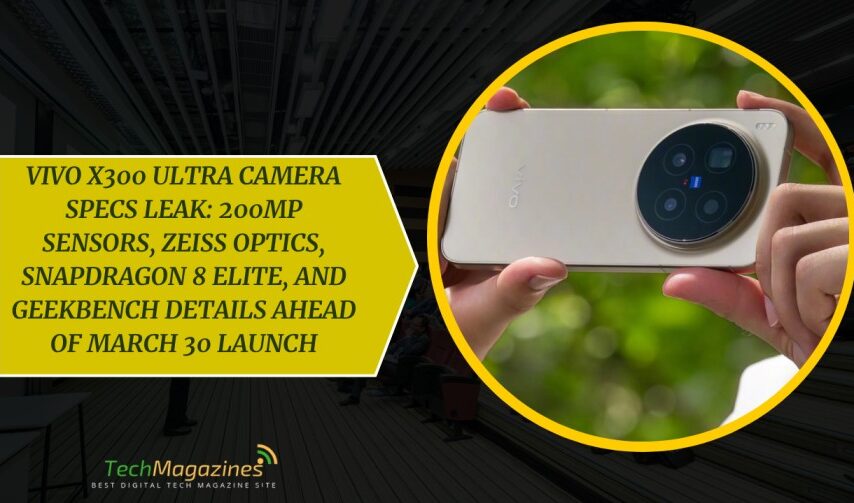

Vivo is expected to introduce its flagship Vivo X300 Ultra together with the Vivo X300s in China on March 30. The launch will add to the X300 series, which already consists of the Vivo X300 and X300 Pro that arrived in October 2025. In the lead-up to the event, details have begun to emerge, some through unofficial channels and others through controlled disclosures, giving a partial view of the Ultra model’s features and possible pricing.
A recent report shifts the focus to the camera system, suggesting that the company has worked to refine image quality and extend zoom capability. The handset has also been listed on a recognized benchmarking platform, an indication that its release is close at hand.
Imaging Hardware Takes Center Stage With Zeiss Collaboration
As reported by IT Home, Vivo recently organized a Blueprint Imaging Technology Communication Conference, where it spoke about the imaging direction of the Vivo X300 Ultra. The device is being framed not simply as another premium smartphone, but as a tool that approaches the function of a dedicated camera while remaining suited to everyday use. The stress, by all accounts, is on improvements in optics and sensor technology which are areas where progress is often incremental but significant. Whether these adjustments will deliver a noticeable difference in practice is something that can only be judged once the phone is used beyond the confines of presentation and expectation.
The Vivo X300 Ultra is expected to employ what is described as a “3 + 2” Zeiss lens arrangement. At its wider end, it is said to include a 1/1.28-inch Sony Lytia 818 sensor for ultrawide shots, supported by the company’s third-generation VCS bionic spectrum system and the familiar Zeiss T coating. The stabilisation is claimed to reach a CIPA 6.0 standard, while the intake of light is said to be markedly improved, by as much as double when set against the previous model. Such figures, though precise, remain abstractions until tested in ordinary conditions.
The main camera is reported to rely on a 1/1.12-inch, 200-megapixel Sony Lytia 901 sensor. Vivo suggests that this configuration leads to steadier image output and finer detail, assisted again by Zeiss T coating and a 1G + 6P lens design. This structure is said to lessen internal reflections while allowing more light to be gathered at the pixel level, with gains in sensitivity and capacity that are presented in measured percentages. There is also mention of Low Noise 4 processing and DCG HDR, both intended to widen dynamic range and limit the intrusion of noise, though such improvements are often more subtle than the language used to describe them.
Periscope Zoom System Push Long-Distance Photography Further
For distant subjects, the Vivo X300 Ultra is said to carry a periscope telephoto unit built around a 1/1.4-inch, 200-megapixel Samsung HP0 sensor. This module reportedly offers stabilisation at a CIPA 7.0 level, described as approaching that of a gimbal. The company claims a significant increase in light capture, up to three times more than before, despite the use of relatively small 0.56-micron pixels. As with the rest, the claims are clear in number, but their real value will depend on how the camera performs outside controlled demonstrations.
New Teleconverter System Promises Extended Optical Reach
Vivo is also said to have revised its teleconverter system, introducing what it calls the G2 Zeiss model. This unit is described as providing a 200mm focal length while remaining smaller and lighter than before. It relies on a two-group, 15-element optical construction and carries Zeiss APO certification, a detail meant to signal a certain standard of precision. A further extension, referred to as the G2 Ultra teleconverter, is said to push the focal length to 400mm. In doing so, it makes use of high-transparency and ultra-low dispersion glass, along with an aspherical lens element intended to correct optical distortions and preserve clarity.
Vivo X300 Ultra Benchmark Listing Hints at Flagship Performance Credentials
In a separate development, the Vivo X300 Ultra has appeared on Geekbench under the model number V2547DA, identified as a variant with satellite communication support. The listing points to the use of a Snapdragon 8 Elite Gen 5 processor, paired with 16GB of RAM, and running on Android 16. The recorded scores, 3,722 in single-core performance and 11,621 in multi-core, offer a numerical outline of its capabilities, though such figures often say less about daily use than they appear to promise.
As for pricing, the device is expected to begin at around CNY 7,500, which roughly translates to Rs. 1,01,000 for the 12GB + 512GB configuration. These details, like the rest, remain provisional. A clearer account should emerge once the phone is formally introduced in China next week, where it is set to appear alongside the Vivo X300s.
Final Words
At least on paper, the Vivo X300 Ultra does not appear as a standard annual update but as an effort to make the distinction between a smartphone and a dedicated camera blurry. The focus on bigger sensors, longer telephoto reach, and Zeiss-branded optics is an indication that Vivo is targeting photography fans who are serious about their photography, but with a second device in their bag.
Meanwhile, the benchmark scores and the anticipated Snapdragon flagship chip suggest that the performance will not be an afterthought. Nevertheless, like most of the promises before the launch, the actual test will be when such meticulously quoted percentages and assertions come up against unpredictable lighting, moving objects, and daily impatience.
Its pricing also puts it squarely in the ultra-premium field, where there is a high expectation and few excuses. The X300 Ultra can be an interesting flagship in case Vivo delivers. Otherwise, it will be just another phone that aims high-up in the sky, yet, only manages to take well-lit selfies. In any case, the launch will be an interesting event to follow.