
If you have ever wondered why you can instantly buy or sell a stock, crypto token, or currency pair at any hour without waiting for someone else to show up, you are watching market makers at work. And increasingly, those market makers are powered by artificial intelligence.
AI market making is the use of automated systems and machine learning algorithms to continuously provide buy and sell orders in financial markets. The goal is simple: keep markets liquid, reduce price gaps, and make sure there’s always someone willing to take the other side of a trade. Think of it as the financial equivalent of keeping the gears oiled so everything runs smoothly.
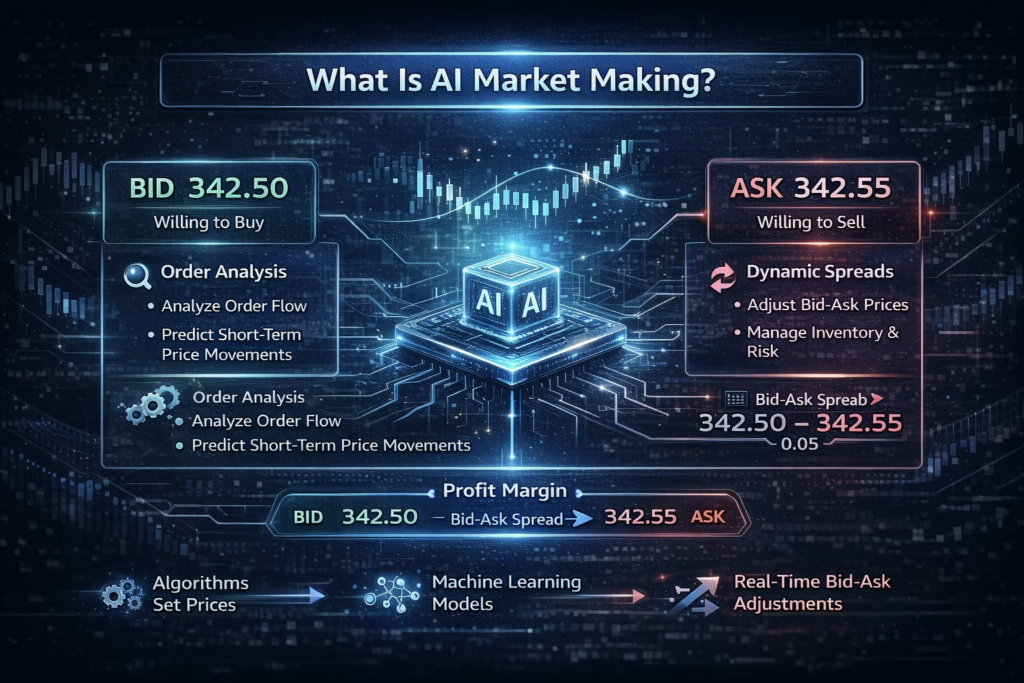
At its core, market making is about standing ready to buy and sell an asset at publicly quoted prices. Traditional market makers profit from the spread between what they’re willing to pay (the bid) and what they’re willing to sell for (the ask). That tiny difference, multiplied across thousands or millions of trades, becomes their revenue.
AI market making takes this concept and automates it through algorithms that can adjust prices, manage inventory, and respond to market conditions in milliseconds. Instead of human traders manually updating quotes, machine learning models analyze order flow, predict short-term price movements, and dynamically set bid-ask spreads based on risk.
This isn’t a trading strategy where you’re trying to outsmart the market or predict the next big move. It’s infrastructure. AI market making exist to provide a service: ensuring that when you want to trade, there’s liquidity available. They make money by facilitating transactions, not by betting on direction.
The technology layer handles several things at once. It monitors order books across multiple exchanges, calculates optimal pricing based on volatility and inventory positions, hedges risk across different instruments, and executes thousands of micro-adjustments per second. What used to require teams of quantitative traders and risk managers now happens inside neural networks and reinforcement learning models.
Why Markets Need Market Makers
Here’s the problem: natural supply and demand rarely line up perfectly. At any given moment, there might be more people wanting to sell Tesla stock than buy it, or vice versa. Without someone stepping in to absorb that imbalance, prices would jump around erratically and trades would take longer to execute.
Market makers solve this by always being present on both sides of the order book. They post a bid price where they’ll buy from you and an ask price where they’ll sell to you. This creates price continuity. Instead of waiting minutes or hours for a matching buyer or seller to appear organically, you can trade immediately against the market maker’s quote.
In fast-moving digital markets like cryptocurrency, where trading happens 24/7 across hundreds of exchanges globally, this function becomes even more critical. A coin might trade on ten different platforms simultaneously. Without market makers keeping prices aligned and liquidity available, you’d see wild price discrepancies and poor execution quality.
Automation improves this efficiency dramatically. AI systems can monitor dozens of trading pairs, react to sudden volume spikes, and adjust pricing faster than any human could. When Ethereum’s price drops 3% in thirty seconds, an AI market maker recalibrates its quotes instantly to reflect new risk levels. That speed prevents the system from breaking during volatile moments.
Who Has Traditionally Been The Market Makers
Historically, market making was the domain of specialized financial institutions. We’re talking about proprietary trading firms like Jane Street and Citadel Securities in equities, or designated market makers on exchanges like the New York Stock Exchange. These organizations have deep capital reserves, sophisticated technology infrastructure, and direct exchange relationships.
The barrier to entry was always high. You needed millions in capital to hold inventory positions, low-latency connections to exchange matching engines, co-located servers in data centers near exchanges, and teams of quantitative developers building custom algorithms. Regulatory requirements added another layer. In many jurisdictions, you need specific licenses and compliance frameworks to act as a registered market maker.
Even in newer markets like crypto, the main liquidity providers tend to be professional firms with significant resources. Companies like Jump Trading, Wintermute, and GSR operate 24/7 with global teams managing billions in trading volume. The technical complexity alone keeps most individual participants out.
But here’s what’s shifting: the capital and infrastructure requirements haven’t disappeared, but the ways to access market-making economics have started to evolve.
How Technology Is Expanding Market Making Participation
You still can’t wake up tomorrow and become a market maker by yourself. The operational reality remains complex. But technology is creating new pathways for participation that didn’t exist five years ago.
AI and automation have introduced abstraction layers that separate the mechanical work of market making from the need to build everything from scratch. Instead of developing your own pricing algorithms, risk management systems, and exchange integrations, structured systems can handle the technical execution while users allocate capital to those operations.
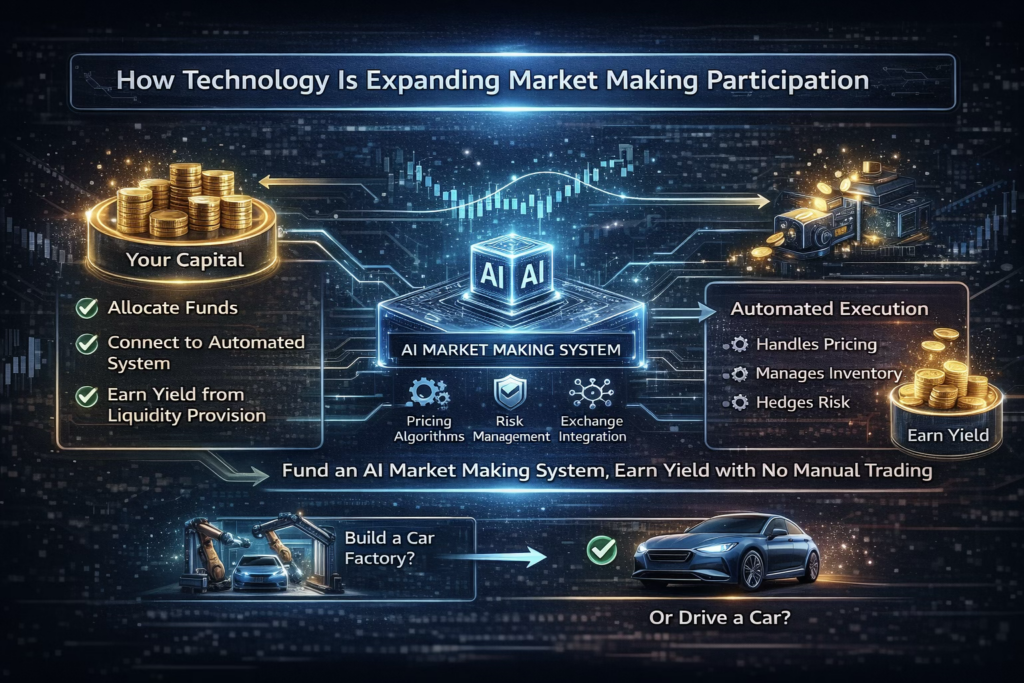
Think of it like the difference between building a car and owning one. Most people participate in transportation by buying vehicles, not by engineering them. Similarly, individuals can now participate in market-making economics indirectly by connecting capital to established systems that do the actual work.
You’re not sitting at a screen making decisions. You’re effectively acting as a liquidity provider by allowing automated systems to use your capital to facilitate trades. The AI handles pricing, inventory management, and risk hedging. Your role is capital allocation and system selection.
The key distinction here matters. The returns come from providing a service (liquidity) rather than predicting market direction. The risks are different too. Instead of directional market risk, you’re taking on execution risk, inventory risk, and technical system risk.
According to industry research from firms such as Messari and Kaiko, retail participation in liquidity provision grew by more than 300% between 2023 and 2025, driven largely by improved access to automated market-making tools. That growth reflects both technological advancement and broader acceptance of algorithmic trading infrastructure.
Recent Trends in AI Market Making
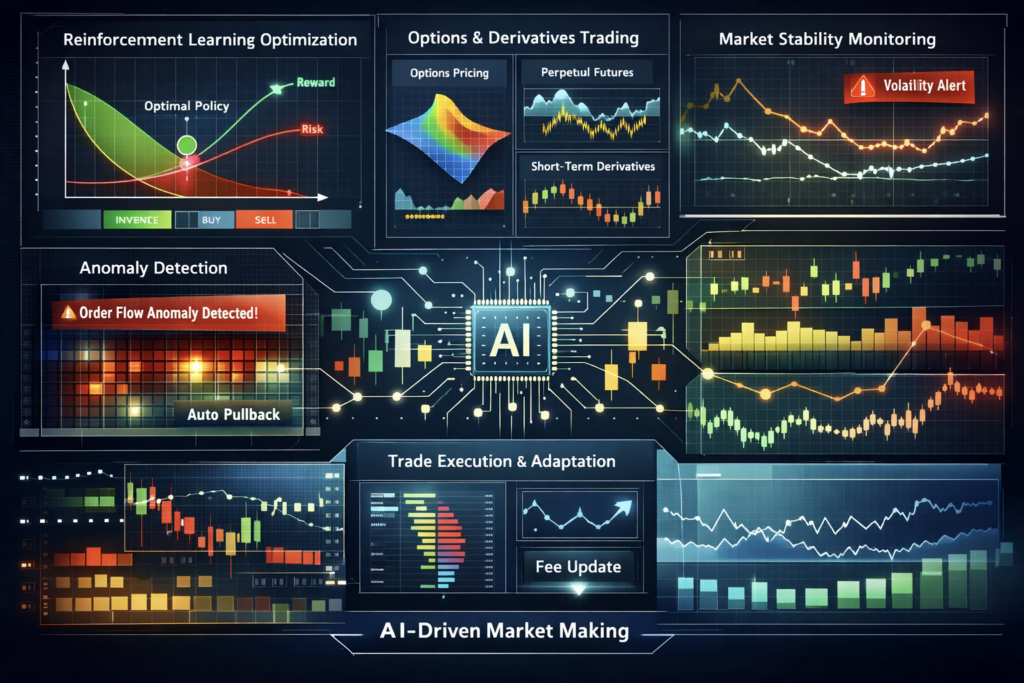
The industry is moving in some interesting directions. One major trend is the application of reinforcement learning to inventory management. Traditional market makers used relatively simple statistical models to decide how much inventory to hold. Modern AI systems treat this as a continuous optimization problem, learning from millions of historical scenarios to balance profitability against risk exposure.
We’re also seeing expansion into more complex instruments. AI market makers are now active in options markets, perpetual futures, and short-duration derivatives that would have been too risky or operationally intensive for purely human-managed operations. The speed and precision of machine learning make previously uneconomical markets viable.
There’s a clear shift toward viewing AI market making as critical financial infrastructure rather than just another trading tactic. Central banks and regulators increasingly recognize that algorithmic liquidity provision stabilizes markets during stress events. During the March 2025 volatility spike in treasury markets, AI-driven market makers maintained tighter spreads and more consistent quoting than human equivalents, according to Federal Reserve research.
The technology itself keeps improving. Newer models can detect anomalous order flow patterns that might indicate manipulation or system errors, pulling back automatically to avoid adverse selection. They can also adjust to changing market microstructure, like when an exchange modifies its fee schedule or tick size rules.
Interestingly, there’s growing collaboration between traditional financial institutions and AI-native firms. Banks that once built everything in-house now license machine learning models from specialized developers. The expertise is consolidating around a smaller number of highly sophisticated players, but the deployment of that expertise is spreading wider.
AI market making represents an evolution in how financial markets function at the most basic level. It’s not a revolution that changes what markets do, but it fundamentally improves how they do it. Better liquidity, tighter spreads, and more stable pricing benefit everyone who trades, even if they never think about the mechanism behind it.
What makes this development significant goes beyond trading communities. As more economic activity moves into digital and decentralized formats, the infrastructure that keeps those markets functional becomes increasingly important. AI market making is part of the plumbing. Most people won’t interact with it directly, but they’ll benefit from markets that work more smoothly and more efficiently.
The technology will keep advancing. But the core function stays the same: someone has to be willing to stand on both sides of the market, and AI is proving exceptionally good at that job.
Understanding this space doesn’t require you to participate in it or even trade frequently. It just helps explain why modern markets feel different from the chaotic, gap-filled environments of decades past. The invisible infrastructure is doing its job.
How do AI market makers actually make money?
They profit from the bid-ask spread, which is the small difference between the price they’ll buy at and the price they’ll sell at. On each transaction, they capture that spread. The AI optimizes how wide or narrow to set that spread based on volatility, competition, and inventory levels. High volume and efficient risk management turn small per-trade profits into substantial returns.
Is AI market making the same as high-frequency trading?
Not exactly. High-frequency trading (HFT) is a broader category that includes many strategies, some of which are directional bets on tiny price movements. AI market making is specifically about providing liquidity. There’s overlap in the technology used (both need speed and automation), but the intent differs. Market making is service provision; HFT can be speculative.
Do retail traders lose money to AI market makers?
Not inherently. Market makers provide a service by offering immediate liquidity. You pay for that convenience through the spread, but you’d face the same cost with human market makers. AI market makers often provide tighter spreads and better fill rates than humans because of efficiency gains.