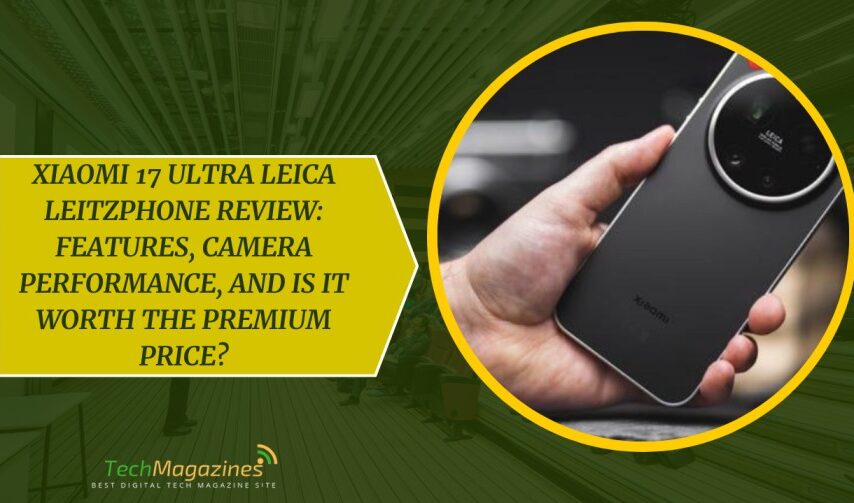

Xiaomi has manufactured a handset that carries the name of Leica with the global launch of the 17 Ultra. It is the first Leitzphone to be exported out of Japan, previous models, manufactured by Sharp, were localized. The device is similar to the 17 Ultra.
It carries the red dot of Leica, and puts a rotating camera ring on it, but its contents are familiar, nearly identical to the Leica Edition already available in China. The phone is competent. Nonetheless, it would be wise to assume that the majority of buyers would be better off purchasing the average 17 Ultra and save the difference in price. The badge is heavy, but the experience is not much different.
The 17 Ultra and the original Leica Edition were released in China on December 25th, 2025. Two months later, during the event of Xiaomi in Barcelona before MWC, the company rolled out the global 17 Ultra and the Leitzphone, in addition to the regular Xiaomi 17. The regular 17 Ultra starts at £1,299 or €1,499 with 512GB of storage. The Leica-branded model will add an additional £400 or €700.It is a high price difference, but not without some differences.
Design Details: The Red Dot, Refined Materials, and Box Extras
Leitzphone is in a subdued black with small gloss, with edges knurled in aluminum alloy, and with the small red Leica badge. It is slightly different to Leica Edition sold in China, which was in two-tone on the back and positioned its logo in a different angle. The box contains some branded extras: a faux leather case with a lens cap, a cleaning cloth, and a red wrist strap.
Leica-Themed Interface and Custom Features
The split persists in the software. Both models use HyperOS 3 on Android 16, but the interface of the Leitzphone has been modified. It has Leica-themed widgets, such as a gallery and an evening light timer, and monochrome icons of popular apps. Initially they provide the system with some unity. Eventually, when other applications are introduced, the effect is less organized and more ordinary.
Most of the alteration lies within the camera itself. The selection of Leica filters is broader, and the interface abandons Xiaomi’s customary yellow in favor of red, with Leica’s typeface used throughout. A new Essential mode offers two simulations: one in color, recalling the M9, and another in black and white, modelled after the M3. There is also the option to attach C2PA credentials to each photograph, for those who wish to certify its origin.
The Rotating Camera Ring
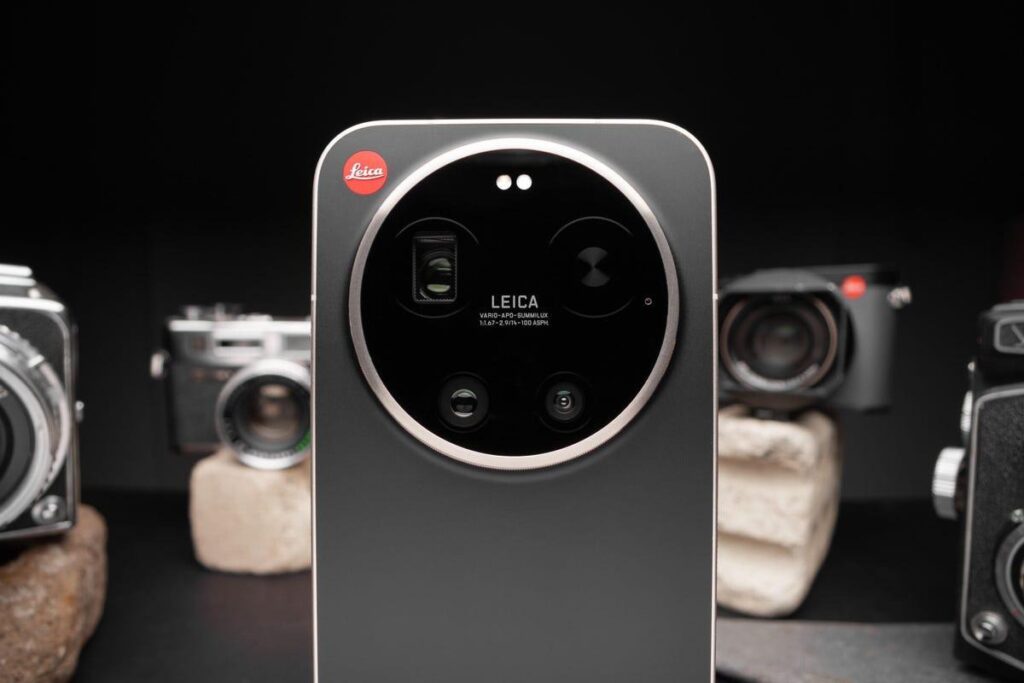
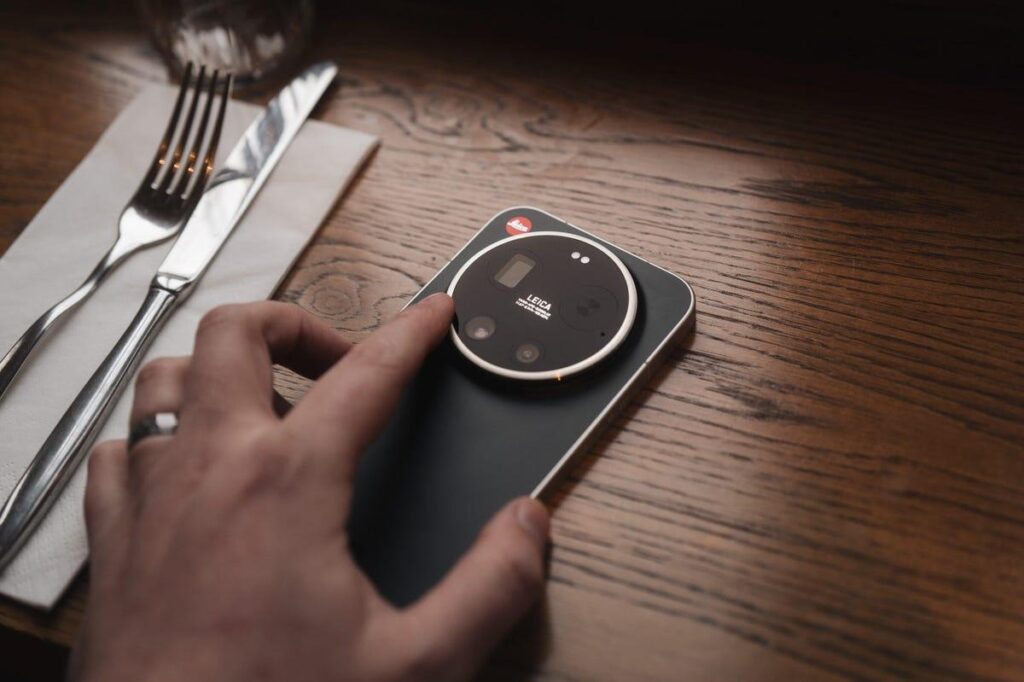
Yet the most conspicuous change is mechanical rather than digital. The rim of the camera module turns beneath the finger, accompanied by a deliberate haptic tremor meant to suggest the movement of gears. It is, at first encounter, pleasing in a trivial way. Its intended function is to adjust zoom, or to scroll through exposure and filter settings, depending on one’s preference.
The notion is sound, and not without precedent. Still, its execution leaves something to be desired. Though large by the measure of a phone, the camera housing is small when compared with a proper camera, and it sits too close to the body to be grasped comfortably. I have found myself reverting to the on-screen controls, which are simpler and quicker. With practice the ring might become instinctive.
Continuous Optical Zoom Explained
The presence of the zoom ring is not accidental. It corresponds to the 17 Ultra’s chief photographic claim: a telephoto lens with continuous optical zoom. Where the 15 Ultra relied on two separate telephoto units, this model merges the task into one. Xiaomi, having passed over the number sixteen in an effort to align itself with Apple’s arithmetic, now presents a single 1/1.4-inch 200-megapixel sensor coupled with a Leica APO lens. The lens moves through 3.2 to 4.3 times magnification, roughly 75 to 100mm in familiar terms, and shifts its aperture from f/2.39 to f/2.96 as it travels.
The difficulty is much the same as that observed in Sony’s Xperia 1 IV, which offered a continuous range of 3.5 to 5.2 times. The span sounds generous in theory but proves modest in practice. A photograph seldom alters its character dramatically within so narrow a band. Step beyond it and one returns to the ordinary expedients of digital zoom and sensor cropping, which are common to nearly every modern phone.
Real-World Image Quality: Strengths and Minor Flaws
The photographs it produces are, in the main, brilliant. The sizeable sensor yields a natural fall of focus and permits close work down to roughly thirty centimeters. It manages difficult light with composure, and in dim conditions it performs with assurance, though on one particularly bright afternoon it allowed the highlights to wash out more than I would have liked. I have tended to rely on Leica Authentic rather than Leica Vibrant. The former gives an image with a certain restraint, holding detail in light and shadow and avoiding the polished flatness that heavy HDR so often brings.
The remaining lenses maintain this standard, though I return most often to the telephoto. The principal camera employs a one-inch-type sensor, while it and the ultrawide and front-facing cameras each offer fifty megapixels. Among its technical novelties is a LOFIC sensor, designed to preserve highlight detail. In practice, this has allowed for skyline photographs of unusual contrast, and for night scenes in which bright lights retain their structure instead of dissolving into glare.
Flagship Performance: Hardware, Display, and Durability
For all the emphasis on optics, the device is not merely a camera with a screen attached. It carries the expected credentials of a flagship handset: Qualcomm’s Snapdragon 8 Elite Gen 5 processor, 16GB of memory, up to 1TB of storage (with 512GB available on the standard model), a 6.9-inch LTPO OLED display that shifts between 1 and 120Hz, and IP68 protection. The red dot may draw the eye, but the substance extends well beyond it.
Battery Life and Charging Speeds in Daily Use
The battery deserves notice of its own. At 6,000mAh, using a silicon-carbon design, it is not the largest available, and in fact falls short of the capacity offered in the Chinese model. Even so, it proves substantial in daily use. Despite the demands of a large display and high-end components, I have generally managed close to two full days between charges, though seldom with much reserve remaining. Charging is brisk: 90W over PPS by cable and 50W wirelessly. Use a standard third-party pad, however, and the speed drops to ordinary Qi levels, and there is no provision for the newer magnetic Qi2 system.
Final Verdict: Is the Leica Branding Worth the Premium?
Ultimately, the Leica Leitzphone by Xiaomi is not a revolution but an embellishment. It is confident in the red dot, turns its camera ring theatrically, and creates photographs which, more than not, are truly excellent. However, under the knurled aluminum and black and white icons, there is a fact that is difficult to deny, and that is that this is still, in essence, the 17 Ultra in a cleaner suit.
That is not an insult. The 17 Ultra is a flagship in its own right that comes with serious optics, a competent sensor stack, and battery life that does not give in when it is needed. The Leitzphone merely introduces a touch of pomp, and a conspicuous addition to the bill. To the Leica fanatics the badge can be worth all the additional pounds. Unless the small red emblem carries particular weight for you, there is little practical reason to pay more, a conclusion made easier by the fact that the standard 17 Ultra stands well enough on its own merits.