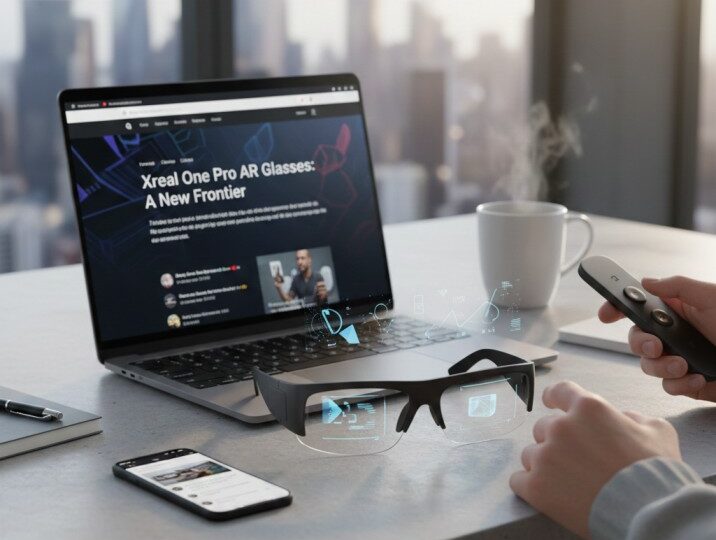

There is always a point at which usefulness gives way to showmanship, and the Xreal One Pro AR glasses do not cross it. They are best understood as a detachable screen for ordinary devices, whether mobile or fixed in place. Their most striking use is in entertainment, films and games benefit naturally from size and immersion, but their value is not limited to leisure. The presence of a large virtual display, either moving with the eyes or set firmly in space, removes certain everyday inconveniences and, in doing so, makes work feel simpler and more tolerable.
This advantage, however, comes with a qualification. For users whose interpupillary distance falls below 57 mm, the promise is only partially fulfilled. Watching videos and playing games remain pleasant enough, but sustained reading or writing soon becomes uncomfortable, and the sense of effort returns more quickly than it should.
Cost, Market Position, and Where to Buy
https://www.instagram.com/reel/DOOcCvUEnXI/?utm_source=ig_web_copy_link&igsh=MzRlODBiNWFlZA==
The Xreal One Pro AR glasses are sold at a price of $649 and can be purchased through Amazon or directly from Xreal’s own site. They sit at the upper end of a very small market, since only a handful of firms produce comparable AR glasses, and the One Pro is the costliest among them. This higher price is not without justification. It includes certain functions and refinements that are absent from rivals such as the Rokid Max 2, the Viture Luma Ultra, or the more economical RayNeo Air 3s Pro, though whether these additions warrant the expense will depend on the buyer’s priorities.
First Impressions: Packaging and Included Extras
The glasses arrive in careful packaging, housed in a black box trimmed with gold details that clearly aim to signal quality. Inside, the glasses rest in a sizeable protective case, with enough room to store both the device and its USB Type-C cable. Alongside this, Xreal includes a microfiber cleaning cloth, a lens insert frame, and several nose pad options to accommodate different faces. Users who need prescription lenses receive them separately, supplied through HonsVR, completing the set without unnecessary fuss.
Xreal One Pro AR Glasses Specs
Each eye is served by a display capable of a standard resolution of 1,920 by 1,080 pixels, which can be widened to 3,840 by 1,080 in the ultra-wide setting. The virtual screen measures 171 inches by default, though this can be extended further depending on viewing distance. At the core sits a 0.55-inch Sony micro-OLED panel, delivering a perceived brightness of around 700 nits, with a quoted peak of up to 5,000 nits. The image refreshes at 120 Hz and is driven by the X1 system-on-chip, developed by Xreal itself.
The field of view spans 57 degrees, a figure that appears modest until experienced in practice. Audio is handled by a pair of speakers tuned by Bose. Interpupillary distance can be adjusted, with two hardware variants covering ranges from 57 to 66 millimetres and from 66 to 75 millimetres. Prescription lenses are supported and attach without complication. The glasses weigh 87 grams and rely on a single USB Type-C connection for both data and power.
Physical Design, Comfort, and Materials Used
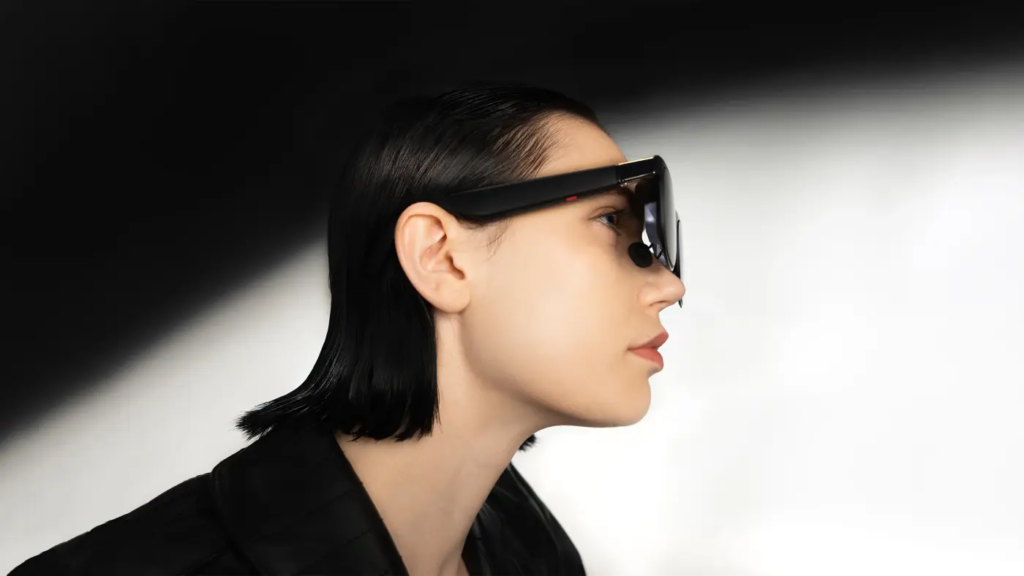
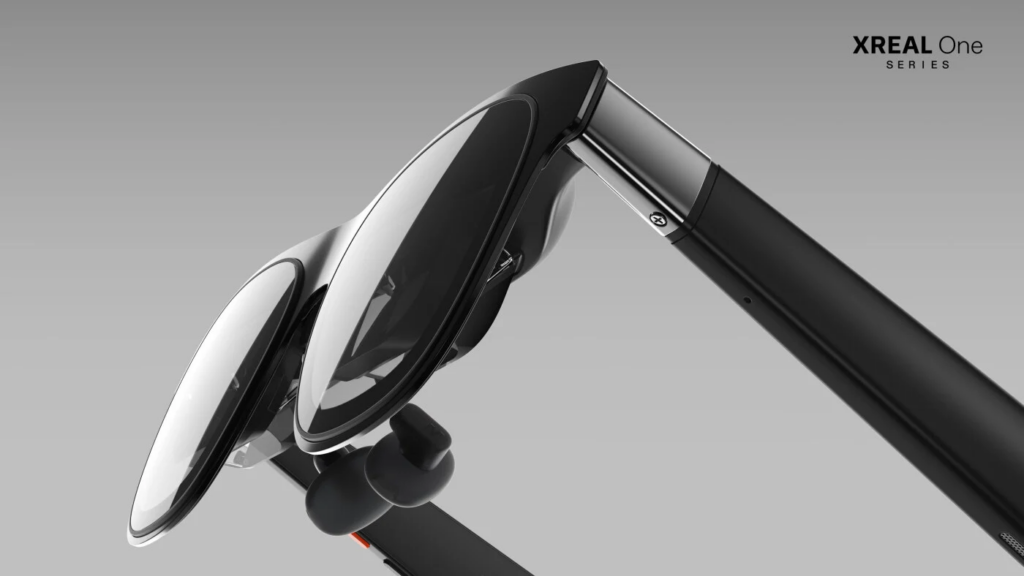
There is little to fault in the physical construction of the One Pro. The glasses feel sturdy in the hand, yet they retain enough flexibility to rest securely on the face. They are undeniably thicker and heavier than ordinary spectacles, weighing 87 grams, but the sensation of weight fades sooner than one expects. For those who rely on prescription lenses, the third-party inserts attach and detach without difficulty, and the frames still fold cleanly with the lenses in place.
After several minutes of use the frames grow slightly warm, though never to a degree that becomes distracting, even over longer sessions. Control buttons are arranged along the right arm, while a USB Type-C input sits at the end of the left. Small downward-facing speakers, tuned by Bose, are built into both arms and sit just above the ears.
The hinges at the ends allow for two stages of angle adjustment, enabling users to refine the position of the displays. These mechanisms are firm and require deliberate effort, usually with both hands. The first adjustment can be alarming, as the sound suggests something has snapped, but this is merely the nature of the mechanism. The connecting cable runs discreetly behind the ear and is long enough to reach a laptop on a desk or a phone kept in a pocket. It neither pulls at the frames nor intrudes on movement, which is a small but welcome mercy.
Controls, Display Modes, and Connectivity Options
On the right arm of the glasses, the controls are arranged with a certain plain efficiency. There is a red X-button, a small rocker beneath it for navigation, and above them a programmable Quick button. Each serves more than one purpose, and the Quick button in particular can be assigned three separate actions, depending on whether it is pressed briefly, held, or tapped twice. The system is logical once learned, though it demands a little patience at first.
The One Pro offers three degrees darkness through electrochromic adjustment, labelled by Xreal as Clear, Shade, and Theatre. An additional option allows the glasses to revert automatically to Clear mode when the wearer looks away from the projected image, a thoughtful concession to everyday use. Even in Theatre mode, the darkest setting, outside light is not entirely shut out, and a faint intrusion remains.
Because these glasses function, at heart, as a movable external screen, they work on a simple plug-and-play basis with laptops and phones that support display output over USB-C, as well as with handheld consoles like the Steam Deck. They draw no power of their own. In cases where extra power is required, Xreal offers a separate hub for $40, adding a second USB Type-C port so that power and display can be supplied at once. This becomes necessary with devices such as the original Nintendo Switch, which must be externally powered before it will send a video signal.
Real-World Experience: Comfort, Clarity, and Immersion
Above all else, the question of focus, and with it, immersion, is not settled in the same way for every wearer. Most adults fall within an average interpupillary distance of roughly 62 to 63 millimetres. Although the glasses technically accommodate measurements down to 57 millimetres, those nearer this lower limit, myself included, will find it harder to achieve consistent clarity, even with the built-in adjustments. The problem shows itself most clearly when reading text. Films and games remain engaging enough, but visual fatigue arrives sooner than it should.
For the majority of users, however, the experience is a strong one. Connecting the USB Type-C cable to any recent smartphone capable of display output simply mirrors the phone’s screen, while Samsung devices with DeX support open up the fuller desktop-style environment. When paired with a laptop, the glasses behave like a conventional external monitor, and they integrate just as smoothly with devices such as the Steam Deck.
Travel, Entertainment, and Productivity Use Cases
The real advantage of AR glasses reveals itself not at a desk, but in transit. I used the Xreal One Pro on a long flight, with a layover in between, and found that it transformed an otherwise tedious stretch of time into something genuinely pleasant. It was there, too, that the limits of certain modes became clear. In a moving vehicle, the display works best when set to follow the gaze, since the anchored option allows the image to drift as the plane shifts.
Watching films at full dimming, paired with noise-cancelling headphones, produced a convincing sense of sitting alone in a small cinema. After a few hours, my eyes needed a pause, which I took by switching tasks rather than stopping altogether, connecting the glasses instead to a Steam Deck. Playing Hyper Light Drifter on a large 1080p screen while cruising at altitude felt quietly astonishing, a reminder of how quickly such luxuries have become ordinary.
Screen Size, Field of View, and Spatial Adjustments
The system allows for numerous adjustments in viewing distance and screen size, letting users settle on a balance that suits their comfort. Push the image too far, however, and the edges slip beyond the field of view, requiring head movement to compensate. There is also an ultra-wide option that stretches the display to a 32:9 ratio, creating a broad workspace better suited to productivity.
Bringing the screen closer and enlarging it is when the stated 57-degree field of view makes itself felt. Though modest on paper, it appears far more generous in practice. Adjusting the interpupillary distance reduces the maximum screen size, and the default configuration (apparently Xreal’s preferred setting) places the image four metres away at a virtual size of 171 inches. In this arrangement, the whole display remains visible at once, without the need to turn one’s head.
Final Words
The Xreal One Pro is in that weird place of true innovation and true inconvenience. At $649, you are buying freedom off small screens and the possibility of watching movies in economy seating without having to strain your neck to watch a seatback screen, both worthy of attainment. But this liberty comes with conditions carved in millimeters: in case your eyes are closer than normal, you will have to compromise.
To the lucky who have the conventional interpupillary dimensions, these glasses do just what they say: a movie theater in your luggage, a computer in your pocket. We are all left peering in at paradise through a window that is only half-focused. The following version will hopefully keep in mind that human beings do not all fit in the same size. Until that time, think over your measurements before commit your wallet.