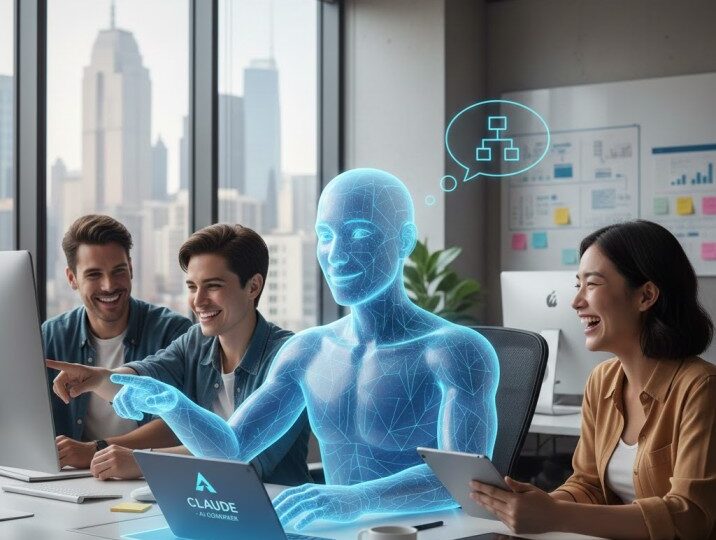

Office Work Does Not Look Quite The Same After The Introduction Of Claude Cowork, A desktop-based agent that changes the position of artificial intelligence in daily labor. The system is no longer limited to answering questions when spoken to, but assumes the role of a colleague who gets on with the job. When allowed to see local folders, it can work its way through directories in a methodical way, bring order to files that have become chaotic, and transform loose collections of screenshots into orderly tables of data.
The importance of such a change would be less in novelty than in continuity, the machine can now continue working on a task over time, tackling its lesser difficulties without constant direction, and in so doing it lessens the friction involved in ordinary office work.
From Reactive Assistants to Persistent Digital Coworkers
At the center of this shift is the ability to engage in work over long spans with little guidance. Earlier tools were easily broken and had to be steered at every turn. The more recent forms of office automation demonstrate more stability. They can be trusted with entire undertakings instead of isolated steps.
A worker can establish the boundaries, grant access where necessary, and then leave the sorting of large collections of documents or the creation of reports from scattered notes to the system. The advantage is not only saving of time, but it is a freeing of attention, as repetitive processes are given over to the machine and human efforts are kept for decisions that still require care and responsibility.
Why Large Companies Are Re-evaluating AI at Scale
Large organizations have begun to pay close attention to the recent changes in Anthropic’s systems, seeing in them a way to deal with problems of scale that were once managed only by layers of staff. The release of the Claude Max tier is a turning point, in the sense that it eliminates many of the practical limitations on the system’s use, and makes it suitable for teams that must operate with a high degree of independence.
In practice, companies are taking advantage of this freedom to establish smaller, more specialized agents, one for watching compliance, another for examining code, each of which can remember a working memory from one session to the next, and which thus act less like an instrumentality and more like a standing office function.
Building AI That Works Within Real-World Constraints
The focus of these new features is as much on restraint as strength, which is critical in tightly regulated areas. Anthropic has introduced the Model Context Protocol, which is an open framework designed to connect the system with external stores of information without yielding control over privacy.
Through this arrangement, the AI can use records from customer databases or internal messaging systems, condense long exchanges to their core and convert them into readable lists of tasks inside project management software. The effect of this is to reduce the distance between discussion and action, while keeping sensitive information within defined boundaries.
India’s Growing Role in the Global AI Workforce
India has come to occupy a central place in Anthropic’s plans and has now become the company’s second-largest market. In recognition of this, a large office is to be set up in Bengaluru by the beginning of 2026. Dario Amodei has pointed to the depth of technical skill in the country as a decisive factor in building forms of artificial intelligence that are meant to be broadly useful rather than narrowly impressive.
Alongside this expansion, the company is paying more attention to the linguistic diversity in India, with improved performance in Hindi and a variety of other regional languages. The aim is a set of tools that can be used across offices and industries without forcing workers into a single linguistic mould.
A Shift From Demonstration Models to Endurance Systems
The present version of Claude also represents a clear break from its former character. Where previous models were largely limited to helping with writing or small pieces of code, the system has now been reworked to be a desktop-based agent working in the user’s working environment. This is not just a cosmetic shift. Earlier iterations often became lost when asked to carry a problem through several stages.
The latest model, Opus 4.5, has more staying power, capable of solving programming tasks on its own for longer periods of time and solving problems that previously required sustained human supervision. The change implies a shift away from clever demonstrations towards tools for sustained, practical use.
Final Words
Seen from a strategic angle, these changes make Claude a practical choice for organizations intent on changing the digital work. The shift away from simple conversation toward direct action is a sign that artificial intelligence has outgrown its usefulness as a source of quick reference, and has begun to serve as a reliable assistant, capable of taking on the repetitive duties that fill so much of office life.
By providing the system with a long-term memory and tools that work directly on the desktop, Anthropic has changed the character of Claude from that of a responsive program to that of an active collaborator. The move from the simple exchanges to the handling of entire pieces of work – not just demanding programming work, but also the coordination of documents between departments – puts it squarely in the category of the most useful instruments for large-scale automation in the modern enterprise.