
In the current Android world, almost all smartphones are either MediaTek or Snapdragon (by Qualcomm) powered. These two silicon giants control the mobile processor market, provide nearly all the major smartphone brands, and compete intensely in performance, battery life, gaming, and life cycle. However, they follow quite different paths to work even though they have the same job description. But which one should you have in your next phone?
MediaTek vs Snapdragon Processors
Two Chipmakers, Two Philosophies
On the face of it, MediaTek and Snapdragon are doing the same thing: they power smartphones. However, their approach to that task cannot be more different.
Snapdragon
Snapdragon is a mobile processor that was created by Qualcomm and has been regarded as the gold standard of mobile processors. Qualcomm, based in San Diego, is the maker of Snapdragon chips that power some of the most premium smartphones in the market. Snapdragon is frequently used in flagship devices, high-performance gaming phones, and best-selling models to continue their reputation.
Snapdragon processors are well separated into levels. The flagship phones and the highest performance are occupied by the Snapdragon 8 series. Below it, the 7 and 6 series serve the upper mid-range and mainstream devices, whereas the Snapdragon 4 series targets entry-level and low-end smartphones.
MediaTek
MediaTek, a Taiwanese company, has pursued a more modest yet no less ambitious course. Previously being linked to low-end phones, MediaTek has gradually increased its presence, especially in the mid-range market. Its Dimensity family has been able to compete with Snapdragon due to its ability to provide good performance, good 5G coverage, and power efficiency at affordable prices.
This strategy is reflected in the processor lineup of MediaTek. The Dimensity 9000 and 8000 series are aimed at flagship performance, whereas the Dimensity 700 and 600 series are oriented at mid-range gadgets with stable 5G functions. Helio series is committed to budget phones without 5G.
The result? MediaTek is no longer the cheap alternative. It now serves a large portion of the gadgets of such brands as Realme, Vivo, Xiaomi, Oppo, and Infinix, and does so with confidence.
Performance
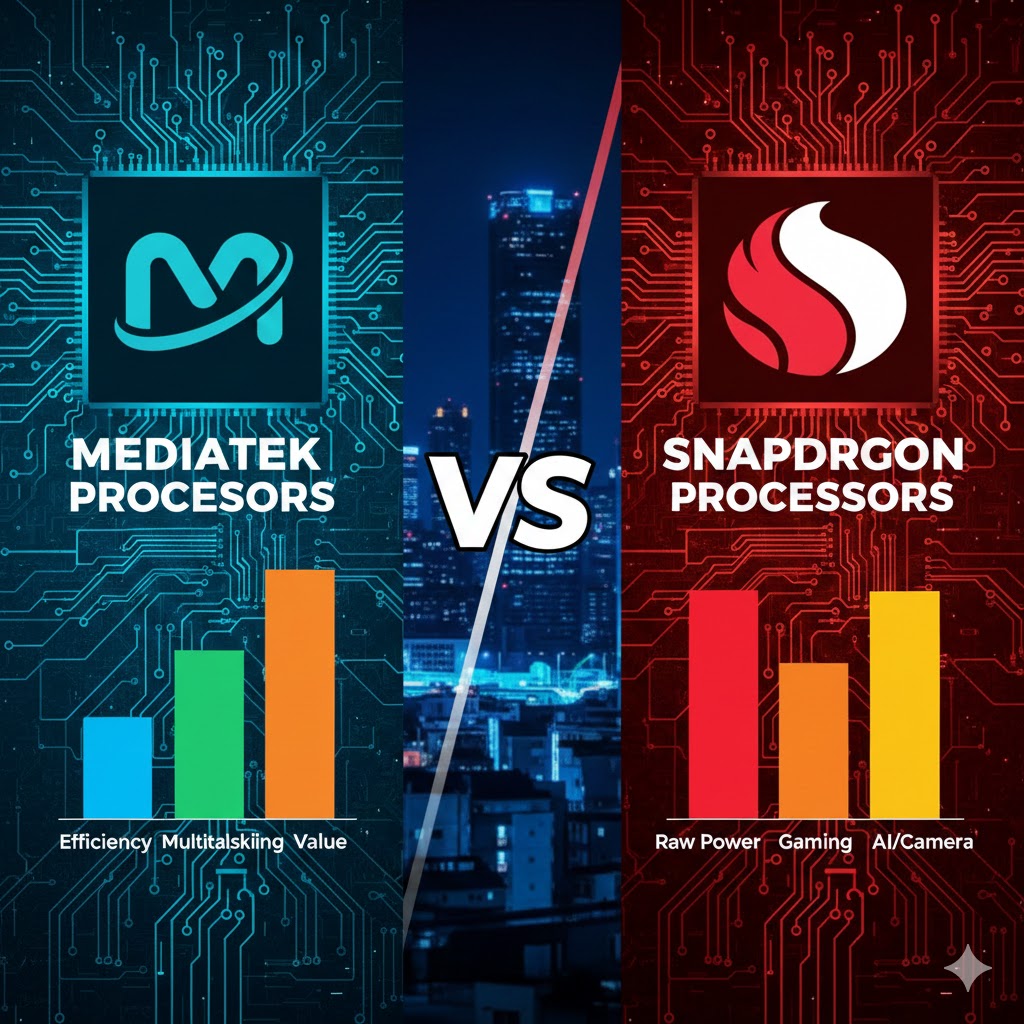
The competition is interesting when it comes to raw processing power. Snapdragon processors are characterized by good single-core performance. This is more than it appears. Single-core speed impacts the speed at which apps open, the responsiveness of your phone and the smoothness of daily tasks. Concisely, Snapdragon chips are more likely to be perceived as fast during normal operations.
MediaTek has however taken big strides in the multi-core performance, particularly with its Dimensity 8000 and 9000 series. Multi-core strength is effective in multitasking, video editing and AI-based work. In some instances, MediaTek chips are now equal or even surpassing Snapdragon in these aspects.
Graphics and Gaming: A Familiar Winner
Graphics performance is the area that Snapdragon has traditionally led in, and continues to lead in to a large extent. The Adreno GPUs of Qualcomm are generally considered the Android gaming standard. They have superior frame stability, more comfortable performance, and more powerful optimization in titles that are more demanding, such as PUBG, Genshin Impact, and Call of Duty Mobile.
MediaTek is dependent on the Mali and Arm Immortalis GPUs, which have been enhanced. Nevertheless, they continue to lag behind Adreno GPUs in sustained performance and heat management, particularly when playing longer games. With that said, the newer Dimensity chips by MediaTek have bridged the gap to the point that even casual and even semi-serious gamers will not feel cheated.
AI Capabilities: Small Margins, Real Gains
Artificial intelligence is not merely a buzzword in this case, but it is involved in photography, voice recognition, and background tasks.
Snapdragon has a minor advantage due to its Hexagon AI processors, which are capable of managing such features as face detection, voice assistants, and camera improvements effectively.
The Dimensity series by MediaTek also features an independent AI Processing Unit (APU), which has been enhanced at a rapid rate. Although it might not be the leader in the category, it provides good on-device AI assistance, especially in the mid-range and high-end phones.
Practically, both platforms perform daily AI tasks sufficiently to not make a significant difference to the majority of users.
Battery Life: MediaTek’s Quiet Strength
One of the areas that MediaTek tends to lead is battery efficiency. With effective fabrication methods and intelligent power control, MediaTek chips, especially the Dimensity 6100, 8100, and 9200 series, would be more likely to provide a better screen-on time. This can be a significant benefit to users who are more interested in all-day battery life than performance.
Snapdragon, however, has been inconsistent in its performance in terms of heat and power consumption. More recent chips such as the 8 Gen 2 and 8 Gen 3 have better thermal control and better performance per watt.
The conclusion is quite straightforward, MediaTek is mostly the choice of an everyday user for long battery life, and Snapdragon is the choice of a power user, who is ready to sacrifice some efficiency to get a performance.
Camera Performance: Refinement vs. Progress
The image signal processor (ISP) of the processor tends to determine the capabilities of the camera. Snapdragon chipsets have been characterized by high ISPs, which help in processing images faster, low-light performance, and other advanced features like 8K video recording, multi-frame noise reduction, and faster autofocus.
MediaTek has also improved significantly, particularly with its more premium Dimensity chips, which have AI video enhancement, HDR capture, and high-resolution image support. Nevertheless, Snapdragon still has an advantage in high-quality camera optimization and sensor compatibility.
Software Updates and Developer Support
This is where Snapdragon obviously takes the lead. Phones based on Snapdragon are generally get faster Android updates and have more developer and custom ROM support. This is the reason Snapdragon devices are preferred by users who are interested in rooting, modding, or creating their own Android builds. Historically, MediaTek devices were lagging behind in this respect, but the situation has started to change with the newer high-end models.
Recent Chip Developments
The newest flagship chips of Snapdragon are characterized by performance improvements, increased AI capabilities, better GPUs, and thermal control. The new Dimensity processors by MediaTek are dedicated to the full-performance CPU architecture, ray tracing, better ISPs, enhanced connectivity, and smarter thermal scheduling.
The takeaway? The two platforms are now offering state-of-the-art performance and are the beginning of a new age of AI-driven mobile computing.
Choosing the Right Processor for You
You should lean towards MediaTek when you desire high value, good battery life and good performance in mid-range phones, without worrying about custom ROMs and extreme gaming.
Snapdragon is more reasonable in case you require flagship performance, the best gaming experience on mobile, high-quality camera features, and good software support.
Final Words
The MediaTek vs. Snapdragon debate does not have a clear winner, just more suitable options to different users. Snapdragon targets gamers, creators and performance lovers. MediaTek is bright among ordinary users who require efficiency, reliability and value without paying a high price. Ultimately, brand loyalty is probably not a good reason to factor in the buying decision.