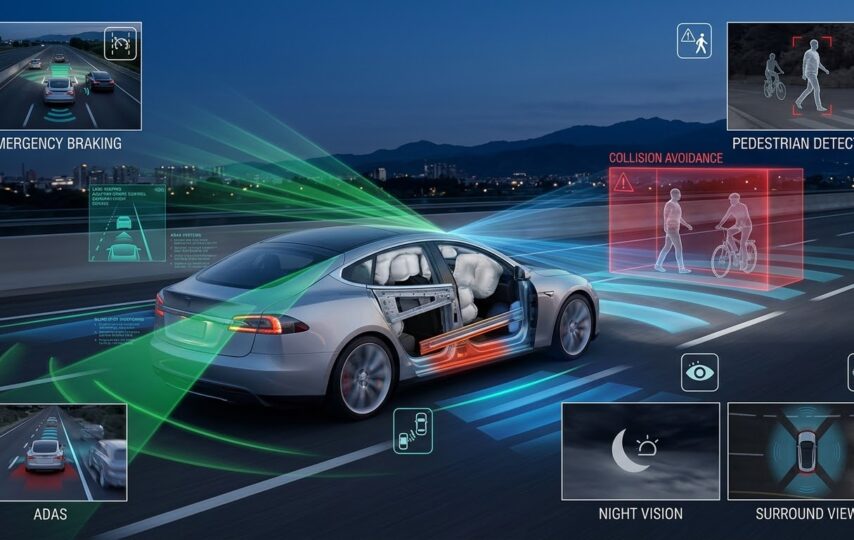

Automotive safety has advanced dramatically in recent years. What once relied mainly on seatbelts and airbags has evolved into a network of sensors, cameras, and intelligent systems designed to prevent accidents before they occur. Modern vehicles now include technologies that monitor the road, assist drivers in real time, and reduce the impact of collisions.
These innovations help address common causes of accidents such as distraction, fatigue, and limited visibility. Below are some of the key automotive safety technologies helping reduce risk on today’s roads.
- Automatic Emergency Braking (AEB)
Automatic emergency braking is one of the most important safety technologies in modern vehicles. Using sensors, radar, and cameras, the system constantly monitors the distance between a vehicle and objects ahead.
If a potential collision is detected and the driver does not react quickly enough, the system automatically applies the brakes. This can either prevent the crash entirely or significantly reduce its severity.
- Lane Departure Warning and Lane-Keeping Assistance
Lane departure warning systems monitor road markings and alert drivers if the vehicle begins drifting out of its lane. This often happens when drivers are tired or distracted.
Lane-keeping assistance adds another level of protection by gently steering the vehicle back into the lane if the driver does not respond to the warning.
- Adaptive Cruise Control
Adaptive cruise control improves upon traditional cruise control by automatically adjusting a vehicle’s speed to maintain a safe distance from the car ahead.
Using radar or camera systems, the vehicle slows when traffic slows and accelerates again when the road clears. This feature helps reduce driver fatigue and improves safety during long journeys.
- Blind Spot Monitoring
Blind spot monitoring systems help drivers detect vehicles that may not be visible in mirrors. Sensors positioned around the vehicle identify cars approaching from behind in neighboring lanes.
When another vehicle enters the blind spot, the system alerts the driver through visual indicators or warnings.
- Rear Cross Traffic Alert
Reversing out of parking spaces can be difficult when visibility is limited. Rear cross traffic alert systems detect vehicles approaching from either side while the driver is backing up.
If a vehicle is detected, the system provides visual or audible warnings to help prevent a collision.
- Driver Monitoring Systems
Driver fatigue and distraction are major causes of accidents. Driver monitoring systems use cameras and sensors to observe behavior such as eye movement, head position, and steering patterns.
If signs of drowsiness or distraction are detected, the system alerts the driver and may suggest taking a break.
- 360-Degree Camera Systems
Parking in tight spaces can be challenging, particularly with larger vehicles. A 360-degree camera system uses multiple cameras around the vehicle to create a bird’s-eye view of the surroundings.
This improves visibility and helps drivers avoid obstacles that might otherwise be difficult to see.
- Intelligent Traffic Sign Recognition
Traffic sign recognition systems use cameras to identify road signs such as speed limits or stop signs. The information is then displayed on the dashboard to help drivers stay aware of current road rules.
Some vehicles also integrate this system with cruise control to help maintain appropriate speeds.
- Automatic High-Beam Headlights
Driving at night can reduce visibility, but automatic high-beam systems help maintain optimal lighting conditions.
The system automatically switches between high and low beams depending on surrounding traffic, improving visibility while preventing glare for other drivers.
- Vehicle Stability Control
Electronic stability control helps drivers maintain control during sudden maneuvers or slippery conditions. The system monitors steering input and wheel speed to detect when a vehicle begins to skid.
It then adjusts braking and engine power to help restore stability and keep the vehicle on its intended path.
Choosing Vehicles with Advanced Safety Features
As safety technology continues to improve, many drivers prioritize these systems when selecting a vehicle. Buyers researching options, such as a Jeep for sale San Diego, often consider safety features alongside performance and comfort. Dealerships such as carlburger.com showcase vehicles that combine durable automotive engineering with advanced safety technologies.
The Future of Automotive Safety
Automotive safety technology will continue evolving as artificial intelligence, advanced sensors, and connected vehicle systems develop further. Future vehicles may share road hazard information and help prevent accidents through predictive technology.
While no system can remove risk entirely, these innovations are already making modern roads significantly safer.