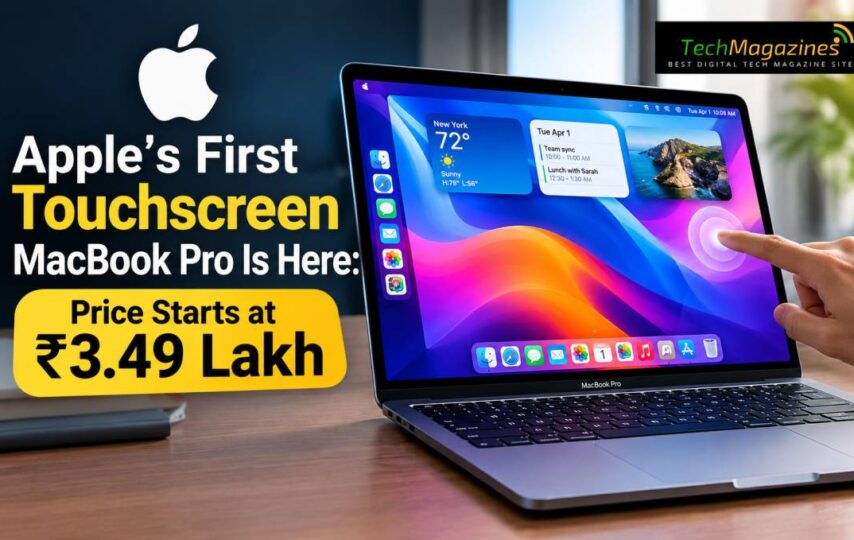

Apple has changed course on a feature it kept out of the MacBook Pro for years: touchscreen operation. The company showcased its latest professional laptop at the “Pro and tell” event on Wednesday, introducing an OLED display alongside its M5 Pro and M5 Max processors. The redesign also brings a lighter chassis and a revised interface intended to make better use of touch input.
The 14-inch model will retail for Rs 3,49,900 in India, with the larger 16-inch version carrying a price tag of Rs 4,09,900. Apple plans to make the new laptops available from November 9.
Touchscreen Controls Meet Apple’s Familiar MacBook Design
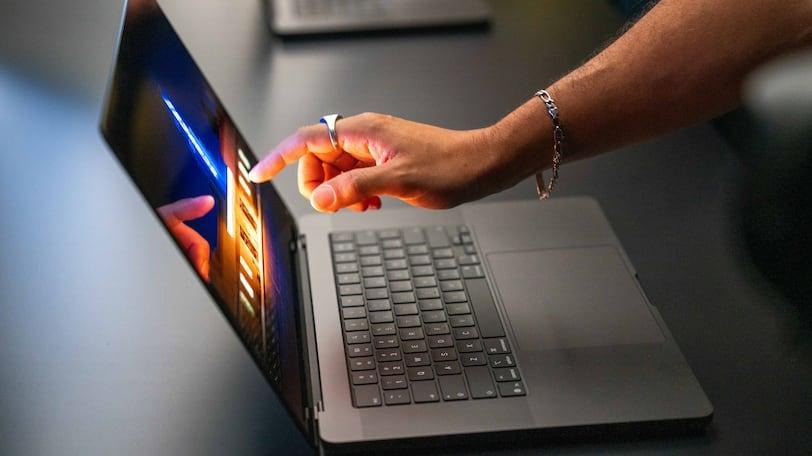
The change gives MacBook Pro owners another way to interact with their work. Rather than relying solely on a trackpad or keyboard, they can manipulate images, mark up documents and sketch directly on the display. The feature may be particularly useful in fields where hands-on control matters. Designers can work with 3D objects on screen, for example, while musicians can adjust production settings by touching the relevant controls.
The latest MacBook Pro changes how users access information without removing the keyboard and trackpad that have defined the laptop. Apple has also brought Dynamic Island to the Mac. The feature sits along the top of the screen and displays updates from Live Activities, music playback and other functions. Users can also call up Spotlight search from this area.
OLED Visuals, M5 Processors and Upgraded Hardware
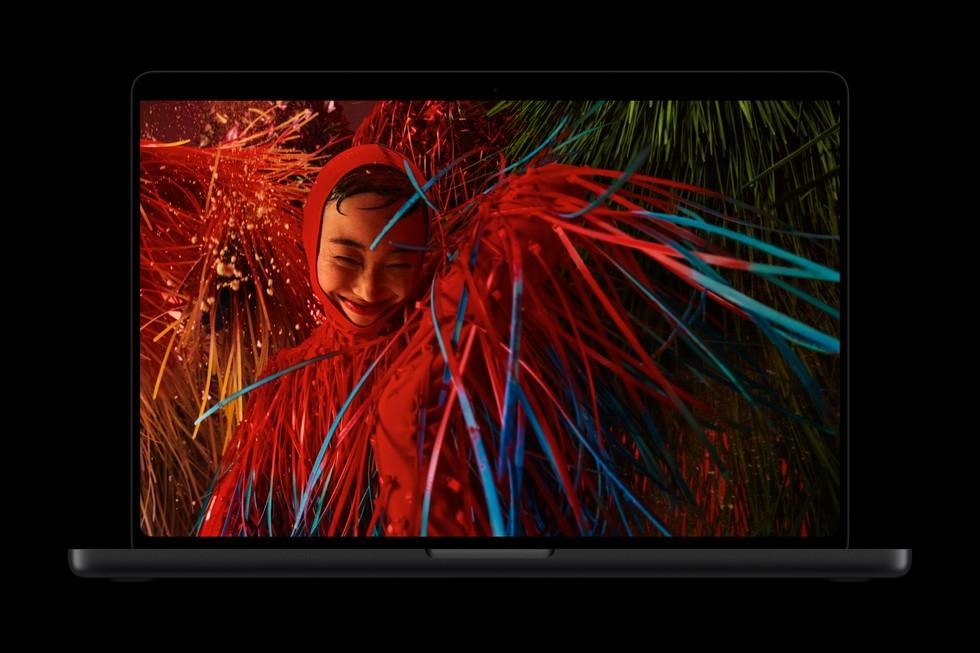
Apple has made substantial changes to the display as well. The new PROLED XDR panel uses tandem OLED technology to improve picture quality, producing deeper blacks, stronger contrast and more accurate colours. Its ProMotion system adjusts the refresh rate up to 120Hz. HDR material can reach 2,000 nits of peak brightness. Those who work in brightly lit spaces can opt for a nano-texture finish, which helps limit distracting reflections.
Processing power comes from Apple’s M5 Pro and M5 Max chips. The company has designed them for work that demands considerable computing resources, including complex video projects, 3D graphics, software development and artificial intelligence. Each chip includes Neural Accelerators within its GPU cores to speed up AI processing. Apple also offers storage options of up to 16TB and says the new machines can transfer data at up to twice the previous storage speed.
Apple has revised several other parts of the MacBook Pro. A new thermal design manages heat, while six speakers handle audio output and three microphones support studio-quality recording. The machine also supports Wi-Fi 7 and Bluetooth 6. Apple has kept the main physical connections, including HDMI, an SDXC card reader, MagSafe 3 and a headphone socket. Three Thunderbolt 5 ports round out the selection.
The company promises as much as 24 hours of battery life. It also says a 30-minute charge can replenish the battery to 50 per cent. The new machines weigh less than the previous models, making the redesign more than a change to the screen alone.
Why Apple Finally Embraced Touchscreen Laptops
For years, Apple treated the touchscreen laptop as a poor idea. Steve Jobs made his objection clear in 2010, when he said that using a touchscreen on a laptop would be ergonomically uncomfortable. Tim Cook defended a similar distinction between devices in 2012. He likened the attempt to combine a tablet and a laptop to joining a toaster with a refrigerator.
Apple did eventually try touch controls on its laptops, though not on the main display. The Touch Bar arrived on the MacBook Pro in 2016 as a narrow, touch-sensitive strip in place of the physical function keys. The company later abandoned the experiment. Its 2021 redesign restored the traditional keys, and by 2023 Apple had discontinued the Touch Bar.
The latest MacBook Pro takes a different course. Instead of replacing familiar controls, Apple has added touch input alongside them. The keyboard and trackpad remain, but users can now work directly on the display. This is a clear shift from the company’s earlier position, though it stops short of turning the Mac into a touchscreen-only device.
Final Words
The first MacBook Pro with a touchscreen is a major change in Apple’s laptop policy, as the company has long been hesitant to embrace touch technology. The new models provide more than just a fingerprint-reactive screen, featuring OLED technology, M5 Pro and M5 Max processors, and a new interface. They also claim to have practical applications for creative professionals and demanding users.
But the laptop is not an impulse buy, starting at Rs 3,49,900 for the 14-inch variant. Whether the touchscreen and performance enhancements are worth the extra price to consumers will determine its popularity. Apple has also refrained from abandoning the traditional controls, indicating that the keyboard and trackpad are not leaving anytime soon.
The true challenge starts Nov. 9, when users will be able to get their hands on the device. After years of thinking that touchscreens and laptops don’t make a good pair, Apple is finally giving them a shot. It’s yet to be seen if it’s going to be a love story or a costly experiment.