
In the rapidly accelerating world of digital commerce, geographical borders have become little more than lines on a map. Today’s businesses—from ambitious e-commerce startups to established global enterprises—operate in a truly borderless environment. They source materials from Asia, hire freelance developers from Eastern Europe, run marketing campaigns on US-based platforms, and sell products to customers worldwide. However, while the operational side of global business has become incredibly fluid, the financial infrastructure supporting it has historically lagged behind.
For decades, small and medium-sized enterprises (SMEs) were forced to rely on traditional banking systems designed for an analog era. Cross-border transactions were synonymous with exorbitant wire fees, opaque foreign exchange (FX) markups, and frustrating delays that could stretch for days or even weeks. Furthermore, managing corporate spending using physical bank cards presented significant challenges in terms of security, expense tracking, and scalability. Fortunately, the landscape is undergoing a dramatic transformation. The rise of innovative financial technology (fintech) platforms is democratizing access to global financial tools, allowing modern enterprises to manage multi-currency funds and international payouts with unprecedented efficiency.
The Evolution of Corporate Expense Management
One of the most critical challenges facing growing global businesses is expense management. In an era where companies rely on dozens of distinct software-as-a-service (SaaS) platforms, digital advertising networks like Google Ads and Meta, and diverse international suppliers, keeping track of outgoing funds is a monumental task. Traditional corporate credit cards simply fall short. They are rigid, difficult to issue to multiple team members, and carry a high risk of compromise. If a physical card’s details are stolen or if a vendor experiences a data breach, the entire card must be canceled and reissued, causing massive disruptions to automated business processes.
This is where fintech steps in to solve the core operational bottlenecks. Modern financial platforms are moving away from physical constraints and embracing digital-first solutions that offer agility, real-time data visibility, and granular control over corporate spending.
The Power and Security of Virtual Financial Instruments
At the forefront of this revolution is the widespread adoption of virtual payment technologies. Unlike their physical counterparts, virtual cards are digitally generated sets of 16-digit numbers, complete with expiration dates and CVV codes. They function identically to traditional cards for online purchases but come with a sophisticated layer of programmable controls.
The security benefits alone have made virtual payment solutions a cornerstone of modern business operations. Companies can generate unique card details for specific vendors or individual subscription services. If a specific merchant’s database is compromised, the business only needs to delete that single virtual number, leaving all other automated payments and ad campaigns entirely unaffected. Furthermore, financial controllers can set strict dynamic spending limits, expiration dates, and merchant category restrictions, virtually eliminating the risk of overbilling or employee misuse.
For modern entrepreneurs seeking seamless global operations, having access to a free virtual credit card can dramatically reduce overhead and simplify the process of scaling international ad campaigns or managing ongoing software subscriptions. By eliminating issuance fees and allowing instant generation, these digital tools empower teams to move fast without sacrificing financial oversight.
Bridging Collection and Spending: The All-in-One Fintech Ecosystem
While managing outgoing expenses is crucial, it is only one half of the global business equation. The other half is efficient revenue collection. Historically, businesses had to use disparate systems: one platform to receive funds from international marketplaces, another to handle currency conversion, and a traditional bank to handle outgoing payments. This fragmented approach led to a loss of margin through double-conversions and administrative bloat.
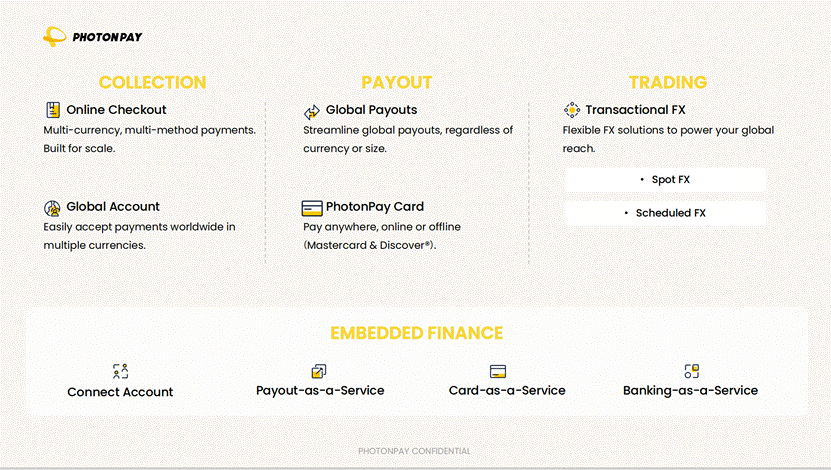
Today’s industry leaders are consolidating these functions into unified financial ecosystems. A prime example of this integrated approach is PhotonPay. Designed specifically for the needs of globalized digital enterprises, PhotonPay goes beyond basic payment processing by offering a comprehensive suite of financial infrastructure services. Its key capabilities showcase exactly how modern platforms are removing friction from cross-border commerce:
Global Accounts: Businesses can create domestic and multi-currency accounts in minutes, seamlessly manage finances across various business entities, and effortlessly collect revenue from major marketplaces like Amazon and Shopify.
Card Issuing: Teams benefit from the instant issuance of multi-currency commercial cards designed for both online and offline spend, backed by comprehensive expense management and smart reconciliation features.
Online Payments: The platform enables merchants to accept payments in 100+ currencies across 200+ countries, utilizing top-class risk control mechanisms and low fees to significantly boost authorization rates.
Payouts: Companies can streamline their global mass payouts in over 60 currencies, leveraging efficient one-click payment execution and bank-beating foreign exchange rates.
FX Management: Users gain access to 24/7 currency exchange capabilities with real-time interbank rates and automated scheduling, helping to systematically mitigate ongoing FX risks.
Embedded Finance: Forward-thinking businesses can innovate with PhotonPay’s API-first platforms for Accounts-as-a-Service, Card-as-a-Service, and Payment-as-a-Service, streamlining compliance and the onboarding process.
Empowering the Next Generation of Global Innovators
The integration of global collection, currency exchange, and intelligent corporate spending tools is fundamentally changing how companies scale. It removes the friction that once held back SMEs from competing on the global stage. By leveraging advanced APIs and automated reconciliation features, finance teams can shift their focus away from tedious manual administrative work and toward strategic growth initiatives.
Looking ahead, the fintech industry is poised for even deeper integrations with artificial intelligence and automated accounting software. Predictive analytics will soon help businesses optimize their cash flow dynamically, recommending the most cost-effective times to convert currencies or warning them of impending subscription renewals.
Conclusion
The narrative of global business is no longer written exclusively by multinational conglomerates with massive treasury departments. Thanks to the relentless pace of fintech innovation, any digital business now has access to enterprise-grade financial tools. By embracing comprehensive platforms like PhotonPay and utilizing flexible, secure tools for everyday operational expenses, modern companies can navigate the complexities of cross-border commerce with confidence, security, and absolute control. The future of business is borderless, and the financial infrastructure to support it has finally arrived.