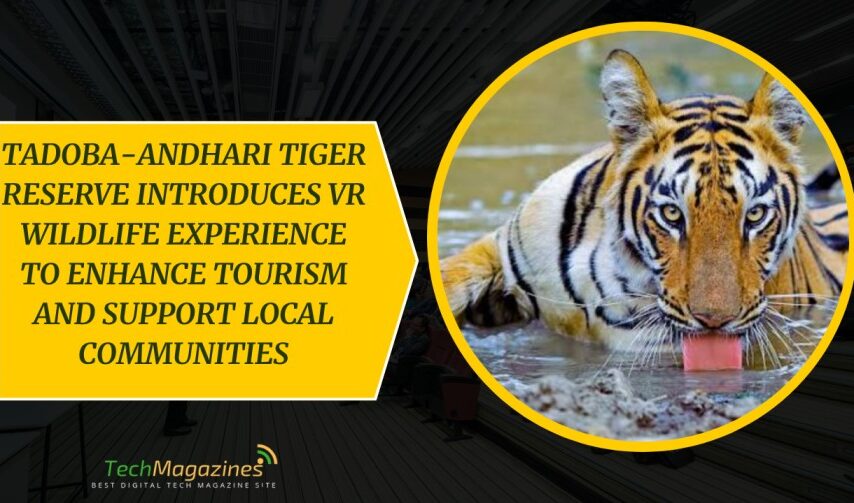

Tourists at Tadoba-Andhari Tiger Reserve are no longer restricted to the typical safari as a means of exploring the forest. A new order has been established. It provides a six-minute virtual movie which presents the reserve in a more understandable and well-organized way than reality can sometimes permit. The viewer observes the forests in every season, the animals in action and the landscape as it evolves with time. A lot of this would be left to chance and chance is seldom a sure thing.
The intent is not very complicated. It tries to provide a more in-depth understanding of the forest and its mechanisms to the tourists. It eliminates distance and substitutes chance with certainty. Meanwhile, it has another purpose. It provides jobs to locals and a more reliable income stream than the unpredictable stream of tourists. By so doing, the experience achieves two things simultaneously. It redefines the way nature is perceived and it is silently transforming the way it is utilized.
Expansion Plans and a Push Toward Smarter Tourism
The new arrangement has begun at the Moharli and Khutwanda gates, though it will not remain limited to them for long. More units are to be placed at other entry points, in proportion to the number of safari vehicles that pass through, so that access may be spread more evenly. There is also talk of extending the system to nearby resorts, if demand proves steady, and of linking it with the ‘Chala Mazha Tadoba’ programme, which aims to instruct visitors rather than merely entertain them.
The officials speak of this in plain terms. Prabhu Nath Shukla, who oversees the reserve, describes it as an effort to join modern devices with the older task of conservation. The intention, he suggests, is to guide tourism into a more responsible form while giving local people a stake in it. It is a practical idea, and one that avoids grand claims.
Small Fees, Bigger Impact for Nearby Communities
Each unit is placed under the care of a young person from the nearby buffer villages. They manage the device and collect a small fee of fifty rupees for each viewing. The sum is modest, but the effect may not be. It is expected that about forty people will find steady work through this scheme. In this way, the forest does not stand apart from those who live near it, but begins, in a limited sense, to support them.
Final Words
The most recent experiment of Tadoba shows that it is not only animals that can adapt in the wild. The reserve is not substituting the safari, it is redefining it, by exchanging a slice of uncertainty with a six-minute dose of virtual clarity. The VR experience seals the gaps left by luck, and silently creates a more sustainable means of livelihood in the local communities. It is conservation with a practical twist: less rhetoric, more practical solutions.
Naturally, no headset will be able to replace the excitement of seeing a tiger with the naked eye, but it will make sure that every visitor leaves with more than crossed fingers and blurred images. Should this balance be true, Tadoba might have discovered a rare middle ground in which technology, tourism and ecology do not clash, but actually work together. And in a world where even holidays can be erratic, that is a very reassuring trend.