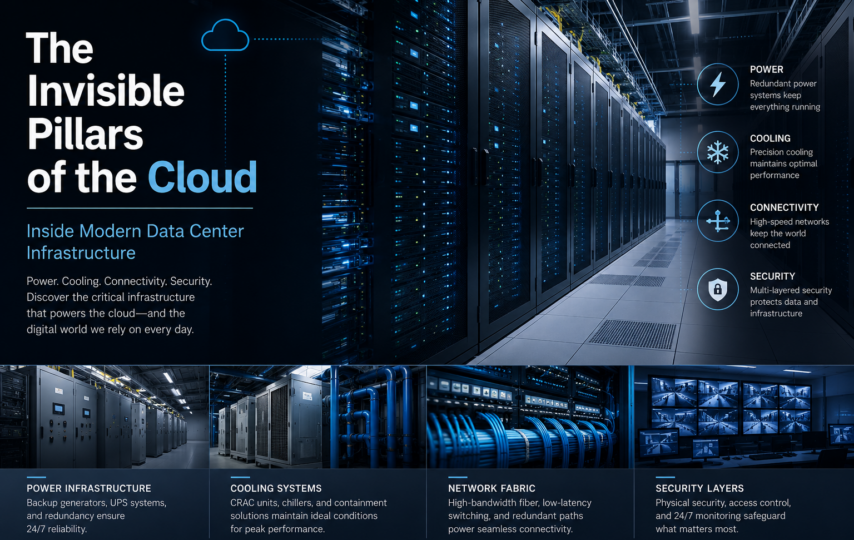

The modern data center is often completely invisible to the average internet user. We stream videos, send frantic messages, and store years of family photos in the cloud without ever thinking about the physical infrastructure making it all possible. Honestly, why would we? Behind every single digital action is a massive, highly coordinated facility designed specifically to keep information moving. These facilities operate constantly, managing massive amounts of electrical power, generating intense heat, and requiring strict security measures to protect the world’s information.
But have you ever paused to think about what actually happens when you click a link or save a file?
To really understand the scale of modern digital infrastructure, you have to look or maybe just peer behind the vague concept of the cloud. The cloud isn’t an abstract, magical space. It’s a physical, heavy network of concrete, steel, copper, and miles of fiber optic cables. Understanding how these facilities manage power, cooling, security, and scale reveals the true foundation of our digital lives.
The Foundation of Operations: Power Distribution
Power is the lifeblood of any facility handling large-scale computational workloads. A modern facility can consume as much electricity as a small town. It’s a staggering thought. This electricity drives thousands of servers, storage arrays, and networking switches. The primary challenge isn’t just securing enough power, but ensuring that power flows without any interruption.
Electricity enters a facility through high-voltage utility lines. It passes through transformers to step down the voltage to usable levels. From there, it moves through industrial switchgear and power distribution units. These units divide the electricity into smaller circuits that feed individual server racks.
Uninterruptible power supply systems act as a critical buffer. If the main power grid fails, large battery banks instantly take over the electrical load. This happens without a millisecond of delay, preventing servers from shutting down.
It keeps the digital world alive.
For longer utility outages, massive diesel generators serve as the backup. These generators can start and accept full electrical loads within seconds. And that’s the point. It allows the facility to run independently for days if necessary, humming away while the rest of the world goes dark.
The Human Element: Navigating the Staffing Crisis
While power, cooling, and scale form the physical foundation of digital infrastructure, none of these systems can function without human expertise. The rapid expansion of global computing infrastructure has created an intense demand for specialized talent. Finding individuals who understand high voltage electrical engineering, advanced liquid cooling mechanics, and critical facility operations has become a significant challenge for operators everywhere.
The talent gap is widened by the specialized nature of these environments. A standard IT technician or traditional facility manager often lacks the training required to work around live, mission-critical server architecture, where a single mistake can cause millions of dollars in downtime.
But where do you find people trained for such high stakes?
Because the industry is growing faster than traditional educational pipelines can produce qualified workers, operators face a continuous talent shortage. I guess it’s a classic case of technology outpacing human supply chains.
So, how do operators manage this massive personnel demand?
You know, to handle this, the industry increasingly relies on specialized skilled labor recruitment solutions. Partnering with staffing agencies that focus specifically on critical infrastructure allows operators to access a vetted network of technicians, engineers, and project managers. These staffing solutions provide flexible personnel options, allowing facilities to scale their workforce up during heavy deployment phases and down during routine operations. Utilizing targeted recruitment strategies is no longer just a convenience. It’s become a necessary operational strategy to keep the digital world running smoothly.
Managing the Heat: Cooling Infrastructure
Every watt of electricity delivered to a server rack eventually turns into heat. When thousands of servers operate closely together, they generate immense thermal energy. Without effective cooling, electronics would quickly overheat, leading to hardware failure and data loss.
Traditional cooling methods rely on raised floors and computer room air conditioners. These systems push cold air under the floor and up through perforated tiles in front of server racks. The hot air exhausted by the servers is then collected and returned to the cooling units.
As computing density increases, facilities are adopting more efficient cooling designs. Hot aisle and cold aisle containment systems physically separate the cold supply air from the hot exhaust air. This prevents the air streams from mixing, which significantly reduces energy consumption.
Many modern facilities now use liquid cooling technologies. Liquid conducts heat far more efficiently than air. Direct to chip cooling circulates a cooling liquid through specialized blocks attached directly to the processors. Another method, immersion cooling, submerges entire servers in a non-conductive dielectric fluid.
Computers running underwater, essentially.
It feels unnatural when you first see it. These advanced thermal management systems allow facilities to support high-density hardware without wasting excessive energy.
Physical and Digital Security
Protecting a large-scale computing facility requires a multi-layered approach to security. The data stored inside is highly valuable, making physical and digital protection equally important. Security begins at the perimeter and becomes more restrictive as you move closer to the actual server rooms.
The outer perimeter is typically protected by heavy fencing, concrete barriers, and continuous video surveillance. Security personnel monitor access points at all hours. Visitors and employees must pass through multiple authentication checkpoints before entering the building.
Inside the facility, access control relies on biometric scanners, such as fingerprint or iris readers, combined with secure badges. Passing through a single security door is rarely enough. Staff must often navigate dual door mantraps, which prevent unauthorized people from following closely behind someone else.
The server rooms themselves are divided into secure cages and locked cabinets. Every entry and exit is logged, and high-definition cameras record all activity within the aisles. If a hard drive or storage device fails, it doesn’t simply go into the trash. It’s physically shredded on-site to guarantee that old data can never be recovered by unauthorized parties. It’s a brutal but necessary end.
Achievable Scale and Modular Growth
The demand for digital services changes rapidly, meaning facilities must be built to scale efficiently. Designing a facility for maximum capacity on day one is often impractical and expensive. Instead, operators use modular design principles to grow as demand increases.
Modular architecture divides a facility into self-contained units, often called data halls or pods. Each pod contains its own power distribution, cooling infrastructure, and server racks. This structure allows operators to build out the physical structure of a building while only equipping the internal components as needed.
This approach to scale also extends to standardizing hardware components. Standardized server designs and rack configurations make deployment fast and predictable. Technicians can roll pre-configured racks directly onto the floor, connect power and network cables, and bring hundreds of servers online in a matter of hours. This predictability is essential for supporting global digital services that experience rapid user growth.