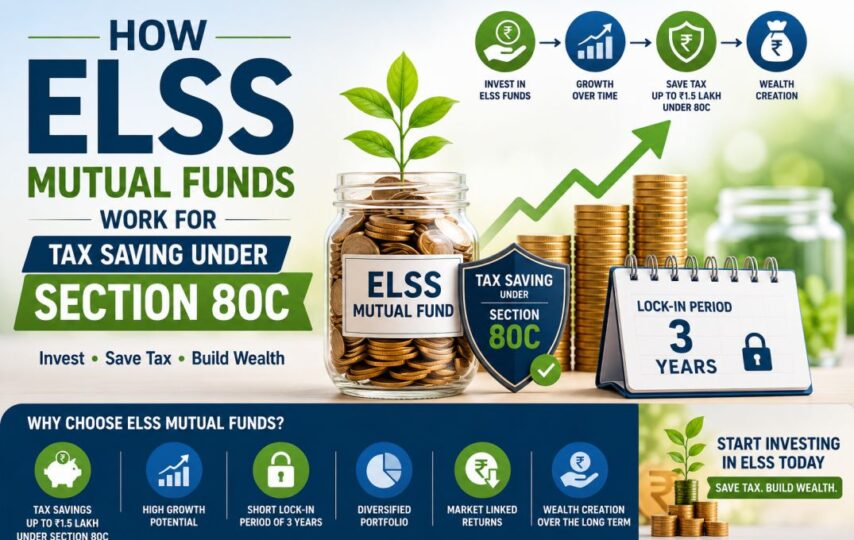

As the financial year progresses, many individuals following the old tax regime review their tax planning under Section 80C of the Income Tax Act, 1961, looking for ways to reduce taxable income. Among the available options, Equity Linked Savings Schemes (ELSS) are often considered by investors seeking tax efficiency along with equity market exposure. Understanding how ELSS works can help assess its role in overall tax and long-term financial planning.
What Is An ELSS Mutual Fund?
ELSS stands for Equity Linked Savings Scheme. It is a category of mutual fund that invests predominantly in equities and equity-related instruments. As per regulatory norms, at least 80% of the scheme’s corpus is allocated to equity and equity-linked securities.
Investments made in ELSS qualify for tax deduction under Section 80C, which allows individuals to claim a deduction of up to ₹1.5 lakh in a financial year from their taxable income, subject to prevailing rules.
How Does ELSS Help In Tax Saving?
The main benefit of ELSS under Section 80C is the tax deduction. Any amount invested in ELSS during a financial year, up to ₹1.5 lakh, may be deducted from your gross total income.
For example:
If your annual taxable income is ₹9,00,000 and you invest ₹1,50,000 in an ELSS scheme. Your taxable income may reduce to ₹7,50,000, subject to applicable provisions
The tax information in this article is based on prevailing laws at the time of publishing the article and is subject to change. Please consult a tax professional or refer to the latest regulations for up-to-date information.
Understanding The Lock-In Period
ELSS funds come with a mandatory lock-in period of three years. This means each investment cannot be redeemed before three years from the date of allotment.
If you invest through a Systematic Investment Plan or SIP, each instalment has its own separate three-year lock-in period.
Compared to several other Section 80C instruments, ELSS has one of the shortest lock-in durations. However, since ELSS invests in equities, returns are market-linked and may fluctuate over the short to medium term.
How Returns And Taxation Work
ELSS funds invest primarily in equities, which means returns depend on market performance. They are not fixed or guaranteed.
Gains from ELSS investments, after completion of the three-year lock-in, are treated as long-term capital gains. As per current tax regulations, long-term capital gains on equity-oriented funds are taxed above a specified exemption threshold at the applicable rate. Investors should refer to the latest tax rules before making decisions.
It is important to approach ELSS with a long-term perspective. Equity investments may offer the potential for capital appreciation over time, but they can also experience periods of volatility.
Investing Through Lumpsum Or SIP
ELSS investments can be made either as a lump sum or through SIPs.
- A lump sum investment may be considered if surplus funds are available.
- A SIP allows you to invest smaller amounts regularly, such as ₹2,000 or ₹5,000 per month, depending on scheme minimums.
SIPs can help distribute investments across different market levels. However, this does not eliminate market risk. It only structures the investment approach.
To understand how your contributions may accumulate over time, you may use an ELSS calculator. Such tools allow you to enter the investment amount, assumed rate of return and tenure to view illustrative projections.
An ELSS calculator for investments can also help compare how different monthly or annual contributions may influence the potential corpus over time under assumed return scenarios.
Key Features Of ELSS At A Glance
Here are the core structural and regulatory features that define ELSS mutual funds under Section 80C:
- Investments in ELSS qualify for a tax deduction of up to ₹1.5 lakh in a financial year under Section 80C, subject to prevailing tax laws.
- ELSS investments are subject to a mandatory lock-in period of three years from the date of each investment.
- At least 80% of the scheme’s corpus is invested in equity and equity-related instruments.
- Returns from ELSS are market-linked and carry the potential for capital appreciation, along with the risk of volatility.
- Long-term capital gains arising after the lock-in period are taxed as per applicable equity fund taxation rules.
Who May Consider ELSS?
ELSS may be suitable for:
- Salaried individuals seeking to utilise their Section 80C limit
- Investors comfortable with equity market exposure
- Individuals with a time horizon beyond the lock-in period
- Those who understand and accept market volatility
ELSS may not be suitable for investors seeking capital protection or fixed returns, as equity markets can move unpredictably.
Conclusion
ELSS offers tax benefits along with equity exposure, but it should not be chosen only for tax saving. Investors may evaluate their financial goals, risk tolerance, time horizon and asset allocation before investing. Past performance does not indicate future results, as market and economic conditions can influence returns. Some investors spread contributions through SIPs during the year for discipline. As a market-linked investment, ELSS carries risk and should be considered based on individual suitability.
Mutual Fund investments are subject to market risks, read all scheme related documents carefully.
This document should not be treated as endorsement of the views/opinions or as investment advice. This document should not be construed as a research report or a recommendation to buy or sell any security. This document is for information purpose only and should not be construed as a promise on minimum returns or safeguard of capital. This document alone is not sufficient and should not be used for the development or implementation of an investment strategy. The recipient should note and understand that the information provided above may not contain all the material aspects relevant for making an investment decision. Investors are advised to consult their own investment advisor before making any investment decision in light of their risk appetite, investment goals and horizon. This information is subject to change without any prior notice.
The content herein has been prepared on the basis of publicly available information believed to be reliable. However, Bajaj Finserv Asset Management Limited does not guarantee the accuracy of such information, assure its completeness or warrant such information will not be changed. The tax information (if any) in this article is based on prevailing laws at the time of publishing the article and is subject to change. Please consult a tax professional or refer to the latest regulations for up-to-date information.