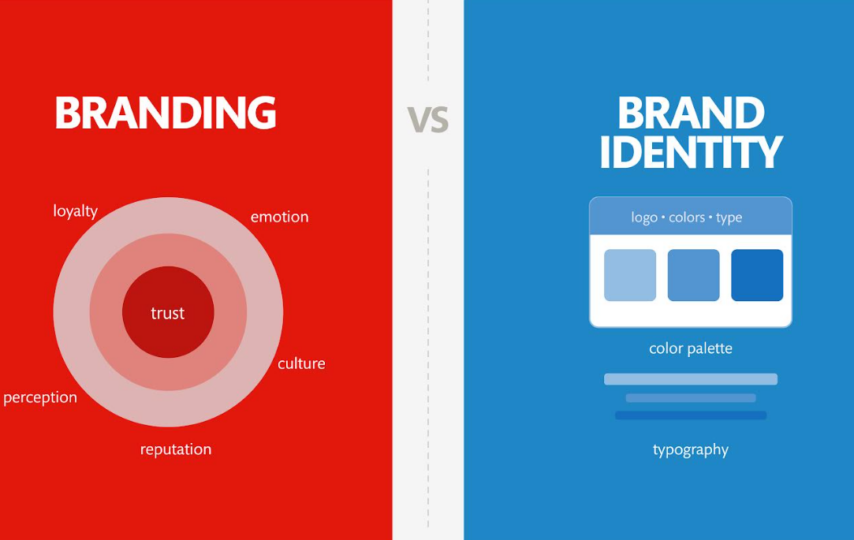

In the current highly competitive business market, what businesses need to outshine others is not just an attractive logo or catchy slogan. What they need is engaging in proper branding and building up a brand identity. Hence, understanding Branding vs Brand Identity is essential for businesses that want to build a strong market presence and create lasting relationships with customers.
Whether one decides to work with a Branding agency or plans to develop one’s own strategy, knowing the difference between branding and brand identity is crucial, as it plays an important role in influencing one’s value and competitive stance in the market.
What is Branding?
Branding is the way people think of a company, product, or service. It includes a business’ mission, values and reputation. It shapes and influences what customers feel about a business. For instance, people’s perception of a company as trustworthy or innovative comes from the successful branding efforts made by the company.
What is Brand Identity?
Brand identity includes within itself all the visual elements that represent a brand. This includes the logo of the company, the colour schemes, typography and packaging styles it uses.
Creation of a strong brand identity helps to create a professional visual identity that truly reflects the business’ brand values and also helps them to connect with their target audience. All these can be achieved with the help of a professional brand identity agency
Branding vs Brand Identity: 10 Key Differences
- Definition
Branding is how customers perceive and view a business.
Brand Identity includes within itself the entire collection of visual elements that represent the business.
- Purpose
The primary purpose of branding is to build a feeling of trust and loyalty within customers towards the company.
On the other hand, brand identity aims at creating visual recognition and makes a brand easily identifiable across different platforms.
- Focus
Branding focuses on creating positive customer perceptions and enhancing their experiences.
Brand identity focuses on design, aesthetic appeal and communication through visuals.
- Components
Branding includes within itself a company’s mission, values and customer service.
Brand identity includes elements like logos, fonts, colour palettes, graphics, icons, and packaging design.
- Emotional vs Visual Impact
Branding influences customers’ feelings and emotional attachment to a company. It creates emotional associations and trust.
Brand identity influences customers’ visual recognition and remembrance of a company.
- Development Process
Branding develops continuously through interactions with customers, marketing efforts, and business practices.
Brand identity is intentionally designed and implemented as a structured visual system.
- Measurement
The success of branding can be measured through loyalty and brand awareness among customers.
Brand identity’s success can be determined through visual consistency, recognition, and recall.
- Flexibility
Branding evolves with the change in expectations of the customers, trends in the market and goals of business.
Brand identity tends to remain more stable to maintain familiarity and consistency.
- Customer Influence
Branding directly shapes the opinions of customers and their purchasing decisions.
Brand identity supports those decisions by creating a memorable visual impression.
- Long-Term Business Role
Branding helps in building up a company’s reputation in the market.
Brand identity, through its visual elements, supports and enhances a company’s branding efforts over time.
Conclusion
Branding vs brand identity are different, but they combine to create an effective customer experience. While branding influences customers’ perception and connection with a business, brand identity provides the visual elements that help in creating those perceptions.
The coming together of both across websites, social media, packaging, and customer interactions helps build trust, improve brand recognition and strengthen long-term customer relationships and, in turn, also contribute to long-term profit goals.
FAQ
- How does branding differ from brand identity?
By definition, branding is how people perceive and experience a business in general, but brand identity is the group of visual parts that represent that business.
- What makes branding important for a business?
Branding shapes the perceptions of the customers towards the company, and hence effective branding would leave a positive impact on the customers’ minds. A well-planned business strategy often involves partnering with a brand identity agency, which in turn helps in improving the business.
- Can a company change its brand identity without changing its branding?
It is possible. If a company decides to change its logo, colours or visual items, it can do so while it keeps the same principles, goals and place in the market.
- Should small businesses invest in branding and brand identity?
To be successful, they should. When a business has a brand that is clear as well as a brand identity that stays the same, it is easier for that company to show that it is reliable. This will build customer trust and will, in turn, promote the business.