Lab grown diamonds (LGDs) are grown in controlled environments and identical to mined diamonds in crystal and optical properties. They are growing important over the last decade and projected to grown to $37.32 billion by 2028. The trend indicates wholesale lab grown diamonds share an upward growth tendency. Two dominant industrial synthesis methodologies are High Pressure High Temperature (HPHT) and Chemical Vapor Deposition (CVD). Let’s dive into two above primary process now.
How Lab-Grown Diamonds Are Manufactured?
Both HPHT and CVD begin with a seed crystal as a base of new diamond layers to growth on. The former replicates the temperature and pressure growing environments deep inside rocky crust of Earth while the later synthesizes diamonds by atom deposition in vacuum plasma machine. Nevertheless, they are completely different in raw materials, parameter setting of temperature and pressure, chemical reactions and growth cycles.
Pre-Production Steps Before Growing Diamonds
Necessary pre-setup and material checks before production are prerequisites of consistent quality. The stage involves standard preparations for two mainstream methods referred above and different material formulas and machine setups. Measures are taken to filter out low-quality seeds, unwanted metal impurities and prevent unstable machine heat, etc.
HPHT Diamond Process
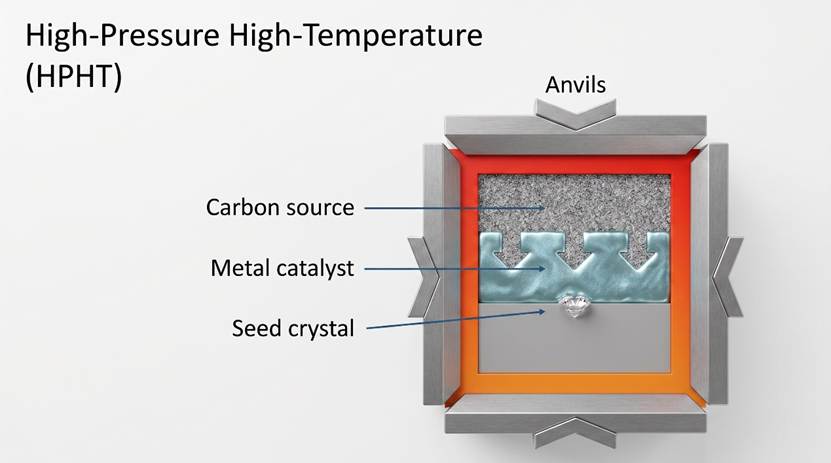
Carbon source and metal catalyst mix preparation. High purity graphite powder pressed in round blocks differs in grain sizes to adjust dissolution velocity for the purpose of different carat size production. Metal catalyst mix is made of nickel, cobalt, iron and small amount of aluminum, which is designed to inhibit the backward graphite formation. Metal liners are forged in advanced and put in press center to hold graphite blocks and seed crystals.
Cubic-anvil press calibration. The empty press chamber undergoes iterative debugging to ascertain six pressing heads equalize pressure on each carbide anvil face. In general, hydraulic power is set to hold 5–6 GPa pressure inside. Heating coils are tuned by built-in heat sensors to keep a constant temperature 1,400°C throughout the whole production process, reducing defect rates caused by uneven growth and metal impurities.
Place diamond seed in chambers. Pressed graphite blocks wrapped in pre-made metal catalyst liners are loaded into the core cavity of cube press.
High pressure and high temperature applied. Internal pressure and temperature are adjusted to 5–6 GPa and 1,350–1,600°C to mimic natural grown conditions in Earth.
Carbon melts and surrounds the seed. High temperature and pressure make graphite melts into liquid metal catalyst, then carbon atoms spread out and grown new layers on the seed.
Take out rough lab diamonds after cooling. High pressure and temperature applied to the synthesis assembly releases and cool down slowly after completion of crystal growth. Abrupt cooling would trigger cracks inside rough diamonds for the sake of thermal shock.
Chemical Vapor Deposition CVD Process
Carbon gas blend and vacuum chamber checks. Methane and hydrogen are blend at a volume ratio from 1:20 to 1:200. The mixed ratio dictates crystal growth rate and internal clarity. For instance, premium impurity-free Type IIa rough lab diamonds require 1% CH₄ and 99% H₂; 2%~3% CH₄ and 97%~98% H₂ are needed to speed up mass production process and guarantee quality; fast-growing thick rough diamonds requires no more than 5% CH₄ to prevent precipitation of graphite and subsequent milky flawed crystals. It should be verified that all air has been pumped out until ultra-low vacuum (10⁻⁶ torr) before pumping in carbon gas.
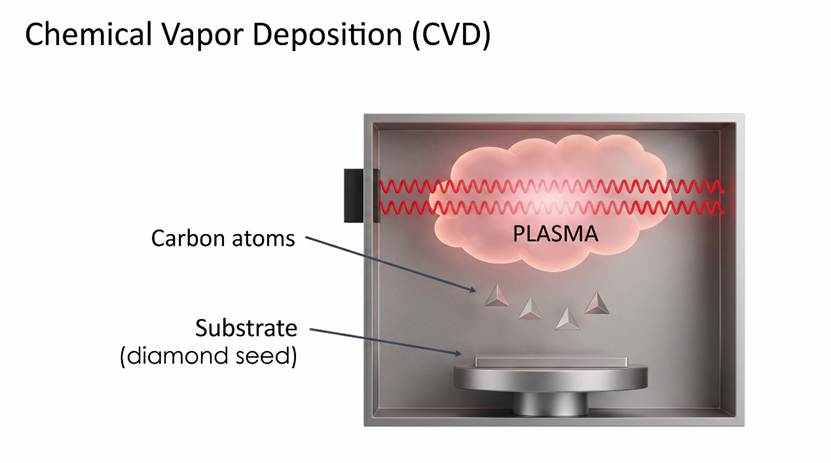
Tune gas flow velocity, microwave power and seed heating settings. All these three factors are regulated to make sure uniform temperature distribution on seed surfaces and prevent asymmetric layered deposition.
Seal the vacuum vessel and meter in carbon gas. Fix polished seed crystals onto temperature-stabilized holders in the plasma reactor.
Initiate plasma discharge to enable layered crystal growth. Microwave or RF power generates a high-frequency electromagnetic field, within which free electrons acquire kinetic energy and move at high speeds. High-speed electrons bombard CH₄ and H₂ molecules and cause ionization and dissociation of gas molecules. High-energy plasma comes into being following this reaction chain. Disassociated carbon atoms migrate towards the heated seed surface and bind to form micrometer-thick diamond crystal layers. Dopant gas metered in chamber in the deposition phase aims at inducing color variation as requirements.
Retrieve rough lab diamonds after plasma power and gas shutdown. Plasma power and gas supply cut off in case diamonds grow to target thickness. Internal crystal stress is prone to trigger cracking, lattice dislocation and chipping in polishing in fast cooling down. Slow down the cooling to release residual stress evenly. Remove rough CVD diamond blocks and clean soft carbon soot leftover via hydrogen plasma etching for surface smoothing.
How Long Do Lab Grown Diamonds Take to Make? HPHT & CVD Growth Cycle Comparison
Time frame of lab diamonds is essential for wholesalers of wholesale loose lab diamonds and lab grown diamond jewelry wholesale. It’s considered as indicators of cost. To a certain extent, power consumption set the cost of lab grown diamonds against current mass production technologies. Production cycle of lab diamonds differs on account of manufacturing method, desired carat & batch sizes and clarity.
| Diamond Size | CVD Time | HPHT Time |
| 1 Carat | 2–4 weeks | Few days–2 weeks |
| 2 Carat | 3–5 weeks | 2–3 weeks |
| 3 Carat | 4–6+ weeks | 3–4 weeks |
CVD diamonds are grown through epitaxial deposition of carbon radical layer by layer on diamond seed. Dissociated carbon moieties broken from methane-hydrogen plasma and bind to the crystal lattice in subsequent, gaining thickness in continuous cycling of chamber. Similarly, graphite carbon is dissolved by molten metal flux in HPHT synthesis, and they precipitate into diamond crystals in temperature-pressure equilibrium. Larger carat sizes mean longer growth time. In summary, carat weight of rough lab diamonds presents a direct positive linear correlation with growth duration.
Both HPHT and CVD diamond production start from seed crystals but differs in raw materials, parameter setting of machines and growth logic. The former gains an edge in production of small carat diamonds while the later leads in high-clarity large carat lab diamonds.