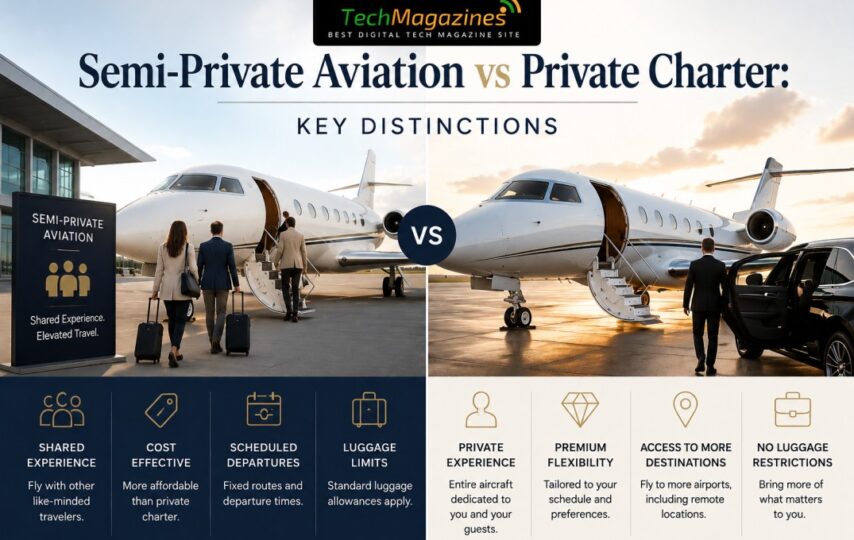

The private aviation industry has evolved significantly over the past two decades, creating a broader spectrum of travel options for individuals and organizations seeking alternatives to traditional commercial airlines. While private charter flights have long represented the benchmark for personalized air travel, the emergence of semi-private aviation has introduced a new model designed to bridge the gap between commercial and private flying.
At first glance, the two options appear similar. Both offer access to private terminals, streamlined airport experiences, and elevated service standards compared with commercial airlines. However, beneath these similarities lie fundamental differences in flexibility, privacy, operational control, accessibility, and overall value.
Understanding these distinctions is essential for travelers evaluating which model best aligns with their objectives. The decision is not simply about choosing between two premium travel experiences. It is about selecting the mobility solution that most effectively supports a specific travel requirement.
For business executives, entrepreneurs, family offices, and frequent travelers, this distinction can have significant implications for productivity, efficiency, and travel outcomes.
The Evolution of Alternative Air Travel
Commercial aviation remains the dominant mode of air transportation worldwide. Its extensive route networks and large-scale operations provide essential connectivity for millions of passengers every year.
However, commercial travel is optimized for volume rather than individual efficiency.
As traveler expectations evolved, private aviation emerged as an alternative focused on flexibility, privacy, and schedule control. More recently, semi-private aviation has entered the market as an intermediary model designed to offer certain private aviation benefits at a lower cost.
Today, these three models—commercial, semi-private, and private charter—occupy distinct positions within the aviation landscape.
Understanding where semi-private and private charter differ is critical for making informed travel decisions.
What Is Semi-Private Aviation?
Semi-private aviation combines elements of private aviation and scheduled airline travel.
Rather than chartering an entire aircraft, travelers purchase individual seats on flights operated by private aircraft.
In many respects, the experience resembles a premium airline service operating from private terminals.
Key characteristics of semi-private aviation typically include:
- Shared aircraft cabins
- Fixed routes
- Scheduled departure times
- Individual seat purchases
- Smaller passenger groups
- Access to private aviation facilities
Passengers benefit from reduced airport processing times and enhanced comfort while sharing the aircraft with other travelers.
The model seeks to deliver selected advantages of private aviation without requiring travelers to bear the cost of an entire aircraft.
What Is Private Charter?
Private charter represents the traditional private aviation model.
Instead of purchasing a seat, the traveler charters the aircraft itself.
The flight is arranged according to the client’s specific requirements, including:
- Departure times
- Airport selection
- Aircraft type
- Passenger list
- Routing preferences
The traveler effectively controls the entire mission.
This level of customization creates a fundamentally different experience compared with semi-private services.
Private charter is designed around flexibility and mission-specific mobility rather than standardized travel schedules.
Ownership of the Travel Experience
Perhaps the most significant distinction between the two models concerns control.
Semi-Private Aviation
In a semi-private environment, travelers purchase access to an existing flight.
The operator determines:
- Schedule
- Route
- Departure airport
- Arrival airport
- Passenger composition
While the experience is more exclusive than commercial travel, individual passengers have limited influence over operational decisions.
Private Charter
Private charter places control in the hands of the traveler.
The aircraft operates according to the client’s schedule and objectives.
This distinction fundamentally changes the nature of the journey.
Rather than adapting plans to a transportation service, the transportation service adapts to the traveler’s plans.
For many business travelers, this difference is the primary reason private charter remains the preferred solution.
Schedule Flexibility
Flexibility is often one of the most valuable aspects of private aviation.
Semi-Private Scheduling
Semi-private operators typically publish fixed schedules along predetermined routes.
Passengers select from available departures much as they would when booking an airline ticket.
Although the airport experience may be significantly improved, travelers remain dependent on established schedules.
Private Charter Scheduling
Private charter allows departure times to be aligned directly with business or personal requirements.
Flights can frequently be adjusted in response to:
- Extended meetings
- Schedule changes
- Operational requirements
- Unexpected opportunities
This adaptability creates substantial value for executives and organizations operating in dynamic environments.
Route Availability and Destination Access
Route flexibility represents another major differentiator.
Semi-Private Route Networks
Semi-private services generally focus on popular city pairs with consistent passenger demand.
Examples often include:
- New York to Miami
- Los Angeles to Las Vegas
- London to Paris
- Other high-traffic business and leisure corridors
While convenient, route options remain limited.
Travelers must choose from available networks.
Private Charter Accessibility
Private charter flights can access thousands of airports worldwide, including many regional and executive airports unavailable through scheduled services.
This capability enables travelers to:
- Reach remote destinations
- Avoid congested hubs
- Reduce ground transportation time
- Build customized itineraries
For organizations with unique travel requirements, destination flexibility often becomes a decisive advantage.
Privacy and Exclusivity
Privacy is frequently cited as one of the defining characteristics of private aviation.
However, privacy levels vary considerably between the two models.
Semi-Private Travel
Passengers share the aircraft cabin with other travelers.
Although the passenger count is significantly lower than on commercial flights, privacy remains limited.
Business discussions, confidential communications, and sensitive meetings may still require discretion.
Private Charter Travel
Private charter provides exclusive access to the aircraft.
Only invited passengers are onboard.
This environment supports:
- Confidential conversations
- Executive meetings
- Strategic planning sessions
- Sensitive negotiations
For corporate leaders, investors, and family offices, complete privacy often represents a significant operational benefit.
Productivity Considerations
Travel efficiency is increasingly measured according to productivity rather than transportation alone.
Productivity in Semi-Private Aviation
Semi-private cabins generally provide comfortable environments suitable for individual work.
However, shared occupancy limits opportunities for collaborative discussions and confidential meetings.
Productivity in Private Charter
Private charter aircraft effectively function as mobile offices.
Teams can:
- Conduct meetings
- Review confidential information
- Collaborate on projects
- Prepare for presentations
- Engage in strategic discussions
The ability to transform travel time into productive time is one of private charter’s most valuable advantages.
Multi-City Travel Capabilities
Business travel frequently extends beyond simple point-to-point transportation.
Semi-Private Limitations
Because flights operate on fixed routes, complex itineraries often require multiple bookings and schedule coordination.
Multi-city travel may be constrained by route availability.
Private Charter Flexibility
Private charter allows customized routing based on the traveler’s objectives.
Executives can frequently visit:
- Multiple cities
- Several countries
- Regional facilities
- Client locations
within a single day.
This operational flexibility significantly enhances mobility and productivity.
Reliability and Operational Control
Reliability influences both convenience and business effectiveness.
Semi-Private Operations
Semi-private flights generally operate according to established schedules and are subject to the operational constraints associated with shared transportation systems.
Passengers have limited control over schedule changes.
Private Charter Operations
Private charter offers greater operational flexibility and control.
Aircraft, routing, and departure timing can often be adjusted to support changing requirements.
This adaptability contributes to greater travel predictability and responsiveness.
Cost Considerations
Cost is one of the most visible differences between the two models.
Semi-Private Economics
Semi-private travel distributes aircraft operating costs across multiple passengers.
As a result, seat pricing is typically substantially lower than chartering an entire aircraft.
For individual travelers seeking an upgraded travel experience, this model can be highly attractive.
Private Charter Economics
Private charter involves exclusive access to the aircraft.
Consequently, costs are generally higher because the traveler assumes responsibility for the entire mission rather than a single seat.
However, direct cost comparisons can be misleading.
Organizations should also evaluate:
- Time savings
- Productivity gains
- Schedule flexibility
- Opportunity costs
- Business outcomes
The appropriate solution depends on travel objectives rather than ticket prices alone.
Who Benefits Most from Semi-Private Aviation?
Semi-private aviation is often well suited to:
- Individual travelers
- Leisure passengers
- Occasional business travelers
- Travelers on popular routes
- Individuals seeking enhanced comfort without full charter costs
These passengers frequently value the improved airport experience and premium service environment.
Who Benefits Most from Private Charter?
Private charter is typically most beneficial for:
- Corporate executives
- Entrepreneurs
- Family offices
- Investor groups
- Executive teams
- High-frequency travelers
These travelers often prioritize flexibility, productivity, privacy, and operational control over transportation cost alone.
Understanding the True Difference
The distinction between semi-private aviation and private charter is not simply a matter of price.
It is a matter of purpose.
Semi-private aviation enhances the scheduled travel experience by offering smaller passenger groups, streamlined airport procedures, and premium service standards. It remains, however, a shared transportation model operating according to predefined schedules and routes.
Private charter represents a fundamentally different approach. It is a customized mobility solution designed around the traveler’s specific objectives, priorities, and schedule.
The traveler does not purchase a seat. The traveler directs the mission.
This difference influences every aspect of the journey, from departure flexibility and destination access to privacy, productivity, and operational efficiency.
Choosing the Right Aviation Solution
Both semi-private aviation and private charter play valuable roles within the modern aviation ecosystem. Each serves a distinct market and addresses different travel requirements.
Semi-private services provide an attractive option for travelers seeking many of the conveniences associated with private aviation at a more accessible price point. Private charter, by contrast, delivers the highest degree of flexibility, customization, privacy, and operational control available in air travel.
The most appropriate choice depends on the mission.
When schedules are predictable and routes align with available networks, semi-private aviation may offer an efficient solution. When time sensitivity, destination flexibility, productivity, confidentiality, and schedule control become critical, private charter frequently emerges as the superior option.
Ultimately, the decision should not be based solely on cost or comfort. It should be based on which model most effectively supports the objectives of the journey. For travelers who view mobility as a strategic asset rather than simply transportation, understanding these distinctions is essential to maximizing the value of every flight.