

The Reno 16 lineup has now reached India, with OPPO introducing two models: the Reno 16 and the Reno 16c. Their arrival comes roughly six months after the Reno 15 series, which entered the Indian market in January. The new devices bring a revised design, updated internals, a broader set of AI-powered features, and a number of smaller refinements. The Reno 16c, meanwhile, stands apart from the Reno 15c by adding a dedicated telephoto camera, making it the more substantial upgrade of the two.
What follows is a closer examination of what OPPO has changed.
OPPO Reno 16 and Reno 16c India Price, Sale Date, and Availability Details
The OPPO Reno 16 starts at Rs 61,999 for the variant with 8GB of RAM and 256GB of storage, while the Reno 16c carries a starting price of Rs 46,999. OPPO has also announced the Bubble accessory, which is priced at Rs 7,999 and will go on sale from July 9. Both smartphones, together with the accessory, will be available through the OPPO Store, Flipkart, and Amazon. A second version of the Reno 16, with 12GB of RAM and the same 256GB of storage, is priced at Rs 67,999.
The Reno 16c offers three options. The base model, with 8GB of RAM and 128GB of storage, starts at Rs 46,999. Buyers can also choose an 8GB + 256GB variant for Rs 49,999 or a 12GB + 256GB model for Rs 55,999. The wider range gives the Reno 16c more room to appeal to buyers with different budgets and storage needs.
OPPO Reno 16: Display, Performance, Cameras, Battery, and AI Features
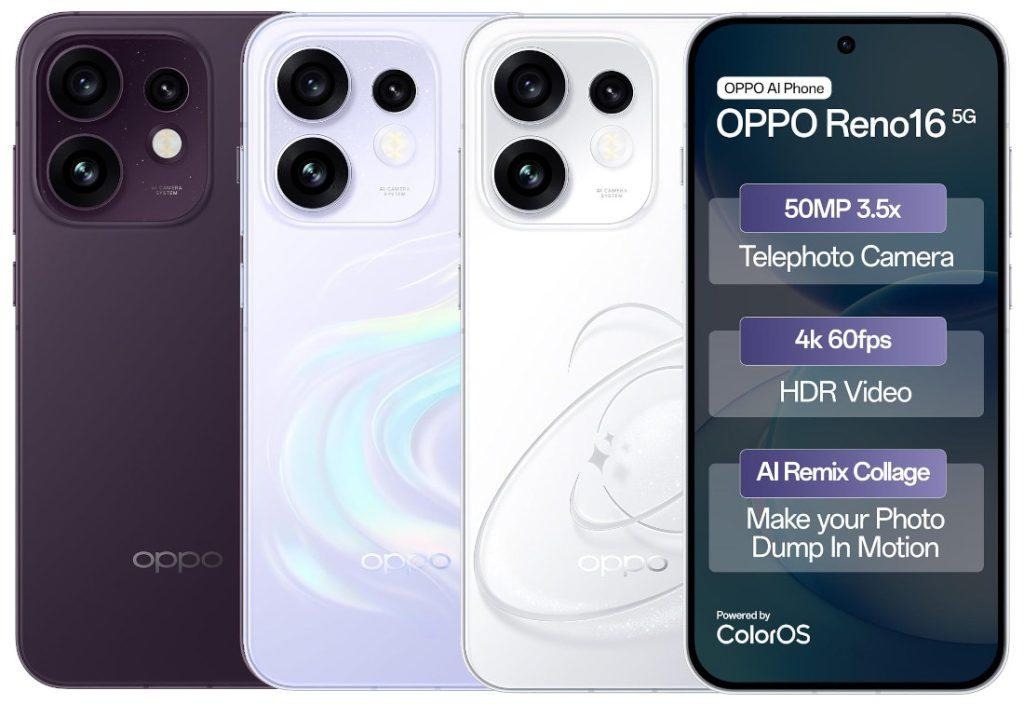
The OPPO Reno 16 features a 6.32-inch AMOLED display with a resolution of 2,640 x 1,216 pixels, a 120Hz refresh rate, and a peak brightness of 3,600 nits. Its smaller footprint gives the phone a different character. It sits more naturally in the hand and is easier to use with one hand than many larger devices. Those who have grown tired of oversized phones may find this a welcome change.
The phone runs on Qualcomm’s Snapdragon 7 Gen 4 processor, paired with 8GB or 12GB of LPDDR5X RAM and 256GB of UFS 3.1 storage. These specifications remain largely unchanged from the Reno 15, so performance is unlikely to differ in any significant way.
The battery measures 6,700mAh and supports 80W SUPERVOOC fast charging. That is only a modest increase of 200mAh over the Reno 15. The difference on paper is small. In daily use, however, the phone should still have little trouble lasting from morning until night.
The cameras are the Reno 16’s strongest point. OPPO has equipped the phone with four 50MP sensors, three on the back and one on the front. The rear setup includes a Sony LYT-600 main camera, a 50MP ultra-wide lens, and a 50MP Samsung JN5 telephoto camera with 3.5x optical zoom. A 50MP selfie camera sits on the front. It is a flexible system.
The telephoto lens, in particular, gives users more freedom to frame distant subjects without relying heavily on digital zoom. OPPO has also included several software additions. These include the Dual Flash System for brighter low-light shots, AI Remix Collage, Pop Cam, Popout 2.0, and Dual-View Video 2.0.
Everything the OPPO Reno 16c Brings to the Table
The Reno 16c takes a different approach. It has a larger 6.57-inch FHD+ AMOLED display with a 120Hz refresh rate and a peak high-brightness mode of 1,400 nits. MediaTek’s Dimensity 7300 powers the phone. Its real-world performance will become clearer after more extensive testing. The device also carries a 7,000mAh battery with support for 80W SUPERVOOC charging. That is a generous capacity. Under ordinary use, it should have little difficulty lasting well beyond a full day.
The Reno 16c also offers a capable camera system. It includes a 50MP main camera, an 8MP ultra-wide lens, and a 50MP telephoto camera with 3.5x optical zoom. That telephoto lens marks one of the biggest changes from the Reno 15c, which did without one. The addition should make the Reno 16c a stronger choice for zoom photography and give it an edge over many phones in the same price range.

Both the Reno 16 and Reno 16c carry IP66, IP68, IP69, and IP69K ratings for dust and water resistance. They ship with ColorOS 16.1 based on Android 16 and introduce several new software features. Among the most notable are AI Snap Key and Mind Space. Together, they let users capture on-screen content and arrange it in a single place for later use.
Mind Pilot serves as a common interface for Gemini, Perplexity, and ChatGPT, aiming to deliver more useful responses. The AI Snap Key itself is a dedicated hardware button on the Reno 16. It works in much the same way as the Plus Key found on recent OnePlus phones.
OPPO has added several other AI tools as well. AI Bill Manager records expenses from receipts or spoken notes and sorts them automatically, while also supporting real-time currency conversion. Other features include menu translation, live voice translation, recording stickers, and document scanning.
What Is the OPPO Bubble Accessory and How Does It Work?
The OPPO Bubble is a small accessory with a simple purpose. It attaches to the back of the Reno 16 through a magnetic sticker and adds a second display. The screen acts as a viewfinder for the rear cameras, making it easier to take selfies without switching to the front camera.
It also allows a degree of personalisation. Users can place wallpapers or interactive pets on the display. The Bubble itself features a 1.73-inch AMOLED screen with a brightness of 600 nits, a 560mAh battery, and an IP54 rating for protection against dust and splashes.
On paper, the Reno 16 makes the stronger case for buyers who want a compact phone without giving up capable cameras, steady performance, a large battery, or modern AI features. The Reno 16c costs less and offers a larger display, a capable camera system, and an even bigger battery.
Yet the Reno 15 series has not been on the market for long. Anyone thinking of an upgrade would do well to compare the two generations first and decide whether the changes are enough to justify the extra cost.
Final Words
Overall, the OPPO Reno 16 series is more of a strategic improvement than a radical overhaul. The Reno 16 is compact, has a versatile camera system and has slick AI features, while the Reno 16c is bigger and has a battery that is clearly not letting up on the weekend. Even though it’s not likely to be everyone’s “must have” gadget right away, the new Bubble accessory brings a fun element to the mix.
However, for current Reno 15 owners, it may be wise to hold off before picking up the phone, as the enhancements are significant, but not game-changers. But for all others, Reno 16 has a perfect balance of performance, photography, and software intelligence. Sometimes the best upgrade isn’t the loudest and neither of these phones make a big deal about it.