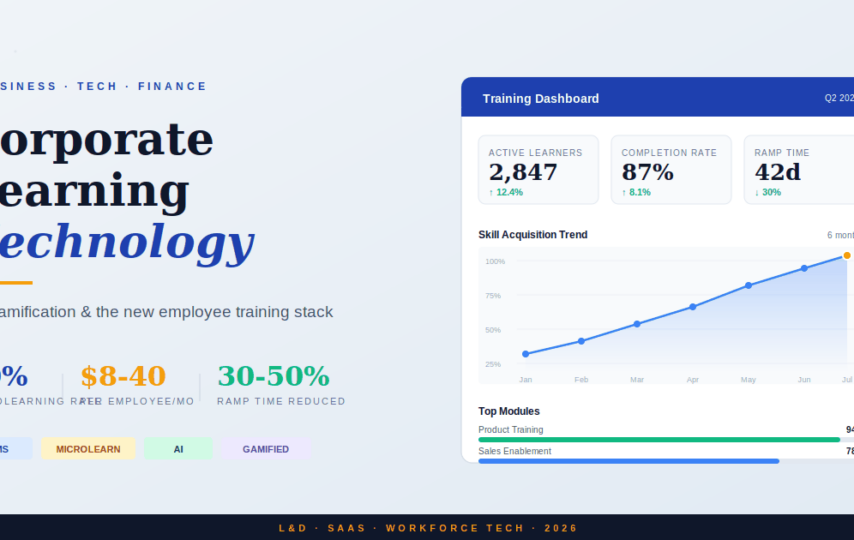

Employee training used to mean a two-day workshop in a hotel conference room and a stack of laminated handouts. In 2026, it means AI-personalized learning paths, gamified microlearning modules delivered to a phone during a lunch break, and dashboards that show a training manager exactly which employees mastered which skill last week.
The gap between these two worlds is the story of corporate learning technology. Companies that closed the gap are compounding workforce capability faster than their competitors. Companies that ignored it are still wondering why their onboarding takes six months and their retention numbers keep dropping.
This guide covers how corporate learning technology actually works in 2026, the platforms driving real business outcomes, the mistakes that quietly waste training budgets, and the metrics that separate a working L&D stack from an expensive one. Written for the professionals who have to make these decisions and defend them to a CFO.
What is corporate learning technology in 2026?
Corporate learning technology in 2026 is the stack of digital platforms, tools, and workflows companies use to train, upskill, and develop employees. It typically combines an LMS, microlearning platforms, AI-powered personalization, gamification elements, and analytics dashboards that measure real skill acquisition rather than course completions. The category expanded rapidly as remote work made in-person training impractical for most global teams.
Three shifts pushed corporate learning tech from a checkbox category into a genuine business priority.
Remote work broke the classroom model. When workforces went distributed, companies that relied on in-person training suddenly had no delivery mechanism. The scramble to digital forced years of platform evolution into months. Even companies that returned to hybrid or in-office models kept the digital layer because it worked better than they expected.
Attention spans caught up with reality. The average corporate learner will not complete a 60-minute compliance module in one sitting. They will, however, complete six 10-minute modules across a week. Microlearning stopped being a buzzword and became the default delivery format for platforms that wanted engagement rates above 20%.
Gamification proved itself with data. For years, gamification in corporate training was dismissed as childish. Then the data started arriving. Companies that added game mechanics to their training reported significantly higher engagement, completion rates, and knowledge retention. The same principles that made platforms like Duolingo, Quizlet, and blooket.it.com effective in classrooms translated directly to workforce training when applied thoughtfully.
The result is a category that finally delivers what corporate L&D promised for decades: measurable skill development at scale, with actual engagement, and analytics that let managers see who needs what.
How do companies actually build a corporate learning stack in 2026?
Companies build a modern corporate learning stack in five layers: a foundational LMS for structured courses, a microlearning platform for skill-specific practice, a gamification layer for engagement, an AI personalization engine for adaptive learning paths, and an analytics dashboard for measurement. Most companies do not build all five at once. The mature stack takes 18-24 months to assemble properly.
Here is the sequence that works in practice.
Step 1 — Start with a functional LMS. Every learning stack needs a system of record. Docebo, TalentLMS, 360Learning, and Litmos all handle the basics well. This is the foundation, not the exciting part. Pick a platform that integrates with your HRIS (Workday, BambooHR, Rippling) and does not lock you into proprietary content formats.
Step 2 — Add microlearning for actual engagement. LMS platforms are great for compliance and record-keeping. They are terrible at engagement. Layer in a microlearning platform — 7taps, EdApp, Axonify — that delivers bite-sized modules to employees where they already work. Slack integration, Teams integration, and mobile-first design matter more than fancy authoring tools.
Step 3 — Introduce gamification carefully. Gamification only works when it is tied to real skill development, not just points for the sake of points. Leaderboards for sales teams work. Badges for arbitrary compliance milestones feel patronizing. Study how consumer gamification platforms structure their engagement loops before you copy their mechanics.
Step 4 — Layer in AI personalization. AI-powered platforms now adapt learning paths to individual employee performance, role requirements, and career goals. Tools like Docebo’s AI features, Cornerstone’s Sonora, and dedicated platforms like Sana Labs handle this layer well. The key metric is whether the AI actually reduces time-to-competency, not whether it looks impressive in a demo.
Step 5 — Build the analytics layer that measures skills, not completions. The biggest change in corporate learning tech is the shift from measuring “who finished the course” to measuring “who can actually do the job.” Modern analytics platforms track skill acquisition through assessments, on-the-job performance data, and manager feedback loops. If your dashboard only shows completion percentages, you are measuring the wrong thing.
Most companies I have observed making the switch from legacy training to modern learning tech take about two years to complete this sequence. The ones who try to do it in six months usually end up with expensive tools that nobody uses.
Which corporate learning platforms actually work in 2026?
The corporate learning platforms delivering real results in 2026 fall into five categories: enterprise LMS platforms (Docebo, Cornerstone, SAP SuccessFactors), microlearning specialists (EdApp, 7taps, Axonify), skills-based platforms (Degreed, Pluralsight, Coursera for Business), gamification-driven training (Kahoot for Business, Motrain, Centrical), and AI-first platforms (Sana Labs, Nolej, Absorb). Each solves a different piece of the puzzle.
Here is how the major categories compare for real business use.
| Category | Best For | Typical Company Size | Standout Strength |
| Enterprise LMS | Compliance, structured programs | 500+ employees | Scale, integration, records |
| Microlearning | Engagement, mobile delivery | 50+ employees | Completion rates, retention |
| Skills platforms | Technical upskilling | Any size | Skill benchmarking |
| Gamification-driven | Sales, customer service teams | 100+ employees | Behavior change |
| AI-first | Personalized learning paths | Any size | Adaptive content |
Enterprise LMS platforms
Docebo, Cornerstone, SAP SuccessFactors, and Workday Learning dominate the enterprise category. These are heavy platforms — sophisticated, expensive, and capable of handling regulatory training for tens of thousands of employees across dozens of countries. Overkill for a 40-person startup. Essential for a 5,000-person manufacturer.
The main criticism is that they are optimized for HR and compliance, not for actual learners. Engagement rates on pure LMS training rarely exceed 40%, which is why microlearning layers became necessary.
Microlearning specialists
EdApp, 7taps, and Axonify built their businesses on the observation that traditional training does not fit modern work. Their platforms deliver 3-10 minute modules through Slack, Teams, mobile apps, and email — meeting employees where they already spend their time. Completion rates on well-designed microlearning routinely hit 80-90%.
Skills-based platforms
Degreed, Pluralsight, and Coursera for Business focus on measurable skill development rather than course consumption. Employees see skill graphs, gap analyses, and personalized recommendations. Managers see who can actually do what. This category is particularly strong for technical teams and knowledge workers.
Gamification-driven training
Gamification has become its own corporate training category. Companies like Motrain and Centrical build entire training experiences around competition, rewards, and progression mechanics. Kahoot expanded into corporate training with Kahoot 360, applying live-quiz formats to sales enablement and product training.
The underlying principles come from consumer platforms that mastered engagement at scale. Even the Blooket dashboard interface — designed for K-12 teachers tracking student game sessions — demonstrates design patterns that translate to any manager-managing-a-cohort scenario, whether that cohort is 30 seventh graders or 30 new sales reps completing product training.
AI-first platforms
Sana Labs, Nolej, and Absorb Software are examples of AI-first learning platforms. These platforms generate content, personalize paths, and assess understanding using AI rather than pre-authored modules. The category is early — most implementations still need significant human oversight — but the direction is clear.
The right combination depends on your company size, industry, and existing HR tech stack. Most mid-market companies benefit from an LMS + microlearning combo. Enterprise companies typically add skills platforms and AI layers. Small companies often skip the LMS entirely and go microlearning-first.
What mistakes do companies make with corporate learning technology?
The biggest mistakes are buying platforms before defining outcomes, measuring completions instead of skills, stacking too many tools that do not integrate, treating learning as a project instead of an ongoing capability, and forcing enterprise platforms onto small teams. Each error is expensive, and most companies make several before finding what works.
Seven patterns repeat across L&D implementations.
Mistake 1 — Buying tools before defining outcomes. L&D teams routinely evaluate platforms based on features rather than the specific outcomes they need. “We need a microlearning platform” is not an outcome. “We need to reduce new-hire time-to-productivity from 90 days to 60 days” is an outcome. Define the outcome first, then evaluate which tools actually deliver it.
Mistake 2 — Measuring the wrong metrics. Completion rates and course enrollments are the corporate learning equivalent of website page views. They feel meaningful but often correlate poorly with business results. The metrics that matter are skill acquisition, on-the-job performance change, time-to-productivity, and retention of trained employees.
Mistake 3 — Stacking incompatible tools. Modern L&D teams often end up with an LMS from 2018, a microlearning tool from 2022, a video platform from 2020, and a gamification tool bolted on last year. None of them share data. Managers cannot see holistic learner progress. Employees have to log into five systems to complete training. Integration should be a requirement, not an afterthought.
Mistake 4 — Treating learning as a one-time project. Learning technology is not a website relaunch. It is ongoing infrastructure that needs continuous content updates, platform tuning, analytics review, and program iteration. Companies that treat implementation as the end state rather than the beginning consistently underperform.
Mistake 5 — Underestimating the content problem. Buying an incredible platform does not solve the fact that great learning content is genuinely hard to create. Most companies underestimate content production requirements by 3-5x. Plan for content creation as a permanent function, not a launch-week task.
Mistake 6 — Forcing enterprise tools on small teams. A 30-person startup does not need Cornerstone. They need a lightweight platform they can implement in a week. Companies that copy enterprise L&D stacks at small scale end up with expensive, unused platforms and demoralized L&D teams.
Mistake 7 — Ignoring the manager layer. Even the best learning platform fails when managers do not reinforce what employees learn. Corporate learning that ignores the manager conversation loop consistently underperforms. Build manager training and manager-facing analytics into the stack from the start, not as an afterthought.
Companies that avoid these traps tend to build learning stacks that measurably move business metrics. Companies that fall into them tend to spend enormous L&D budgets with little to show for it beyond compliance certificates.
How do companies measure ROI on corporate learning technology?
Companies measure ROI on corporate learning technology through five core metrics: time-to-productivity for new hires, skill certification rates in critical roles, employee retention of trained versus untrained cohorts, business outcome correlation (sales lift, error reduction, customer satisfaction), and cost-per-competency-gained. Vanity metrics like completion rates get reported but do not drive investment decisions.
The mature ROI conversation focuses on business outcomes rather than training activity.
Time-to-productivity. How long does a new hire take to reach full performance? Effective learning platforms reduce this by 30-50% in most implementations. The financial impact is significant — a two-month reduction in ramp time for a $80,000 role saves roughly $13,000 per new hire in productivity terms.
Skill certification rates. For roles with defined technical skills (engineers, technicians, sales, service), certification rates provide a hard measure of whether training is producing capable workers. Rising rates track directly to lower error rates and higher customer satisfaction in most industries.
Retention comparisons. Employees who complete significant training programs typically stay 25-40% longer than untrained counterparts. Given that replacing a mid-level employee costs 50-200% of annual salary, retention improvements dwarf most direct training investments.
Business outcome correlation. Sales enablement programs should correlate with quota attainment. Customer service training should correlate with CSAT scores. Compliance training should correlate with reduced incidents. If the correlations do not exist, the training is not delivering business value regardless of how engaging the platform feels.
Cost-per-competency-gained. The most sophisticated L&D teams calculate not “cost per employee trained” but “cost per employee who demonstrably gained the competency.” The distinction is significant — many companies discover that half their training expenditure goes to employees who did not actually learn the material.
FAQs
What is the average cost of corporate learning technology per employee?
Corporate learning tech costs typically range from $8-15 per employee per month for microlearning platforms, $15-40 per employee per month for full LMS platforms, and $30-80 per employee per month for enterprise stacks with multiple integrated tools. Small companies often start under $10 per employee monthly and scale as they grow.
Should companies build custom learning content or license it?
Most companies should license generic content (compliance, general skills) and build custom content only for company-specific processes, products, and culture. Building custom content for topics that already have excellent commercial offerings wastes resources. Custom content for unique competitive advantage is worth the investment.
Is AI-generated training content actually reliable in 2026?
AI-generated content is reliable for factual, structured topics like software training, product overviews, and process walkthroughs. It remains unreliable for nuanced topics like management coaching, ethics training, and culturally-sensitive material. Human review of AI-generated content is still essential for anything client-facing or high-stakes.
How long does implementing a new corporate learning platform take?
Full implementation of an enterprise LMS typically takes 6-12 months. Microlearning platforms can go live in 2-4 weeks. AI-first platforms range from 1-6 months depending on data integration needs. Most companies underestimate the change management timeline, which often exceeds the technical implementation timeline by 2-3x.
Does gamified corporate training actually work with adult professionals?
Yes, when designed for adults rather than as a copy of children’s game mechanics. Adult professionals respond well to competition, progression, mastery, and recognition when tied to real work skills. They dismiss gamification that feels condescending or arbitrary. Design intent matters more than the presence of game mechanics.
How should companies handle GDPR and data privacy in learning tech?
Every learning platform collects significant employee data — performance, skill gaps, learning pace. GDPR, CCPA, and equivalent regulations require clear consent, data minimization, and retention limits. Include your legal and privacy teams in learning platform evaluation. Vendors that cannot explain their data practices clearly should be excluded from consideration.
What is the best corporate learning platform for a small startup?
Small startups typically benefit most from mobile-first microlearning platforms like 7taps or EdApp, combined with a skills platform like Pluralsight for technical roles. Skip the enterprise LMS until you cross 100+ employees. The tools that work for a 5,000-person company are usually wrong for a 30-person team.
How do companies keep employees engaged with ongoing training?
Engagement comes from relevance, brevity, and reinforcement. Training tied to employees’ actual daily work outperforms generic content. Microlearning modules under 10 minutes complete at higher rates than 30-minute sessions. Manager-driven reinforcement conversations after training convert learning into behavior change more reliably than any platform feature.
Closing thoughts
Corporate learning technology in 2026 is a genuine business capability, not a compliance checkbox. Companies that treat it as strategic infrastructure — integrated, measured, ongoing — are building workforces that adapt faster to market changes than competitors relying on the old model.
The stack matters less than the discipline. A perfectly designed learning tech stack executed poorly delivers less value than an average stack executed with clear outcome focus, honest measurement, and consistent iteration. The tools have never been better. The question is whether L&D teams have the mandate and resources to use them properly.
Start with one specific business outcome that better training would improve. Pick two or three tools that credibly address it. Measure whether they do. Iterate quarterly. Expand only when the current stack demonstrably moves business metrics. That is the working formula. Everything else — the RFPs, the platform evaluations, the AI feature comparisons — is secondary to the discipline of measuring whether training actually changes what employees can do.
The companies who master this in the next three years will be the ones setting the productivity benchmarks for the next decade. The ones who do not will keep buying platforms and wondering why nothing changes.