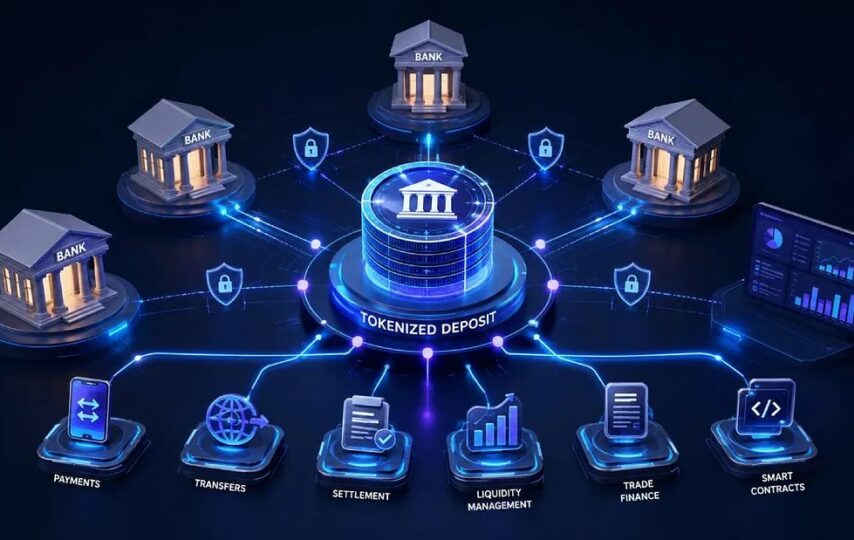

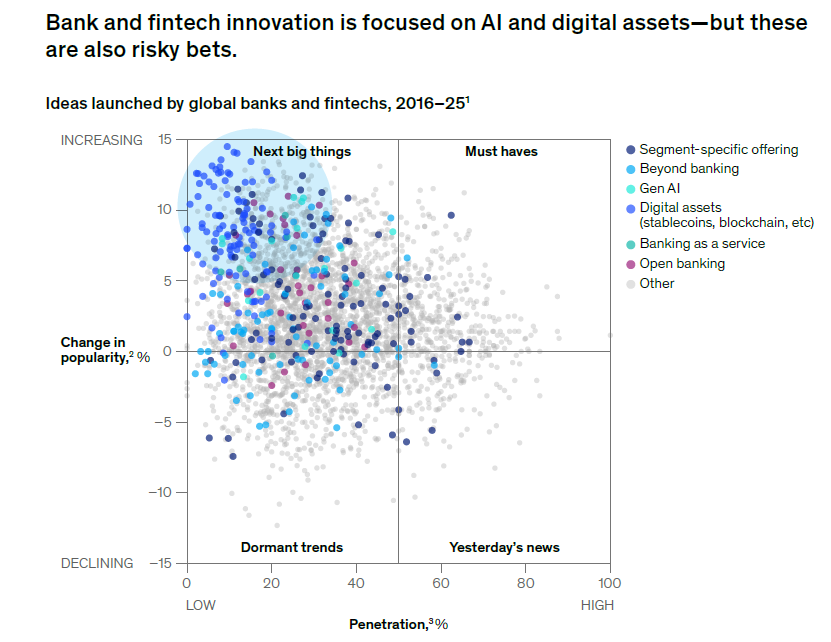
Tokenized deposits are not designed to replace traditional banking infrastructure. But the more useful question is which parts of traditional infrastructure are becoming redundant, which parts are being extended, and which parts are essential and will remain so. Because innovation is costly for banks, too. The exhibit below from a McKinsey report can be a valuable addition here in this regard.
So, banks need to segregate them clearly. Otherwise, they may either move too slowly because they treat tokenization as a threat to existing systems reflexively, or move too aggressively by applying blockchain where the current infrastructure already works well.
Here is how to think through the question across the major layers of banking infrastructure:
1. Core banking systems are not going to be replaced
The core banking system manages accounts, balances, interest calculations, statements, and general ledger entries. These functions are not moving to blockchain. The reasons are operational, legal, and practical.
Regulators require banks to maintain authoritative records of deposit liabilities in formats they can audit. Those records live in the core system. Interest calculation depends on account-level logic, tiered rate structures, product rules, and client classification. That logic is too complex and too regulated to migrate into smart contracts without significant legal and compliance risk.
The core banking system is also where credit decisions, know-your-customer data, sanctions screening, and product eligibility checks are executed. None of these functions belong on a public or consortium ledger.
So, what will change is not the core banking systems. But the surface area of the core. A tokenized deposit program adds a hold management function, a tokenization reference registry, and a real-time event bridge. The core still owns the deposit. The token reflects it on a shared tokenized deposit consortium network.
So, banks that are thinking they have to replace their CBS with a blockchain ledger need to be certain that the blockchain cannot replicate the regulatory, legal, and operational requirements the core satisfies. The infrastructure risk of core replacement is also not comparable to the infrastructure risk of adding a digital asset overlay. They are different categories of change.
2. Correspondent banking networks will be partially replaced
This is the area where tokenized deposits have the clearest replacement potential.
Correspondent banking solves the problem of cross-border payments between institutions that do not share infrastructure. It does so through a chain of bilateral relationships, nostro accounts, and message flows that are slow, opaque, and costly today. A payment from a corporate in Singapore to a supplier in Germany may pass through three or four correspondent banks, each adding fees, delays, and reconciliation overhead.
A tokenized deposit that moves on a shared ledger between two banks eliminates the intermediate chain for that bilateral flow. The payment can settle in minutes, with full traceability, without nostro pre-funding at each hop. This is what is called atomic settlement.
For example, Partior, JPMorgan’s wholesale payment network, and several BIS Innovation Hub projects are focused on this. The value proposition is very simple. Correspondent banking works because it is universal. A tokenized alternative only displaces it if enough institutions join the same network.
The practical choice could be selective displacement. Banks will tokenize high-volume corridors first. Legacy correspondent relationships will persist for long-tail flows. The two will co-exist at least for the next few years.
3. Intraday liquidity management will be extended
Treasury and liquidity management functions are not being replaced by tokenized deposits. They are being extended into hours and settlement windows that conventional infrastructure cannot reach.
Current intraday liquidity management depends on forecasting, credit lines, central bank repo facilities, and queuing logic in payment systems. It works within the operating hours of settlement infrastructure. The drawback is that it doesn’t work when settlement systems are closed.
Tokenized deposits give treasury functions access to programmable liquidity that moves at any hour. A bank can use tokenized deposits to move liquidity between branch entities after local cut-off times. A corporate treasurer can receive payment in a tokenized format and immediately redeploy it without waiting for the next clearing window.
This is what we meant by extension. The forecasting models, risk frameworks, and credit assessment functions still require conventional systems. The token is the execution mechanism in hours where conventional mechanisms do not operate.
Citi Token Services for Cash follows this model. They allow tokenized interbranch deposits for real-time operations. The underlying account infrastructure, credit framework, and regulatory reporting remain conventional. The token adds functionality at the margin of what existing infrastructure reaches. Though they use a private tokenized deposit network built for their own system only.
4. Clearing and settlement will see selective replacement for specific asset classes
Multilateral clearing is one area where tokenized infrastructure has genuine structural advantages over existing systems.
Securities settlement currently involves multiple intermediaries, a central securities depository, a clearing counterparty, and a settlement cycle that can run two days or more. Delivery versus payment requires coordination across separate systems for the cash leg and the securities leg.
Tokenized deposits enable atomic settlement. The cash token and the security token can exchange ownership simultaneously on a shared ledger. There is no settlement risk between leg one and leg two. There is no counterparty credit exposure during the settlement window.
The Hong Kong Monetary Authority’s Project Ensemble and the Euroclear and Banque de France-led experiments in tokenized bond settlement have both validated this thesis. For tokenized bonds and funds, atomic delivery versus payment using tokenized deposits is technically feasible and operationally attractive.
This is selective replacement. It applies to specific asset classes in specific markets. It does not affect the broader clearing infrastructure for equities, derivatives, or foreign exchange in a near-term horizon. Those markets involve scale, complexity, and regulatory frameworks that require phased approaches.
5. Customer-facing banking channels will not be replaced
Retail and corporate clients will not manage blockchain wallets instead of bank accounts for the foreseeable future.
The user experience of tokenized deposits is not the blockchain. It is the bank’s existing digital interface. Clients submit tokenization requests through portals and APIs they already use. The bank manages keys, wallets, and smart contract interactions behind the interface. The client sees token balances, not transaction hashes.
This is the design principle that Citi or JP Morgan uses. Clients do not hold tokens directly. They do not manage blockchain infrastructure. The blockchain layer operates beneath the client experience. The bank absorbs the complexity.
This principle is not a limitation. It is a product design choice that reflects regulatory reality, client readiness, and the bank’s own risk appetite. Corporate treasury teams are not prepared to manage custody of digital assets directly. Institutional asset managers in regulated structures have custody requirements that blockchain self-custody does not satisfy.
Here’s the honest answer
Tokenized deposits will not replace traditional banking infrastructure. They will selectively displace, extend, and improve specific functions within that infrastructure.
The displacement case is strongest in correspondent banking for high-volume corridors, securities settlement for tokenized asset classes, and intraday liquidity operations in cross-border and cross-entity contexts.
The extension case is strongest for programmability, always-on availability, and conditional settlement logic that existing infrastructure cannot support.
The preservation case is strongest for core banking, customer-facing channels, credit infrastructure, and regulatory reporting.
Banks should build tokenized deposit programs with this map in mind. The question is not whether tokenized deposits will replace everything. The question is where the new infrastructure earns its place and where it does not.